

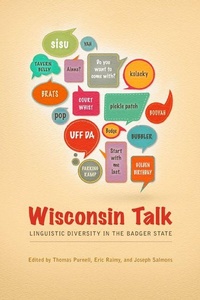
Wisconsin Talk
Linguistic Diversity in the Badger State
Published on 30. August 2013
Book
Paperback/Softback
152 pages
978-0-299-29334-5 (ISBN)
Description
Wisconsin is one of the most linguistically rich places in North America. It has the greatest diversity of American Indian languages east of the Mississippi, including Ojibwe and Menominee from the Algonquian language family, Ho-Chunk from the Siouan family, and Oneida from the Iroquoian family. French place names dot the state's map. German, Norwegian, and Polish - the languages of immigrants in the nineteenth and early twentieth centuries - are still spoken by tens of thousands of people, and the influx of new immigrants speaking Spanish, Hmong, and Somali continues to enrich the state's cultural landscape. These languages and others (Walloon, Cornish, Finnish, Czech, and more) have shaped the kinds of English spoken around the state. Within Wisconsin's borders are found three different major dialects of American English, and despite the influences of mass media and popular culture, they are not merging - they are dramatically diverging.
An engaging survey for both general readers and language scholars, Wisconsin Talk brings together perspectives from linguistics, history, cultural studies, and geography to illuminate why language matters in our everyday lives. The authors highlight such topics as:
words distinctive to the state
how recent and earlier immigrants have negotiated cultural and linguistic challenges
the diversity of bilingual speakers that enrich our communities
how maps can convey the stories of language
the relation of Wisconsin's Indian languages to language loss worldwide.
An engaging survey for both general readers and language scholars, Wisconsin Talk brings together perspectives from linguistics, history, cultural studies, and geography to illuminate why language matters in our everyday lives. The authors highlight such topics as:
words distinctive to the state
how recent and earlier immigrants have negotiated cultural and linguistic challenges
the diversity of bilingual speakers that enrich our communities
how maps can convey the stories of language
the relation of Wisconsin's Indian languages to language loss worldwide.
More details
Language
English
Place of publication
Wisconsin
United States
Target group
Professional and scholarly
Product notice
Paperback (trade)
Unsewn / adhesive bound
Illustrations
46 black & white illustrations
Dimensions
Height: 226 mm
Width: 152 mm
Thickness: 15 mm
Weight
272 gr
ISBN-13
978-0-299-29334-5 (9780299293345)
Copyright in bibliographic data and cover images is held by Nielsen Book Services Limited or by the publishers or by their respective licensors: all rights reserved.
Schweitzer Classification
Persons
Thomas Purnell is associate professor of English at the University of Wisconsin-Madison, and his research examines the interface between phonetics and phonology with a focus on regional pronunciation.
Eric Raimy is associate professor of English language and linguistics at the University of Wisconsin-Madison and is coeditor of Contemporary Views on Architecture and Representations in Phonology and Handbook of the Syllable.
Joseph Salmons is the Lester W. J. ""Smoky"" Seifert Professor of Germanic Linguistics at the University of Wisconsin-Madison. He is author of A History of German: What the Past Reveals about Today's Language and executive editor of Diachronica: International Journal for Historical Linguistics.
Eric Raimy is associate professor of English language and linguistics at the University of Wisconsin-Madison and is coeditor of Contemporary Views on Architecture and Representations in Phonology and Handbook of the Syllable.
Joseph Salmons is the Lester W. J. ""Smoky"" Seifert Professor of Germanic Linguistics at the University of Wisconsin-Madison. He is author of A History of German: What the Past Reveals about Today's Language and executive editor of Diachronica: International Journal for Historical Linguistics.