

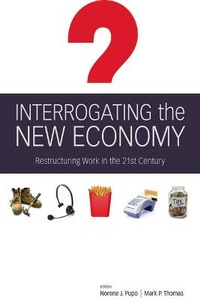
Interrogating the New Economy
Restructuring Work in the 21st Century
Published on 21. December 2009
Book
Hardback
250 pages
978-1-4426-0057-7 (ISBN)
Description
Interrogating the New Economy is a collection of original essays investigating the New Economy and how changes ascribed to it have impacted labour relations, access to work, and, more generally, the social and cultural experiences of work in Canada. Based on years of participatory research, sector-specific studies, and quantitative and qualitative data collection, the work accounts for the ways in which the contemporary workplace has changed but also the extent to which older forms of work organization still remain. The collection begins with an overview of the key social and economic transformations that define the New Economy. It then illustrates these transformations through examples, including essays on wine tourism, the regeneration of mining communities, the place of student workers, and changes in the public service workplace. It also addresses unions and their responses to the restructuring of work, as well as other forms of resistance.
More details
Language
English
Place of publication
Toronto
Canada
Target group
College/higher education
Professional and scholarly
Dimensions
Height: 235 mm
Width: 160 mm
Thickness: 22 mm
Weight
540 gr
ISBN-13
978-1-4426-0057-7 (9781442600577)
Copyright in bibliographic data and cover images is held by Nielsen Book Services Limited or by the publishers or by their respective licensors: all rights reserved.
Schweitzer Classification
Persons
Norene J. Pupo is Director of the Centre for Research on Work and Society (CRWS) at York University. She is the author of many books on the sociology of work, including The Part-Time Paradox (McClelland & Stewart, 1992) and Few Choices: Women, Work and Family (Garamond, 1989). Mark P. Thomas is Associate Professor of Sociology at York University. He is the author of Regulating Flexibility: The Political Economy of Employment Standards (McGill-Queen's, 2009).