

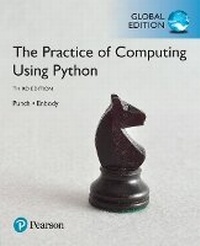
The Practice of Computing Using Python plus MyProgrammingLab with Pearson eText, Global Edition
3rd Edition
Published on 10. February 2017
Book
Mixed media product
978-1-292-16672-8 (ISBN)
Description
For courses in Python Programming Introduces Python programming with an emphasis on problem-solving Now in its Third Edition, Practice of Computing Using Python continues to introduce both majors and non-majors taking CS1 courses to computational thinking using Python, with a strong emphasis on problem solving through computer science. The authors have chosen Python for its simplicity, powerful built-in data structures, advanced control constructs, and practicality. The text is built from the ground up for Python programming, rather than having been translated from Java or C++. Focusing on data manipulation and analysis as a theme, the text allows students to work on real problems using Internet-sourced or self-generated data sets that represent their own work and interests. The authors also emphasize program development and provide both majors and non-majors with a practical foundation in programming that will be useful in their respective fields. Among other changes, the Third Edition incorporates a switch to the Anaconda distribution, the SPYDER IDE, and a focus on debugging and GUIs.
This package includes MyProgrammingLab, an online learning system designed to engage students and improve results. MyProgrammingLab consists of a set of programming exercises correlated to specific Pearson CS1/Intro to Programming textbooks. Through practice exercises and immediate, personalized feedback, MyProgrammingLab improves the programming competence of beginning students who often struggle with the basic concepts of programming languages. MyProgrammingLab should only be purchased when required by an instructor. Please be sure you have the correct ISBN and Course ID. Instructors, contact your Pearson representative for more information.
This package includes MyProgrammingLab, an online learning system designed to engage students and improve results. MyProgrammingLab consists of a set of programming exercises correlated to specific Pearson CS1/Intro to Programming textbooks. Through practice exercises and immediate, personalized feedback, MyProgrammingLab improves the programming competence of beginning students who often struggle with the basic concepts of programming languages. MyProgrammingLab should only be purchased when required by an instructor. Please be sure you have the correct ISBN and Course ID. Instructors, contact your Pearson representative for more information.
More details
Edition
3rd edition
Language
English
Place of publication
Harlow
United Kingdom
Target group
College/higher education
Dimensions
Height: 234 mm
Width: 188 mm
Thickness: 29 mm
Weight
1282 gr
ISBN-13
978-1-292-16672-8 (9781292166728)
Copyright in bibliographic data is held by Nielsen Book Services Limited or its licensors: all rights reserved.
Schweitzer Classification
Other editions
Previous edition
William Punch | Richard Enbody
Practice of Computing Using Python, The, Global Edition -- MyLab Programming with Pearson eText
Software
02/2017
3rd Edition
Pearson Education Limited
Unfortunately, price unknown
Article exhausted; check for reprint
Content
I. Thinking About Computing
0. The Study of Computer Science
II. Starting to Program
1. Beginnings
2. Control
3. Algorithms and Program Development
III. Data Structures and Functions
4. Working with Strings
5. Functions-QuickStart
6. Files and Exceptions I
7. Lists and Tuples
8. More on Functions
9. Dictionaries and Sets
10. More Program Development
IV. Classes, making your own Data Structure and Algorithms
12. More on Classes
13. Program Development with Classes
V. Being a better programmer
14. Files and Exceptions II
15. Recursion: Another Control Mechanism
16. Other Fun Stuff with Python
17. The End, or Perhaps the Beginning
0. The Study of Computer Science
II. Starting to Program
1. Beginnings
2. Control
3. Algorithms and Program Development
III. Data Structures and Functions
4. Working with Strings
5. Functions-QuickStart
6. Files and Exceptions I
7. Lists and Tuples
8. More on Functions
9. Dictionaries and Sets
10. More Program Development
IV. Classes, making your own Data Structure and Algorithms
12. More on Classes
13. Program Development with Classes
V. Being a better programmer
14. Files and Exceptions II
15. Recursion: Another Control Mechanism
16. Other Fun Stuff with Python
17. The End, or Perhaps the Beginning