

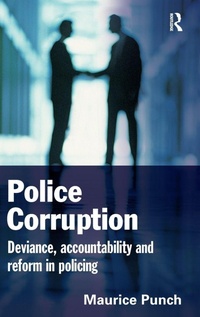
Police Corruption
Exploring Police Deviance and Crime
1st Edition
Published on 1. June 2009
Book
Hardback
296 pages
978-1-84392-411-1 (ISBN)
Description
Policing and corruption are inseparable. This book argues that corruption is not one thing but covers many deviant and criminal practices in policing which also shift over time. It rejects the 'bad apple' metaphor and focuses on 'bad orchards', meaning not individual but institutional failure. For in policing the organisation, work and culture foster can encourage corruption. This raises issues as to why do police break the law and, crucially, 'who controls the controllers'?
Corruption is defined in a broad, multi-facetted way. It concerns abuse of authority and trust; and it takes serious form in conspiracies to break the law and to evade exposure when cops can become criminals. Attention is paid to typologies of corruption (with grass-eaters, meat-eaters, noble-cause); the forms corruption takes in diverse environments; the pathways officers take into corruption and their rationalisations; and to collusion in corruption from within and without the organization. Comparative analyses are made of corruption, scandal and reform principally in the USA, UK and the Netherlands.
The work examines issues of control, accountability and the new institutions of oversight. It provides a fresh, accessible overview of this under-researched topic for students, academics, police and criminal justice officials and members of oversight agencies.
Corruption is defined in a broad, multi-facetted way. It concerns abuse of authority and trust; and it takes serious form in conspiracies to break the law and to evade exposure when cops can become criminals. Attention is paid to typologies of corruption (with grass-eaters, meat-eaters, noble-cause); the forms corruption takes in diverse environments; the pathways officers take into corruption and their rationalisations; and to collusion in corruption from within and without the organization. Comparative analyses are made of corruption, scandal and reform principally in the USA, UK and the Netherlands.
The work examines issues of control, accountability and the new institutions of oversight. It provides a fresh, accessible overview of this under-researched topic for students, academics, police and criminal justice officials and members of oversight agencies.
Reviews / Votes
'This book is superb. The standard, as far as I am concerned, for books on police deviance. Straightforward as well as entertaining, the book covers all that I think is known about the genesis, transmission, facilitation, reform, and control of police deviance.' - David Bailey (University at Albany, SUNY)'At last, from the leading writer and researcher in this field, a comprehensive overview of the study of police misconduct and corruption. Maurice Punch is unrivalled in this field and anyone seeking a reliable guide should consult this book.' - Professor Tim Newburn (LSE)
More details
Language
English
Place of publication
Cullompton
United Kingdom
Publishing group
Taylor & Francis Ltd
Target group
College/higher education
Dimensions
Height: 240 mm
Width: 161 mm
Thickness: 21 mm
Weight
611 gr
ISBN-13
978-1-84392-411-1 (9781843924111)
Copyright in bibliographic data and cover images is held by Nielsen Book Services Limited or by the publishers or by their respective licensors: all rights reserved.
Schweitzer Classification
Other editions
Additional editions
E-Book
01/2013
1st Edition
Willan Publishing
€59.49
Available for download
E-Book
01/2013
1st Edition
Willan Publishing
€59.49
Available for download
Book
06/2009
1st Edition
Willan Publishing
€72.03
Shipment within 3-4 weeks
Person
Maurice Punch is a Professor at the Mannheim Centre for Criminology at LSE.
Content
1. Introduction 2. What is Corruption? 3. The US: From Pad to Crew 4. The Netherlands: Amsterdam and the 'IRT' Affair 5. The UK: London, Miscarriages of Justice and Northern Ireland 6. 'Creatures in Between': Pathways into Police Deviance 7. Scandal, Reform and Accountability 8. Conclusion: Sticky Fingers and Dirty Hands