

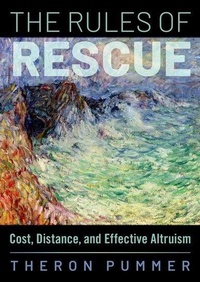
The Rules of Rescue
Cost, Distance, and Effective Altruism
Published on 23. January 2023
Book
Hardback
264 pages
978-0-19-088414-7 (ISBN)
Description
This is an open access title available under the terms of a CC BY-NC-ND 4.0 International licence. It is free to read at Oxford Scholarship Online and offered as a free PDF download from OUP and selected open access locations.
When do you have to sacrifice life and limb, time and money, to prevent harm to others? When must you save more people rather than fewer? These questions might arise in emergencies involving strangers drowning or trapped in burning buildings, but they also arise in our everyday lives, in which we confront opportunities to donate time or money to help distant strangers in need of food, shelter, or medical care. With the resources available, we can provide more help--or less.
In The Rules of Rescue, Theron Pummer argues that we are often morally required to engage in effective altruism, directing altruistic efforts in ways that help the most. Even when the personal sacrifice involved makes it morally permissible not to help at all, he contends, it often remains wrong to provide less help rather than more. Using carefully crafted examples, he defends the view that helping distant strangers is more morally akin to rescuing nearby strangers than most of us realize. The ubiquity of opportunities to help distant strangers threatens to make morality extremely demanding, and Pummer argues that it is only thanks to adequate permissions grounded in considerations of cost and autonomy that we may pursue our own plans and projects. He ultimately concludes that many of us are required to provide no less help over our lives than we would have done if we were effective altruists.
When do you have to sacrifice life and limb, time and money, to prevent harm to others? When must you save more people rather than fewer? These questions might arise in emergencies involving strangers drowning or trapped in burning buildings, but they also arise in our everyday lives, in which we confront opportunities to donate time or money to help distant strangers in need of food, shelter, or medical care. With the resources available, we can provide more help--or less.
In The Rules of Rescue, Theron Pummer argues that we are often morally required to engage in effective altruism, directing altruistic efforts in ways that help the most. Even when the personal sacrifice involved makes it morally permissible not to help at all, he contends, it often remains wrong to provide less help rather than more. Using carefully crafted examples, he defends the view that helping distant strangers is more morally akin to rescuing nearby strangers than most of us realize. The ubiquity of opportunities to help distant strangers threatens to make morality extremely demanding, and Pummer argues that it is only thanks to adequate permissions grounded in considerations of cost and autonomy that we may pursue our own plans and projects. He ultimately concludes that many of us are required to provide no less help over our lives than we would have done if we were effective altruists.
Reviews / Votes
Having a special appeal and value for readers with an interest in the philosophy underpinning ethics, philanthropy, charity, and morality, The Rules of Rescue: Cost, Distance, and Effective Altruism is a seminal, thought provoking work which is unreservedly recommended for personal, professional, community, and academic library Contemporary Philosophy collections. * Midwest Book Review * Many believe that we are under a duty to rescue someone in need; many also believe that, if we have to choose between helping one person in need and helping two such persons, we must save the greater number. Those seemingly obvious claims belie a huge range of knotty problems. Pummer's wonderfully well-written book carefully takes readers through increasingly complex cases, and shows that, even from a non-consequentialist perspective, we are under fairly demanding duties to help others-be it by giving money to charities, or by volunteering our time and energy. This book is a major contribution to the literature on the ethics of rescue. * Cecile Fabre, Professor of Political Philosophy, University of Oxford * This book is filled to the brim with subtle and original ideas. One of the most important involves the interplay of "requiring reasons" and "permitting reasons" over time: while constant opportunities to help give us constant requiring reasons, we aren't constantly required to help. Pummer compellingly shows how this is so-and how beneficence is an imperfect duty-given the way permitting reasons operate over a lifetime. The Rules of Rescue is a must read for those working on the duty to rescue or the duty of beneficence. * Douglas W. Portmore, Professor of Philosophy, Arizona State University * The Rules of Rescue is admirably clear, elegantly written, and packed with highly original arguments. Time and again Pummer defends novel and surprising conclusions from careful consideration of relatively simple cases. Many people accept, for example, that we have broad discretion about what charities to give to, especially when the amount we give exceeds what we are morally required to give. Pummer shows, however, that this view is actually very hard to defend, and carries many counterintuitive implications. This book is required reading for anyone interested in the ethics of assistance and normative ethics more generally. * Christian Barry, Professor of Philosophy, Australian National University * Recommended. Graduate students, researchers, faculty; general readers. * Choice * I highly recommend it to people interested in the status of effective altruism, the nature of deontology, * Peter Murphy, Ethics *More details
Language
English
Place of publication
New York
United States
Target group
Professional and scholarly
Dimensions
Height: 135 mm
Width: 179 mm
Thickness: 27 mm
Weight
318 gr
ISBN-13
978-0-19-088414-7 (9780190884147)
Copyright in bibliographic data and cover images is held by Nielsen Book Services Limited or by the publishers or by their respective licensors: all rights reserved.
Schweitzer Classification
Other editions
Additional editions
E-Book
12/2022
OUP eBook
€9.99
Available for download
E-Book
12/2022
OUP eBook
€0.00
Available for download
Person
Theron Pummer is a Senior Lecturer in Philosophy at the University of St Andrews, and Director of the Centre for Ethics, Philosophy and Public Affairs. Previously he was a Junior Research Fellow in Philosophy at the University of Oxford. He received his PhD from the University of California, San Diego. Pummer's articles have been published in such journals as The Journal of Philosophy, Ethics, Philosophy and Public Affairs, Analysis, Philosophical Studies, Philosophy and Phenomenological Research, and Philosophical Review.
Content
Dedication
Acknowledgements
Introduction
Chapter One: Requirements to Rescue and Permissions Not to
Chapter Two: Numbers Count
Chapter Three: The All or Nothing Problem
Chapter Four: Praiseworthiness
Chapter Five: Distant Rescues
Chapter Six: Frequent Rescues
Chapter Seven: Special Connections
Chapter Eight: Must You Be An Effective Altruist?
Glossary of Cases
Notes
Bibliography
Acknowledgements
Introduction
Chapter One: Requirements to Rescue and Permissions Not to
Chapter Two: Numbers Count
Chapter Three: The All or Nothing Problem
Chapter Four: Praiseworthiness
Chapter Five: Distant Rescues
Chapter Six: Frequent Rescues
Chapter Seven: Special Connections
Chapter Eight: Must You Be An Effective Altruist?
Glossary of Cases
Notes
Bibliography