

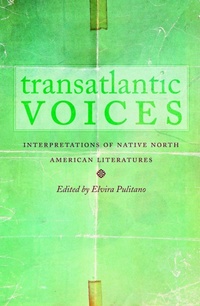
Transatlantic Voices
Interpretations of Native North American Literatures
Published on 1. December 2007
Book
Paperback/Softback
336 pages
978-0-8032-6034-4 (ISBN)
Description
Transatlantic Voices is the first collection of critical essays by European scholars on contemporary Native North American literatures. Devoted to the primary genres of Native literature-fiction, nonfiction, drama, poetry-the essays chart the course of recent theories of Native literature, delineate the crosscurrents in the history of Native literature studies, and probe specific themes of trauma and memory as well as changing mythologies. These essays also incorporate incipient transnational and transcultural methodologies in their approach to Native North American writing. Blending western critical approaches-from cultural studies to postcolonialism and trauma theory-with indigenous epistemological perspectives, the contributors to Transatlantic Voices advocate "the inescapable hybridity and intermixture of ideas" proposed by Paul Gilroy in his study of black diasporic identity. Native North American writers forcefully suggest that the study of American ethnicities in the twenty-first century can no longer be confined to the borders of the United States. Given the increasing transnational aspect of American studies, a collection such as Transatlantic Voices, presenting scholars from countries as diverse as Germany, France, Bulgaria, Switzerland, Italy, the United Kingdom, and Finland, offers a timely contribution to such border crossing in scholarship and writing.
Reviews / Votes
"Transatlantic Voices represents some of the most recent critical studies of contemporary Native North American literature by fourteen European scholars... The anthology will be a useful resource for anyone interested in interdisciplinary crossings in postcolonial studies, diaspora studies, and narrative ethics."-Laura Castor, Great Plains Quarterly -- Laura Castor Great Plains QuarterlyMore details
Language
English
Place of publication
Lincoln
United States
Target group
Professional and scholarly
Product notice
Paperback (trade)
Illustrations
Index
Dimensions
Height: 218 mm
Width: 145 mm
Thickness: 17 mm
Weight
390 gr
ISBN-13
978-0-8032-6034-4 (9780803260344)
Copyright in bibliographic data and cover images is held by Nielsen Book Services Limited or by the publishers or by their respective licensors: all rights reserved.
Schweitzer Classification
Person
Elvira Pulitano is an assistant professor of ethnic studies at California Polytechnic State University. She is the author of Toward a Native American Critical Theory (Nebraska 2003). Contributors: Helmbrecht Breinig, Brigitte Georgi-Findlay, Kathryn Napier Gray, Ulla Haselstein, Hartwig Isernhagen, Yonka Krasteva, A. Robert Lee, Deborah L. Madsen, Simone Pellerin, Gaetano Prampolini, Elvira Pulitano, Bernadette Rigal-Cellard, Mark Shackleton, Paul Beekman Taylor, and Rebecca Tillett.
Content
Contents
Acknowledgments
Introduction
Elvira Pulitano, California Polytechnic State University
Part 1. Theoretical Crossings
1. "They Have Stories, Don't They?": Some Doubts Regarding an Overused Theorem
Hartwig Isernhagen, Universitaet Basel
2. Plotting History: The Function of History in Native North American Literature
Bernadette Rigal-Cellard, Universite Michel de MontaigneBordeaux 3
3. Transculturality and Transdifference: The Case of Native America
Helmbrecht Breinig, Universitaet Erlangen-Nuernberg
Part 2. From Early Fiction to Recent Directions
4. American Indian Novels of the 1930s: John Joseph Mathews's Sundown and D'Arcy McNickle's Surrounded
Gaetano Prampolini, Universita di Firenze
5. Transatlantic Crossings: New Directions in the Contemporary Native American Novel
Brigitte Georgi-Findlay, Technische Universitaet Dresden
Part 3. Trauma, Memory, and Narratives of Healing
6. Of Time and Trauma: The Possibilities for Narrative in Paula Gunn Allen's The Woman Who Owned the Shadows
Deborah L. Madsen, Universite de Geneve
7. "Keep Wide Awake in the Eyes": Seeing Eyes in Wendy Rose's Poetry
Kathryn Napier Gray, University of Plymouth
8. Anamnesiac Mappings: National Histories and Transnational Healing in Leslie Marmon Silko's Almanac of the Dead
Rebecca Tillett, University of East Anglia
Part 4. Comparative Mythologies, Transatlantic Journeys
9. Vizenor's Trickster Theft: Pretexts and Paratexts of Darkness in Saint Louis Bearheart
Paul Beekman Taylor, Universite de Geneve
10. "June Walked over It like Water and Came Home": Cross-Cultural Symbolism in Louise Erdrich's Love Medicine and Tracks
Mark Shackleton, University of Helsinki
11. Encounters across Time and Space: The Sacred, the Profane, and the Political in Linda Hogan's Power
Yonka Krasteva, University of Veliko Tarnovo, Bulgaria
12. Double Translation: James Welch's Heartsong of Charging Elk
Ulla Haselstein, Freie Universitaet Berlin
13. Clown, Indians, and Poodles: Spectacular Others in Louis Owens's I Hear the Train
Simone Pellerin, Universite Paul-ValeryMontpellier III
14. Oklahoma International: Jim Barnes, Poetry, and the Sites of Imagination
A. Robert Lee, Nihon University, Tokyo
List of Contributors
Index
Acknowledgments
Introduction
Elvira Pulitano, California Polytechnic State University
Part 1. Theoretical Crossings
1. "They Have Stories, Don't They?": Some Doubts Regarding an Overused Theorem
Hartwig Isernhagen, Universitaet Basel
2. Plotting History: The Function of History in Native North American Literature
Bernadette Rigal-Cellard, Universite Michel de MontaigneBordeaux 3
3. Transculturality and Transdifference: The Case of Native America
Helmbrecht Breinig, Universitaet Erlangen-Nuernberg
Part 2. From Early Fiction to Recent Directions
4. American Indian Novels of the 1930s: John Joseph Mathews's Sundown and D'Arcy McNickle's Surrounded
Gaetano Prampolini, Universita di Firenze
5. Transatlantic Crossings: New Directions in the Contemporary Native American Novel
Brigitte Georgi-Findlay, Technische Universitaet Dresden
Part 3. Trauma, Memory, and Narratives of Healing
6. Of Time and Trauma: The Possibilities for Narrative in Paula Gunn Allen's The Woman Who Owned the Shadows
Deborah L. Madsen, Universite de Geneve
7. "Keep Wide Awake in the Eyes": Seeing Eyes in Wendy Rose's Poetry
Kathryn Napier Gray, University of Plymouth
8. Anamnesiac Mappings: National Histories and Transnational Healing in Leslie Marmon Silko's Almanac of the Dead
Rebecca Tillett, University of East Anglia
Part 4. Comparative Mythologies, Transatlantic Journeys
9. Vizenor's Trickster Theft: Pretexts and Paratexts of Darkness in Saint Louis Bearheart
Paul Beekman Taylor, Universite de Geneve
10. "June Walked over It like Water and Came Home": Cross-Cultural Symbolism in Louise Erdrich's Love Medicine and Tracks
Mark Shackleton, University of Helsinki
11. Encounters across Time and Space: The Sacred, the Profane, and the Political in Linda Hogan's Power
Yonka Krasteva, University of Veliko Tarnovo, Bulgaria
12. Double Translation: James Welch's Heartsong of Charging Elk
Ulla Haselstein, Freie Universitaet Berlin
13. Clown, Indians, and Poodles: Spectacular Others in Louis Owens's I Hear the Train
Simone Pellerin, Universite Paul-ValeryMontpellier III
14. Oklahoma International: Jim Barnes, Poetry, and the Sites of Imagination
A. Robert Lee, Nihon University, Tokyo
List of Contributors
Index