

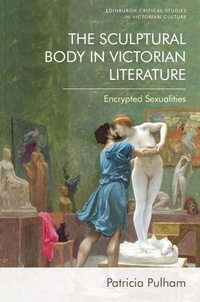
The Sculptural Body in Victorian Literature
Encrypted Sexualities
Published on 25. August 2022
Book
Paperback/Softback
240 pages
978-1-3995-0459-1 (ISBN)
Description
Explores Victorian writers' erotic investment in statues
Theorises the function of the sculptural body in Victorian poetry and proseOffers thorough readings of sculpture in Victorian texts and contextsExamines a wide range of works by well-known and lesser-known writers of the period (e.g. Thomas Hardy, John Ruskin, Oscar Wilde, Walter Pater, Vernon Lee, Olive Custance, Arthur O'Shaughnessy)Extends the British focus to encompass nineteenth-century European and American writings
This book argues that, in Victorian literature, transgressive desires that cannot be openly acknowledged are often buried and encrypted in the marble bodies of statues. Examining sculpture's ubiquity in Victorian galleries and museums, Pulham observes that while touch is prohibited in these cultural locations Victorian texts offer 'safe' spaces where sculptures may be kissed or caressed using metaphors of tactility that work at the intersections of touch and vision and permit the recovery of forbidden love.
Theorises the function of the sculptural body in Victorian poetry and proseOffers thorough readings of sculpture in Victorian texts and contextsExamines a wide range of works by well-known and lesser-known writers of the period (e.g. Thomas Hardy, John Ruskin, Oscar Wilde, Walter Pater, Vernon Lee, Olive Custance, Arthur O'Shaughnessy)Extends the British focus to encompass nineteenth-century European and American writings
This book argues that, in Victorian literature, transgressive desires that cannot be openly acknowledged are often buried and encrypted in the marble bodies of statues. Examining sculpture's ubiquity in Victorian galleries and museums, Pulham observes that while touch is prohibited in these cultural locations Victorian texts offer 'safe' spaces where sculptures may be kissed or caressed using metaphors of tactility that work at the intersections of touch and vision and permit the recovery of forbidden love.
Reviews / Votes
The Sculptural Body in Victorian Literature is a pertinently thought-provoking text. Its contents are thoroughly researched and productively interdisciplinary, and I do not doubt that the book will prove highly useful to those researching in gender and sexuality studies, museum studies, and nineteenth-century literature and art history for many years to come. Moving forward, I hope that relevant scholars will begin to work on answering Pulham's concluding call for more research to be undertaken into instances where literature, sculpture, race, and/or national identity intersect. -- Caitlin Doley, University of York * British Association for Victorian Studies * This gracefully written, well-edited interdisciplinary study offers a historical account of statuary and its reception in Victorian Britain. [...] Pulham articulates an original, cogent, and elegant interpretation of the arts of suppression and indulgence [...] Highly recommended. -- T. Hoagwood, emeritus, Texas A&M University * CHOICE * By focusing its discussion of Victorian desire through the understudied central motif of touching statues, Pulham offers a turn of the critical kaleidoscope that brings into focus new aspects of well-known works and foregrounds lesser-known writers and texts. She opens the way for new assessments of well-established critical models, from the male gaze to Eve Sedgwick's theories of triangulated homoerotic relationships, and brings together art history, literary studies, and classical reception studies in a fresh convergence. -- Laura Eastlake, Edge Hill University * Victorian Studies * Patricia Pulham's strikingly original interdisciplinary study expertly guides us through Victorian literature's imaginary museum of sculpture. With characteristic vivacity and flair, she explores the role of statues in the Victorians' negotiation of their own sexualities, revealing how sculptures in nineteenth-century poetry and fiction function as intensified sites of transgressive desire. -- Hilary Fraser, Birkbeck, University of LondonMore details
Series
Language
English
Place of publication
Edinburgh
United Kingdom
Target group
Professional and scholarly
Illustrations
14 black and white illustrations, 4 colour illustrations
Dimensions
Height: 156 mm
Width: 233 mm
Thickness: 23 mm
Weight
358 gr
ISBN-13
978-1-3995-0459-1 (9781399504591)
Copyright in bibliographic data and cover images is held by Nielsen Book Services Limited or by the publishers or by their respective licensors: all rights reserved.
Schweitzer Classification
Person
Patricia Pulham is Professor of Victorian Literature at the University of Surrey and editor of the EUP journal, Victoriographies. Her research focuses on Victorian literature, culture and the visual arts, and she has published widely on a range of nineteenth-century authors. She joined the University of Surrey in 2017 where she is Director of Research in the School of Literature and Languages and teaches modules on the Victorian fin-de-siecle and neo-Victorian literature.
Content
List of IllustrationsSeries Editor's PrefaceAcknowledgementsIntroduction
1: Nineteenth-Century Pygmalions: The Sexual Politics of Tactility2: Artworks in Marble: Capturing Venus in Durable Form3: 'Of marble men and maidens': Sculptural Transformations4: Statuephilia and the Love of the Impossible5: Between Death and Sleep: Libidinal Entombments
Works CitedIndex
1: Nineteenth-Century Pygmalions: The Sexual Politics of Tactility2: Artworks in Marble: Capturing Venus in Durable Form3: 'Of marble men and maidens': Sculptural Transformations4: Statuephilia and the Love of the Impossible5: Between Death and Sleep: Libidinal Entombments
Works CitedIndex