

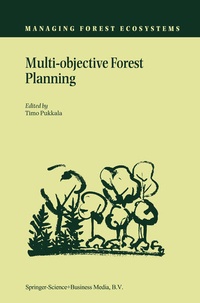
Multi-objective Forest Planning
Published on 7. December 2010
Book
Paperback/Softback
VIII, 208 pages
978-90-481-6207-9 (ISBN)
Description
Most of the scientific methods devised for forest planning support timber production ignoring the existence of forest functions other than wood production. Fortunately, the realisation that the forest planning methods available today do not correspond to the needs of today's forestry has activated forest researchers to develop and adopt new methodologies and approaches, which are specifically aimed at multi-objective situations. This book is about the quantitative approach to multi-objective forest planning. The emphasis is on topics that are rather new and not yet systematically applied in forest planning practice. The topics and methodologies discussed in this book include: measurement of preferences, multiple criteria decision analysis, use of GIS to support multi-objective forest management, heuristic optimization, spatial optimisation, and the measurement of non-wood forest outputs. By reading the book, a planning specialist, student or a researcher will get an insight into some of the current developments in forest planning research.
More details
Series
Edition
Softcover reprint of the original 1st ed. 2002
Language
English
Place of publication
Dordrecht
Netherlands
Target group
Professional and scholarly
Research
Illustrations
VIII, 208 p.
Dimensions
Height: 235 mm
Width: 155 mm
Thickness: 13 mm
Weight
341 gr
ISBN-13
978-90-481-6207-9 (9789048162079)
DOI
10.1007/978-94-015-9906-1
Schweitzer Classification
Other editions
Additional editions
Timo Pukkala
Multi-objective Forest Planning
Book
12/2002
Kluwer Academic Publishers
€160.49
Shipment within 15-20 days
Content
to multi-objective forest planning.- Measurement of preferences in multiple criteria evaluation.- Multiple criteria decision support methods in forest management. An overview and comparative analyses.- Multidimensional measurements and approaches to forest sustainability assessments.- Using GIS to support multi-objective decision making in forest management. An experience from Ghana, West Africa.- Heuristics in multi-objective forest management.- Spatial optimisation in forest planning. A review of recent Swedish research.- Measuring non-wood forest outputs in numerical forest planning. A review of Finnish research.