

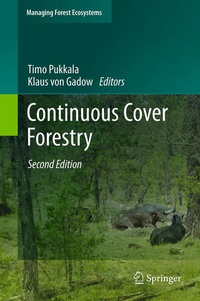
Continuous Cover Forestry
2nd Edition
Published on 30. November 2013
Book
Paperback/Softback
VIII, 296 pages
978-94-007-3803-4 (ISBN)
Description
Although the majority of the world's forest ecosystems are dominated by uneven-sized multi-species stands, forest management practice and theory has focused on the development of plantation monocultures to maximize the supply of timber at low cost. Societal expectations are changing, however, and uneven-aged multi-species ecosystems, selectively managed as
Continuous Cover Forestry
(
CCF
), are often believed to be superior to monocultures in addressing a wide range of expectations. This book presents methods which are relevant to CCF management and planning: analysing forest structures, silvicultural and planning, economic evaluation, based on examples in Europe, Asia, Africa and North and South America.
More details
Series
Edition
Second Edition 2012
Language
English
Place of publication
Dordrecht
Netherlands
Target group
Professional and scholarly
Research
Illustrations
VIII, 296 p.
Dimensions
Height: 235 mm
Width: 155 mm
Thickness: 17 mm
Weight
464 gr
ISBN-13
978-94-007-3803-4 (9789400738034)
DOI
10.1007/978-94-007-2202-6
Schweitzer Classification
Other editions
Additional editions
Timo Pukkala | Klaus Gadow
Continuous Cover Forestry
Book
10/2011
2nd Edition
Springer
€267.49
Shipment within 15-20 days
Content
1 Historical Emergence and Current Application of CCF.- 2 Forest Structure and Diversity.- 3 Continuous Cover Forestry in Finland - Recent Research Results.- 4 Regulation of Timber Yield Sustainability for Tropical and Subtropical Moist Forests: Ecosilvicultural Paradigms and Economic Constraints.- 5 The Economics of Continuous Cover Forestry.- 6 Optimizing Continuous Cover Forest Management .- 7 Modelling Continuous Cover Forests.- 8 Bootstrap simulation, Markov decision process models, and role of discounting in the valuation of ecological criteria in uneven-aged forest management.- 9 Resource Assessment Techniques for Continuous Cover Forestry.