

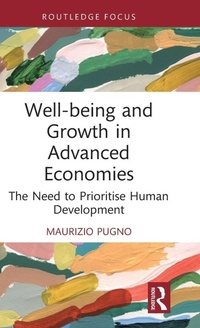
Well-being and Growth in Advanced Economies
The Need to Prioritise Human Development
1st Edition
Published on 29. July 2022
Book
Hardback
114 pages
978-1-032-14905-9 (ISBN)
Description
Economic growth is generally regarded by governments and most ordinary people as a panacea for all problems, including issues caused by the COVID pandemic. But this raises an important question: is further growth in advanced economies able to increase well-being once people's basic subsistence needs are met? Some advanced market economies, e.g. the United States, have exhibited a decline in well-being, both subjectively and objectively measured, over several decades despite seeing economic growth during the same period.
This book provides an original and comprehensive explanation: economic growth, as driven by market forces, induces people, through both the demand- and supply-side channels, to pursue command over more material resources, and this weakens the self-generation of capabilities, putting well-being at risk of deterioration. The book argues, with the support of a variety of evidence, that the challenge can be overcome if governments' policies and people's choices pursue, as their ultimate goal, 'fundamental human development' on an evolutionary basis: the development of the capability of a typical person to conceive and share with others new purposes, to pursue them individually or collectively, and thus to contribute to building human culture. If such human development is prioritised, it makes people satisfied with their lives and resistant to adverse shocks, and it can even shape the pattern of economic growth. By contrast, if economic growth is prioritised, it tends to weaken and impoverish fundamental human development, and consequently people's well-being and social cohesion.
With this volume, readers will find an answer to a problem that is both urgent and long-term, both individual and societal. The work makes a substantial contribution to the literature on wellbeing, the economics of happiness, human capital and growth, and the capability approach.
This book provides an original and comprehensive explanation: economic growth, as driven by market forces, induces people, through both the demand- and supply-side channels, to pursue command over more material resources, and this weakens the self-generation of capabilities, putting well-being at risk of deterioration. The book argues, with the support of a variety of evidence, that the challenge can be overcome if governments' policies and people's choices pursue, as their ultimate goal, 'fundamental human development' on an evolutionary basis: the development of the capability of a typical person to conceive and share with others new purposes, to pursue them individually or collectively, and thus to contribute to building human culture. If such human development is prioritised, it makes people satisfied with their lives and resistant to adverse shocks, and it can even shape the pattern of economic growth. By contrast, if economic growth is prioritised, it tends to weaken and impoverish fundamental human development, and consequently people's well-being and social cohesion.
With this volume, readers will find an answer to a problem that is both urgent and long-term, both individual and societal. The work makes a substantial contribution to the literature on wellbeing, the economics of happiness, human capital and growth, and the capability approach.
Reviews / Votes
"Given its stated aims, the book has a very appropriate structure that helps the development and comprehension of its theses. The topics are constructed in a systematic and careful manner, and each chapter provides a very useful literature review...The book is not only valuable for scholars working in the area of happiness research, but also for a much larger readership with an interest of the current problems that modern advanced economies are facing and the possible ways to tackle them."Stavros A. Drakopoulos, Journal of Economic Psychology
More details
Series
Language
English
Place of publication
London
United Kingdom
Publishing group
Taylor & Francis Ltd
Target group
College/higher education
Postgraduate
Illustrations
4 s/w Abbildungen, 4 s/w Zeichnungen
4 Line drawings, black and white; 4 Illustrations, black and white
Dimensions
Height: 222 mm
Width: 145 mm
Thickness: 11 mm
Weight
300 gr
ISBN-13
978-1-032-14905-9 (9781032149059)
Copyright in bibliographic data and cover images is held by Nielsen Book Services Limited or by the publishers or by their respective licensors: all rights reserved.
Schweitzer Classification
Other editions
Additional editions
Book
01/2024
1st Edition
Routledge
€32.70
Shipment within 10-20 days
E-Book
07/2022
1st Edition
Routledge
€27.49
Available for download
E-Book
07/2022
1st Edition
Routledge
€27.49
Available for download
Person
Maurizio Pugno (M.Phil., Cambridge, UK) is Full Professor of Economics at the University of Cassino, Italy.
Content
Introduction and Summary Prologue Chapter 1. Economic growth and people's well-being in advanced countries Chapter 2. Human development and well-being Chapter 3. Why growth in market economies can deteriorate human development and well-being Chapter 4. Economic growth and human development: which priority in the post-pandemic era? Epilogue