

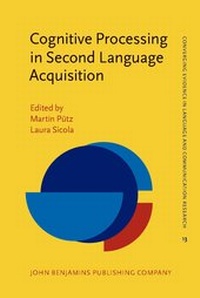
Cognitive Processing in Second Language Acquisition
Inside the learner's mind
Published on 19. March 2010
Book
Hardback
373 pages
978-90-272-3902-0 (ISBN)
Description
This edited volume represents state of the field research linking cognition and second language acquisition, reflecting the experience of the learner when engaged in noticing, input/output processing, retrieval, and even attrition of target forms. Contributions are both theoretical and practical, describing a variety of L1, L2 and L3 combinations from around the world as observed in spoken, written, and computer-mediated contexts. The book relates conditions of language, task, medium or environment to how learners make decisions about language, with discussions about the application or efficacy of these conditions on linguistic success and development, and pedagogical implications.
Reviews / Votes
Kudos to the editors for putting together such a far-reaching volume. The range of topics will be of broad interest - to those who are interested in cognitive and psycholinguistic processes of second language learning and to those who are interested in understanding what this means for formal classroom learning. This is a must-read for students and scholars of SLA and anyone who wants to learn what SLA can tell us about general human cognition. -- Susan Gass, Michigan State UniversityMore details
Series
Language
English
Place of publication
Amsterdam
Netherlands
Target group
Professional and scholarly
Dimensions
Height: 245 mm
Width: 164 mm
Weight
850 gr
ISBN-13
978-90-272-3902-0 (9789027239020)
Copyright in bibliographic data and cover images is held by Nielsen Book Services Limited or by the publishers or by their respective licensors: all rights reserved.
Schweitzer Classification
Other editions
Additional editions
Martin Pütz | Laura Sicola
Cognitive Processing in Second Language Acquisition
Inside the learner's mind
E-Book
03/2010
1st Edition
John Benjamins Publishing Company
€118.99
Available for download
Persons
Content
1. Acknowledgements; 2. Introduction: Cognitive processing in second language acquisition (by Putz, Martin); 3. I. Cognitive theoretical foundations of language and learning; 4. 1. Concept stretching and model merging: An attempt to better account for L2 processing and acquisition of grammatical constructions (by Seilhamer, Mark Fifer); 5. 2. Construction learning as category learning (by Ellis, Nick C.); 6. 3. The role of relevance theory in SLA studies (by Jodlowiec, Maria); 7. 4. Distinct mechanisms in the processing of English past tense morphology: A view from L2 processing (by Kirkici, Bilal); 8. 5. Third language acquisition, macrocategories and synonymy (by Filatova, Ksenya); 9. II. Mental processes and acquisition procedures followed by language learners; 10. 6. First exposure: Converting target language input to intake (by Rast, Rebekah); 11. 7. On the stability of representations in the multilingual lexicon (by Bot, Kees de); 12. 8. Conceptual representations in the multilingual mind: A study of advanced Dutch students of English (by Lowie, Wander); 13. 9. Formulaic language in L2: Storage, retrieval and production of idioms by second language learners (by Cieslicka, Anna); 14. 10. A procedure for testing the Noticing Hypothesis in the context of vocabulary acquisition (by Godfroid, Aline); 15. 11. Construal and the use of impersonalisation strategies in English and Spanish in an FLL context (by Marin Arrese, Juana Isabel); 16. 12. Inside the attriter's mind: A comparative exploration of the cognitive constraints in Dutch L1 attrition in an L2 English environment and advanced Dutch L1 acquisition (by Keijzer, Merel C.J.); 17. III. Cognitive language pedagogy: Classroom studies with applications for teaching; 18. 13. Situating and distributing cognition across task demands: The SSARC model of pedagogic task sequencing (by Robinson, Peter); 19. 14. Typology in the L2 classroom: Second language acquisition from a typological perspective (by Filipovic, Luna); 20. 15. Metaphoric competence in the first and second language: Similarities and differences (by Littlemore, Jeannette); 21. 16. Figurative competence is better developed in L1 than in L2, or is it?: Understanding conversational implicatures in L1 and L2 (by Bromberek-Dyzman, Katarzyna); 22. 17. Attention to phonological form: Modified output in task-based negotiated interaction (by Sicola, Laura); 23. 18. Quality and type of corrective feedback, noticing, and learner uptake in synchronous computer-mediated text-based and voice chats (by Sotillo, Susana M.); 24. Index