

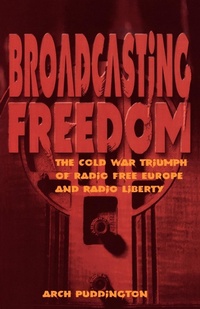
Broadcasting Freedom
The Cold War Triumph of Radio Free Europe and Radio Liberty
Published on 19. May 2003
Book
Paperback/Softback
408 pages
978-0-8131-9045-7 (ISBN)
Description
Among America's most unusual and successful weapons during the Cold War were Radio Free Europe and Radio Liberty. RFE-RL had its origins in a post-war America brimming with confidence and secure in its power. Unlike the Voice of America, which conveyed a distinctly American perspective on global events, RFE-RL served as surrogate home radio services and a vital alternative to the controlled, party-dominated domestic press in Eastern Europe. Over twenty stations featured programming tailored to individual countries. They reached millions of listeners ranging from industrial workers to dissident leaders such as Lech Walesa and Vaclav Havel.
Broadcasting Freedom draws on rare archival material and offers a penetrating insider history of the radios that helped change the face of Europe. Arch Puddington reveals new information about the connections between RFE-RL and the CIA, which provided covert funding for the stations during the critical start-up years in the early 1950s. He relates in detail the efforts of Soviet and Eastern Bloc officials to thwart the stations; their tactics ranged from jamming attempts, assassinations of radio journalists, the infiltration of spies onto the radios' staffs, and the bombing of the radios' headquarters.
Puddington addresses the controversies that engulfed the stations throughout the Cold War, most notably RFE broadcasts during the Hungarian Revolution that were described as inflammatory and irresponsible. He shows how RFE prevented the Communist authorities from establishing a monopoly on the dissemination of information in Poland and describes the crucial roles played by the stations as the Berlin Wall came down and the Soviet Union broke apart.
Broadcasting Freedom is also a portrait of the Cold War in America. Puddington offers insights into the strategic thinking of the RFE-RL leadership and those in the highest circles of American government, including CIA directors, secretaries of state, and even presidents.
Broadcasting Freedom draws on rare archival material and offers a penetrating insider history of the radios that helped change the face of Europe. Arch Puddington reveals new information about the connections between RFE-RL and the CIA, which provided covert funding for the stations during the critical start-up years in the early 1950s. He relates in detail the efforts of Soviet and Eastern Bloc officials to thwart the stations; their tactics ranged from jamming attempts, assassinations of radio journalists, the infiltration of spies onto the radios' staffs, and the bombing of the radios' headquarters.
Puddington addresses the controversies that engulfed the stations throughout the Cold War, most notably RFE broadcasts during the Hungarian Revolution that were described as inflammatory and irresponsible. He shows how RFE prevented the Communist authorities from establishing a monopoly on the dissemination of information in Poland and describes the crucial roles played by the stations as the Berlin Wall came down and the Soviet Union broke apart.
Broadcasting Freedom is also a portrait of the Cold War in America. Puddington offers insights into the strategic thinking of the RFE-RL leadership and those in the highest circles of American government, including CIA directors, secretaries of state, and even presidents.
Reviews / Votes
No one measure won the Cold War - but Radio Free Europe and Radio Liberty should be in the first rank of those getting the highest medals. Puddington tells the story with style and grace. - R. James Woolsey, former director, Central Intelligence Agency; ""A compelling chronicle of one crucial battlefront in the Cold War."" - Wall Street Journal; ""A thorough and even-handed account of the role that this surrogate home radio service provided."" - Times Literary Supplement; ""A ground-breaking history of RFE-RL that is both erudite and a delight to read. Should help rescue the radios from the 'memory-hole' to which their detractors are attempting to consign them."" - American SpectatorMore details
Language
English
Place of publication
Lexington
United States
Target group
College/higher education
Professional and scholarly
Product notice
Paperback (trade)
Unsewn / adhesive bound
Illustrations
illus
Dimensions
Height: 216 mm
Width: 140 mm
Thickness: 24 mm
Weight
545 gr
ISBN-13
978-0-8131-9045-7 (9780813190457)
Copyright in bibliographic data and cover images is held by Nielsen Book Services Limited or by the publishers or by their respective licensors: all rights reserved.
Schweitzer Classification
Person
Arch Puddington, deputy director of the New York Bureau of Radio Free Europe-Radio Liberty from 1985 to 1993, is a journalist and commentator whose writings have appeared in Commentary, National Review, New York Times, Washington Post, and other publications. He is currently vice president for research at Freedom House in New York.
Content
Dimensions of Difference in Indigenous Film
Reading Nanook's Smile: Visual Sovereignty, Indigenous Revisions of Ethnography, and Atanarjuat (The Fast Runner)
Dismantling the Master's House: The Feminist Fourth Cinema Documentaries of Alanis Obomsawin and Loretta Todd
Indigenous (Re)memory and Resistance: Video Works by Dana Claxton
Native Resistance to Hollywood's Persistence of Vision: Teaching Films about Contemporary American Indians
Geographies of Identity and Belonging in Sherman Alexie's The Business of Fancydancing
Teaching Native American Filmmakers: Osawa, Eyre and Redroad
"The Native's Point of View" As Seen Through the Native's (and Non-Native's) Points of View
The Dirt Roads of Consciousness: Teaching and Producing Videos with Indigenous Purpose
"Pockets Full of Stories": An Interview with Sterlin Harjo and Blackhorse Lowe
Wrestling the Greased Pig: An Interview with Randy Redroad
Sandra Osawa: An Upstream Journey
Video as Community Ally and Dakota Sense of Place: An Interview with Mona Smith
The Journey's Discover: An Interview with Shelly Niro
Reading Nanook's Smile: Visual Sovereignty, Indigenous Revisions of Ethnography, and Atanarjuat (The Fast Runner)
Dismantling the Master's House: The Feminist Fourth Cinema Documentaries of Alanis Obomsawin and Loretta Todd
Indigenous (Re)memory and Resistance: Video Works by Dana Claxton
Native Resistance to Hollywood's Persistence of Vision: Teaching Films about Contemporary American Indians
Geographies of Identity and Belonging in Sherman Alexie's The Business of Fancydancing
Teaching Native American Filmmakers: Osawa, Eyre and Redroad
"The Native's Point of View" As Seen Through the Native's (and Non-Native's) Points of View
The Dirt Roads of Consciousness: Teaching and Producing Videos with Indigenous Purpose
"Pockets Full of Stories": An Interview with Sterlin Harjo and Blackhorse Lowe
Wrestling the Greased Pig: An Interview with Randy Redroad
Sandra Osawa: An Upstream Journey
Video as Community Ally and Dakota Sense of Place: An Interview with Mona Smith
The Journey's Discover: An Interview with Shelly Niro