

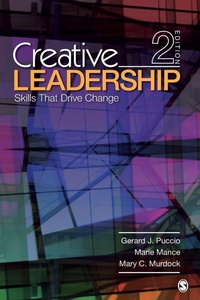
Creative Leadership
Skills That Drive Change
2nd Edition
Published on 1. February 2011
Book
Paperback/Softback
376 pages
978-1-4129-7757-9 (ISBN)
Description
Creativity-today's most important leadership skill
Successful leadership today relies heavily on an individual's ability to effectively respond to and proactively drive change-in short, to be creative. This book helps readers enhance their creative talents and employ these skills as a leader, providing a concrete set of principles and procedures based in creativity that, once internalized, will forever change how we lead.
Successful leadership today relies heavily on an individual's ability to effectively respond to and proactively drive change-in short, to be creative. This book helps readers enhance their creative talents and employ these skills as a leader, providing a concrete set of principles and procedures based in creativity that, once internalized, will forever change how we lead.
More details
Edition
2nd Revised edition
Language
English
Place of publication
Thousand Oaks
United States
Target group
College/higher education
Edition type
Revised edition
Dimensions
Height: 229 mm
Width: 152 mm
Thickness: 20 mm
Weight
544 gr
ISBN-13
978-1-4129-7757-9 (9781412977579)
Copyright in bibliographic data and cover images is held by Nielsen Book Services Limited or by the publishers or by their respective licensors: all rights reserved.
Schweitzer Classification
Other editions
Previous edition
Book
10/2006
1st Edition
SAGE Publications Inc
€63.32
Article exhausted; check for reprint
Persons
Gerard J. Puccio is the Department Chair and Professor in the Department for Creativity and Change Leadership, SUNY-Buffalo State.
Dr. Puccio has written more than 60 articles, chapters and books. His most recent book titled Organizational Creativity and Innovation: A Personal Journey for Innovators and Entrepreneurs (2018 by Sage Press), highlights the crucial role creativity plays in an economy driven by innovation. Prior to this publication, Dr. Puccio co-authored The Innovative Team, published by Jossey-Bass, a fable about a team that was able to apply proven creative-thinking tools to turn around a dysfunctional and unproductive situation.
Dr. Puccio is an accomplished speaker and consultant; he has worked with major corporations, universities, and numerous school districts. Some of his recent clients include the BBC, Fisher-Price Brands, Blue Cross and Blue Shield, Kraft Foods, The Smithsonian Institution, BNP Paribas, Rubbermaid, Coca-Cola, and the Fashion Institute of Technology. He has delivered creativity workshops and presentations across the United States and in more than 20 different countries.
In 2013 Dr. Puccio was selected by the Teaching Company as one of America's Great Lecturers and as such was invited to design and deliver a course comprised of twenty-four 30-minute video sessions. This "Great Course," titled The Creative Thinker's Toolkit, was released in January 2014. Dr. Puccio was also a featured speaker at a TEDx event held in New York City in December of 2012.
Gerard holds a Ph.D. in organizational psychology from the University of Manchester, England.
Marie Mance is Director of Leadership Development at Buffalo State College and an adjunct faculty member at the International Center for Studies in Creativity, teaching in the undergraduate and graduate programs. She holds an M.S. in Creativity and M.Ed. in Counseling/Student Personnel. She has traveled internationally to present creativity and creative problem solving courses and workshops in Nigeria, Singapore and South Africa. She has also designed and delivered workshops in creativity, strategic planning and other change initiatives for a number of organizations in the public and private sector. Currently she is developing and presenting leadership programs for faculty, staff and students at Buffalo State with creativity as a core component. Marie also coaches in the leadership program and has completed training at the Coaches Training Institute. She is pursuing certification to become a Certified Professional Co-Active Coach. She is President of the Niagara Frontier chapter of ASTD (American Society for Training and Development) and a Colleague of the Creative Education Foundation.
Mary C. Murdock was an Associate Professor and graduate faculty member at the International Center for Studies in Creativity, Buffalo State College, Buffalo, NY, where she taught graduate courses and supervised master's work. Through her career, Dr. Murdock was involved in international work, including work as a guest lecturer on qualitative research in the Cognitive Psychology Unit of the University of Bergen and in teaching Creative Problem Solving courses at international schools in five countries (Colombia, Dominican Republic, Tanzania, China, Malaysia). Her publications included two texts: Creative Problem Solving and Role Playing, co-authored with E. Paul Torrance and Creativity Assessment: Readings and Resources with Gerard Puccio. She was also a co-editor along with Center colleagues, of Understanding and Recognizing Creativity: The Emergence of a Discipline and Nurturing and Developing Creativity: The Emergence of a Discipline.
Mary held a BA in English from the University of North Carolina at Greensboro, an M.Ed. in Gifted Education and a doctorate in Educational Psychology from the University of Georgia.
Dr. Puccio has written more than 60 articles, chapters and books. His most recent book titled Organizational Creativity and Innovation: A Personal Journey for Innovators and Entrepreneurs (2018 by Sage Press), highlights the crucial role creativity plays in an economy driven by innovation. Prior to this publication, Dr. Puccio co-authored The Innovative Team, published by Jossey-Bass, a fable about a team that was able to apply proven creative-thinking tools to turn around a dysfunctional and unproductive situation.
Dr. Puccio is an accomplished speaker and consultant; he has worked with major corporations, universities, and numerous school districts. Some of his recent clients include the BBC, Fisher-Price Brands, Blue Cross and Blue Shield, Kraft Foods, The Smithsonian Institution, BNP Paribas, Rubbermaid, Coca-Cola, and the Fashion Institute of Technology. He has delivered creativity workshops and presentations across the United States and in more than 20 different countries.
In 2013 Dr. Puccio was selected by the Teaching Company as one of America's Great Lecturers and as such was invited to design and deliver a course comprised of twenty-four 30-minute video sessions. This "Great Course," titled The Creative Thinker's Toolkit, was released in January 2014. Dr. Puccio was also a featured speaker at a TEDx event held in New York City in December of 2012.
Gerard holds a Ph.D. in organizational psychology from the University of Manchester, England.
Marie Mance is Director of Leadership Development at Buffalo State College and an adjunct faculty member at the International Center for Studies in Creativity, teaching in the undergraduate and graduate programs. She holds an M.S. in Creativity and M.Ed. in Counseling/Student Personnel. She has traveled internationally to present creativity and creative problem solving courses and workshops in Nigeria, Singapore and South Africa. She has also designed and delivered workshops in creativity, strategic planning and other change initiatives for a number of organizations in the public and private sector. Currently she is developing and presenting leadership programs for faculty, staff and students at Buffalo State with creativity as a core component. Marie also coaches in the leadership program and has completed training at the Coaches Training Institute. She is pursuing certification to become a Certified Professional Co-Active Coach. She is President of the Niagara Frontier chapter of ASTD (American Society for Training and Development) and a Colleague of the Creative Education Foundation.
Mary C. Murdock was an Associate Professor and graduate faculty member at the International Center for Studies in Creativity, Buffalo State College, Buffalo, NY, where she taught graduate courses and supervised master's work. Through her career, Dr. Murdock was involved in international work, including work as a guest lecturer on qualitative research in the Cognitive Psychology Unit of the University of Bergen and in teaching Creative Problem Solving courses at international schools in five countries (Colombia, Dominican Republic, Tanzania, China, Malaysia). Her publications included two texts: Creative Problem Solving and Role Playing, co-authored with E. Paul Torrance and Creativity Assessment: Readings and Resources with Gerard Puccio. She was also a co-editor along with Center colleagues, of Understanding and Recognizing Creativity: The Emergence of a Discipline and Nurturing and Developing Creativity: The Emergence of a Discipline.
Mary held a BA in English from the University of North Carolina at Greensboro, an M.Ed. in Gifted Education and a doctorate in Educational Psychology from the University of Georgia.
Content
Chapter 1: Change, Leadership, and Creativity: The Powerful Connection
Chapter 2: Creative Problem Solving: A Framework for Creative Leadership
Chapter 3: Creative Leadership: The Foundational Skills for Creative Problem Solving
Chapter 4: Creative Leadership: The Cognitive and Affective Skill Base for Creative Problem Solving
Chapter 5: Transforming Your Thinking: Developing a Creative Mindset
Chapter 6: Assessing the Situation: Tools for Diagnostic Thinking
Chapter 7: Exploring the Vision: Tools for Visionary Thinking
Chapter 8: Formulating Challenges: Tools for Strategic Thinking
Chapter 9: Exploring Ideas: Tools for Ideational Thinking
Chapter 10: Formulating Solutions: Tools for Evaluative Thinking
Chapter 11: Exploring Acceptance: Tools for Contextual Thinking
Chapter 12: Formulating a Plan: Tools for Tactical Thinking
Chapter 13: Psychological Diversity: Leading People with Different Creativity Styles
Chapter 14: Building a Climate for Creativity: How Leadership Sets the Tone
Conclusion
Chapter 2: Creative Problem Solving: A Framework for Creative Leadership
Chapter 3: Creative Leadership: The Foundational Skills for Creative Problem Solving
Chapter 4: Creative Leadership: The Cognitive and Affective Skill Base for Creative Problem Solving
Chapter 5: Transforming Your Thinking: Developing a Creative Mindset
Chapter 6: Assessing the Situation: Tools for Diagnostic Thinking
Chapter 7: Exploring the Vision: Tools for Visionary Thinking
Chapter 8: Formulating Challenges: Tools for Strategic Thinking
Chapter 9: Exploring Ideas: Tools for Ideational Thinking
Chapter 10: Formulating Solutions: Tools for Evaluative Thinking
Chapter 11: Exploring Acceptance: Tools for Contextual Thinking
Chapter 12: Formulating a Plan: Tools for Tactical Thinking
Chapter 13: Psychological Diversity: Leading People with Different Creativity Styles
Chapter 14: Building a Climate for Creativity: How Leadership Sets the Tone
Conclusion