

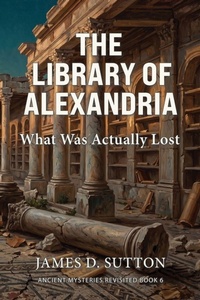
The Library of Alexandria
Description
Everyone knows the story. The greatest library in the ancient world, burned in a single fire, plunging humanity into centuries of darkness. Caesar did it. Or the Christians did it. Or the Arabs did it. Pick your villain, get your outrage.
Almost none of it is true.
The Library of Alexandria: What Was Actually Lost traces the real history of the institution that became the most famous library in the world-and separates it from the myth that replaced it. The ancient sources disagree on nearly everything: how many scrolls the Library held (estimates range from 40,000 to 700,000), what the building looked like (no one knows-no archaeological remains have ever been identified), and how it was destroyed (at least four separate events over six centuries have been blamed, and none of them tells the whole story).
The Library was not destroyed in a single fire. It was abandoned-slowly, across centuries, through a combination of political instability, lost royal patronage, budgetary starvation, competition from rival institutions, the scroll-to-codex transition, and episodic violence. No single event ended it. No single villain killed it. The system that sustained it-the scribes, the funding, the administrative infrastructure of continuous preservation-eroded until the collection quietly disappeared.
But the story of what survived may be more remarkable than the story of what was lost. The Byzantine copyists of Constantinople, the Arabic translators of Baghdad, the Reconquista scholars of Toledo, the Renaissance humanists of Italy, the monastic scriptoria of Western Europe-five transmission channels carried ancient knowledge through a millennium of disruption. This book traces each channel and explains why the classical tradition that reaches the modern world is shaped by the priorities of every civilization that participated in the chain of copying.
The real losses are enormous. Ninety tragedians are known by name; complete plays survive from only three. Sappho wrote nine books of poetry; one substantially complete poem survives. Aristotle's published dialogues are entirely gone. Callimachus's Pinakes - the 120-scroll catalogue that could have told us what the Library contained-is itself lost. The accounting is honest and unflinching. But the losses are not what the popular narrative claims: they are the product of systemic transmission failure across centuries, not a single bonfire lit by a single villain.
Carl Sagan's Cosmos gave the Library its most famous modern treatment-emotionally powerful, historically oversimplified, and wrong in almost every particular about the destruction. This investigation engages Sagan's version directly and honestly, correcting the record without attacking the man or dismissing the cultural impact of his presentation.
Every factual claim sourced to verified scholarship, primary ancient texts, and the archaeological record. Every scholarly debate presented with competing positions at full strength. Where the evidence is uncertain, the book says so. Where the popular narrative is wrong, the book explains why.
The real story is more interesting than the myth. And the questions it raises about how knowledge is preserved and lost apply to any age-including ours.
Ancient Mysteries Revisited is an investigative nonfiction series examining the sites, artifacts, and unsolved questions of the ancient world. Each book investigates a single subject from the evidence outward-no sensationalism, no conspiracy theories, no simple answers where the evidence is genuinely complicated.
Each book stands alone. Each follows the evidence wherever it leads.