

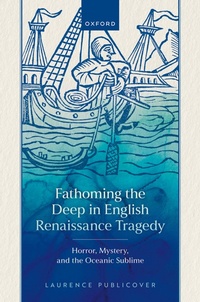
Fathoming the Deep in English Renaissance Tragedy
Horror, Mystery, and the Oceanic Sublime
Published on 1. October 2024
Book
Hardback
224 pages
978-0-19-890708-4 (ISBN)
Description
This book demonstrates how a group of tragedies by Shakespeare and his contemporaries stage the fear and exhilaration generated by encounters with the unknown and the extraordinary. Arguing that the maritime art of fathoming--that is, dropping a lead and line into water to measure its depth--operates as a master-image for these plays, it illustrates how they create sublime horror through intuitions of mysterious more-than-human agencies and of worlds beyond the visible.
Though tightly focused on a specific body of imagery, the book strikes up dialogue with a number of critical fields, including theories and histories of tragedy; ecocriticism and the environmental humanities; oceanic studies; and work on early modern ideas about the body, madness, and language. Countering a tendency within tragic theory to value the textual over the dramatic, it also demonstrates how the tragic effects to which it points are created through specific theatrical strategies, including the use of offstage space, intertheatricality, and the violation of dramatic conventions. Situating its arguments within recent criticism on these plays and on tragedy more generally, and pushing back against scholarship that regards the genre in Shakespeare's time as concerned more with pity than with fear, the book offers fresh and detailed readings of some of the most frequently studied plays in the English canon, including Hamlet, King Lear, Macbeth, The Duchess of Malfi, and The Changeling.
Though tightly focused on a specific body of imagery, the book strikes up dialogue with a number of critical fields, including theories and histories of tragedy; ecocriticism and the environmental humanities; oceanic studies; and work on early modern ideas about the body, madness, and language. Countering a tendency within tragic theory to value the textual over the dramatic, it also demonstrates how the tragic effects to which it points are created through specific theatrical strategies, including the use of offstage space, intertheatricality, and the violation of dramatic conventions. Situating its arguments within recent criticism on these plays and on tragedy more generally, and pushing back against scholarship that regards the genre in Shakespeare's time as concerned more with pity than with fear, the book offers fresh and detailed readings of some of the most frequently studied plays in the English canon, including Hamlet, King Lear, Macbeth, The Duchess of Malfi, and The Changeling.
Reviews / Votes
Original, absorbing, persuasive, and beautifully written: throughout this book, Publicover reveals tragedies' recurring preoccupation with the uneasy experience of stumbling on, or near, hidden mysteries. Even more important, he shows why a language of depth and descent matters for our thinking about tragedy more broadly: it reflects the genre's fundamental investment not simply in affective power, but also in an epistemological abyss that triggers a more all-consuming disorientation. His readings are not only beautiful but moving: this is a rare and unforgettable achievement. * Tanya Pollard, Brooklyn College, CUNY * Laurence Publicover's lucid, elegantly-written book offers fresh and intelligent insight into Shakespeare's major tragedies and some of the most important tragedies of his contemporaries, including Hamlet, King Lear, Macbeth, Kyd's Spanish Tragedy and Webster's Duchess of Malfi. Through its focus on imagery of marine depth, the book shows how tragedy sends metaphorical plumb-lines into aspects of experience not normally available to the human senses. If there are more things in heaven and earth than standard philosophy dreams of, Publicover shows there are other, still-more troubling things below the oceans, and tragic experience may be the only way of accessing them, for good or ill. Fathoming the Deep will be stimulating and useful for students of these plays at all levels, and will prompt much interesting thinking among scholars. * Tom MacFaul, St Edmund Hall, University of Oxford * [Publicover shows how] the rich and striking metaphors strategically placed throughout The Duchess of Malfi serve less to explain the action of Webster's tragedy than to point to the horrifying, unexplained depths that surround our existence, 'no more than a rug placed over a trapdoor' - an image that demonstrates that the critic is alive to the power of the literature he studies. * Andrew Hadfield, Times Literary Supplement * The first thing Publicover tells us is that he has tried to aim at student readers as well as academics, and that the chapters are therefore intended to be freestanding as well as part of a developing argument. This promise is fulfilled; not only does each chapter provide a handy summary of the critical backstory on the play under discussion, but in this as in other respects the book wears its learning lightly and remains clear, readable, and engaging. * Lisa Hopkins, Shakespeare Journal *More details
Language
English
Place of publication
Oxford
United Kingdom
Target group
Professional and scholarly
Product notice
sewn/stitched
Cloth over boards
Illustrations
5
Dimensions
Height: 240 mm
Width: 165 mm
Thickness: 21 mm
Weight
503 gr
ISBN-13
978-0-19-890708-4 (9780198907084)
Copyright in bibliographic data and cover images is held by Nielsen Book Services Limited or by the publishers or by their respective licensors: all rights reserved.
Schweitzer Classification
Other editions
Additional editions
Laurence Publicover
Fathoming the Deep in English Renaissance Tragedy
Horror, Mystery, and the Oceanic Sublime
E-Book
09/2024
OUP eBook
€23.49
Available for download
Laurence Publicover
Fathoming the Deep in English Renaissance Tragedy
Horror, Mystery, and the Oceanic Sublime
E-Book
09/2024
OUP eBook
€23.49
Available for download
Person
Laurence Publicover is Senior Lecturer in English at the University of Bristol, where he works on English Renaissance literature and on human-ocean relations in the early modern period and beyond. He is the author of Dramatic Geography: Romance, Cultural Encounter, and Intertheatricality in Early Modern Mediterranean Drama (Oxford University Press, 2017) and co-editor, with Susann Liebich, of Shipboard Literary Cultures: Reading, Writing, and Performing at Sea (Palgrave, 2021). Alongside Jimmy Packham, he is writing a human and literary history of the seabed to be published by University of Chicago Press.
Content
Introduction: Horatio's Warnings
1: The Spanish Tragedy and the English Tradition
2: Fathoming King Lear
3: The Horror of Macbeth
4: Peering into the Beyond: The Duchess of Malfi
5: Middleton's Deep
Conclusion: Tragedy, History, and Ecological Thought
1: The Spanish Tragedy and the English Tradition
2: Fathoming King Lear
3: The Horror of Macbeth
4: Peering into the Beyond: The Duchess of Malfi
5: Middleton's Deep
Conclusion: Tragedy, History, and Ecological Thought