


ERP
Tools, Techniques, and Applications for Integrating the Supply Chain
1st Edition
Published on 28. September 1999
Book
Hardback
456 pages
978-1-57444-270-0 (ISBN)
Description
Intensifying competition forces companies to closely integrate with their customers and suppliers. Cooperation creates a more flexible supply chain. Yet, lead-times become shorter and demand for increased variety continues to grow. This dilemma requires a means to implement the desired integration. Enterprise Resource Planning (ERP) is that tool.
ERP, a system for effectively planning and managing all the resources of an enterprise, fully utilizes the increased power available in computers today. ERP is distinguished from MRP in its use of relational databases, fourth-generation languages, integrated computer aided engineering tools, and open system portability to adjunct planning systems, finite scheduling systems, and manufacturing execution systems.
INTRODUCING THE MANAGEMENT INTERACTIVE CASE STUDY SIMULATOR
This book includes the Management Interactive Case Study Simulator (MICSS) on CD-ROM, a computerized case study that lets you manage a small company, illustrating crucial management issues. The challenge: learn to control the dynamics of this virtual company and maneuver it to financial success.
The Advanced Planning and Scheduling tools of the ERP system help determine the most beneficial mix of customers and orders. ERP provides timing recommendation for material purchases and can share this information with all links of the supply chain. A successful ERP is highly effective in reducing material costs, which boosts profitability.
The most common reason that ERP implementations fail is when operators are not properly educated in the integrated business application of the system. This ignorance turns ERP into an overpriced inventory control system. ERP: Tools, Techniques and Applications for Integrating the Supply Chain helps provide the education that is critical for ERP success.
Features
ERP, a system for effectively planning and managing all the resources of an enterprise, fully utilizes the increased power available in computers today. ERP is distinguished from MRP in its use of relational databases, fourth-generation languages, integrated computer aided engineering tools, and open system portability to adjunct planning systems, finite scheduling systems, and manufacturing execution systems.
INTRODUCING THE MANAGEMENT INTERACTIVE CASE STUDY SIMULATOR
This book includes the Management Interactive Case Study Simulator (MICSS) on CD-ROM, a computerized case study that lets you manage a small company, illustrating crucial management issues. The challenge: learn to control the dynamics of this virtual company and maneuver it to financial success.
The Advanced Planning and Scheduling tools of the ERP system help determine the most beneficial mix of customers and orders. ERP provides timing recommendation for material purchases and can share this information with all links of the supply chain. A successful ERP is highly effective in reducing material costs, which boosts profitability.
The most common reason that ERP implementations fail is when operators are not properly educated in the integrated business application of the system. This ignorance turns ERP into an overpriced inventory control system. ERP: Tools, Techniques and Applications for Integrating the Supply Chain helps provide the education that is critical for ERP success.
Features
More details
Series
Language
English
Place of publication
London
United Kingdom
Publishing group
Taylor & Francis Ltd
Illustrations
37 s/w Tabellen
37 Tables, black and white
Dimensions
Height: 229 mm
Width: 152 mm
Weight
730 gr
ISBN-13
978-1-57444-270-0 (9781574442700)
Copyright in bibliographic data is held by Nielsen Book Services Limited or its licensors: all rights reserved.
Schweitzer Classification
Other editions
New editions
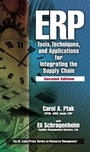
Carol A. Ptak | Eli Schragenheim
ERP
Tools, Techniques, and Applications for Integrating the Supply Chain, Second Edition
Book
10/2003
2nd Edition
CRC Press
€178.56
Shipment within 15-20 days
Persons
Content
History of ERP
Requirements of an ERP System
Selecting the Right System for You
Advanced Planning and Scheduling (APS) (Sales and Operation Planning)
Inventory Strategies
Data Record Accuracy
Product Data Management (PDM) Including Configuration Control
Operations Planning (Material and Capacity Requirements Planning)
Manufacturing Execution Control
Generalized Industry Application
Distribution
Field Service
Repetitive Manufacturing Application
Complex Manufacturing (Project Control Manufacturing)
Process Industry
Remanufacturing
Developing the Business Processes
Integrating the Supply Chain to Reap the Rewards
Requirements of an ERP System
Selecting the Right System for You
Advanced Planning and Scheduling (APS) (Sales and Operation Planning)
Inventory Strategies
Data Record Accuracy
Product Data Management (PDM) Including Configuration Control
Operations Planning (Material and Capacity Requirements Planning)
Manufacturing Execution Control
Generalized Industry Application
Distribution
Field Service
Repetitive Manufacturing Application
Complex Manufacturing (Project Control Manufacturing)
Process Industry
Remanufacturing
Developing the Business Processes
Integrating the Supply Chain to Reap the Rewards