

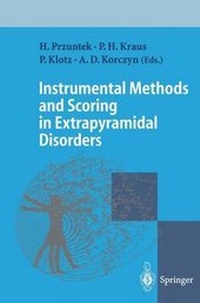
Instrumental Methods and Scoring in Extrapyramidal Disorders
Published on 12. December 1995
Book
Hardback
XIV, 268 pages
978-3-540-57875-8 (ISBN)
Description
Many extrapyramidal motor diseases result from underlying neurodegenerative processes, which however are very advanced at the time the clinical diagnosis is made. From animal experiments it seems likely that we may soon have several substances that provide neuroprotective effects, but that their therapeutic use must be as early as possible. This fact was the starting point for the meeting, held at Chiemsee, that formed the basis of this book. The idea was to develop in strumental methods that, first, permit an earlier diagnosis by drawing on the experience of experts and, second, provide a better resolution of successful therapy than the currently used methods. As early as 1886, Charcot tried to differentiate the tremor of polysclerosis and Parkinson patients by using a drum developed by Marey, a physiologist. Subse quently, many apparatuses were developed to better identify movement disorders, initially for diagnostic purposes. Most of these methods proved to be inferior to the skill of experienced observers. In the last two decades, however, both the technical advances made in measuring methods and the improvements achieved in methods of evaluation have led to marked advances in the quantification of motor dis turbances. An objective of the symposium held at Chiemsee and of this book is to provide an overview of the procedures that are currently commonly used for extrapyramidal movement disorders, and to identify their potential and limitations.
More details
Language
English
Place of publication
Heidelberg
Germany
Publishing group
Springer Berlin
Target group
Professional and scholarly
Illustrations
biography
Dimensions
Height: 23.5 cm
Width: 15.5 cm
Weight
562 gr
ISBN-13
978-3-540-57875-8 (9783540578758)
DOI
10.1007/978-3-642-78914-4
Schweitzer Classification
Other editions
Additional editions
Horst Przuntek | Peter H. Kraus | Peter Klotz
Instrumental Methods and Scoring in Extrapyramidal Disorders
E-Book
12/2012
Springer
€96.29
Available for download
Horst Przuntek | Peter H. Kraus | Peter Klotz
Instrumental Methods and Scoring in Extrapyramidal Disorders
Book
12/2011
Springer
€106.99
Shipment within 7-9 days
Content
Theoretical Basics of Rating Scales.- The Hoehn and Yahr Rating Scale for Parkinson's Disease.- A Rational Basis for a New Scoring System Measuring Disability in Parkinson's Disease.- Depression Inventories in Parkinson's Disease.- Selecting Neurologic Function Tests for Parkinson's Disease: A Primer.- Measurement of Muscle Tone - Demarcation Between Spasticity and Rigidity.- Instrumental Assessment of Rigidity.- Tremor Assessment in Clinical Trials.- Frequency, Amplitude and Waveform Characteristics of Physiologic and Pathologic Tremors.- Interaction Between Voluntary and Involuntary Movements.- Long-Term Measurement of Tremor.- Kinematics of Standing Posture Associated with Aging and Parkinson's Disease.- Differential Diagnosis of Organic and Psychogenic Vertigo Using Dynamic Posturography.- Relevance of Posturographic Parameters in the Differential Diagnosis of Parkinsonism.- Quantification of Dopaminomimetic Effects on Parkinsonian Symptoms Using Automatic and Voluntary Postural Responses.- Posturography in Parkinson's Disease Patients on and off Medication.- Tracking Measures of Movement.- Kinematic Analysis of Complex Movements in Parkinson's Disease.- The Age Function of Normative Data for a Personal Computer-based Test System for the Analysis and Quantification of Manual Movement Disability.- Quantitative Clinical Evaluation of Parkinsonism Based on Visuomotor Tracking and Tracing.- Kinematic Properties of Upper Limb Movement Trajectories.- Use of Quantitative Assessment in Evaluating Patients with Neural Transplants.- Measurement of Diadochokinesia.- The Complexity Effect as an Indicator for the Parkinson Plus Syndrome.- Quantitative Assessment of Akinesia in Parkinson's Disease.- Motor Performance Test after Schoppe and Clinical Rating Scales - A Comparison.