

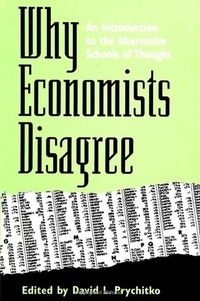
Why Economists Disagree
An Introduction to the Alternative Schools of Thought
Published on 4. December 1997
Book
Paperback/Softback
415 pages
978-0-7914-3570-0 (ISBN)
Description
Provides a convenient introduction to heterodox alternatives to neoclassical economics.
Economists disagree. They disagree over policy, prediction, and matters of pure theory. They even disagree over why they disagree. Why Economists Disagree demonstrates that the "crisis" of contemporary economics may actually be a sign of healthy disagreement and fresh thinking over the nature and scope of economic theory and policy.
Since the 1980s, several dissenting schools of thought have emerged that offer serious methodological and theoretical challenges to mainstream economics. Why Economists Disagree provides a convenient introduction to Austrian, Post Keynesian, Institutionalist, Feminist, Marxist, and other heterodox alternatives to neoclassical economics. Written by eminent economists within each tradition, the book's chapters convey both the main characteristics, the controversies, and disagreement within each school of thought.
Contributors include Jack Amariglio, Paul Davidson, William M. Dugger, Alfred S. Eichner, Roger W. Garrison, Albert O. Hirschman, Geoffrey M. Hodgson, Israel M. Kirzner, Arjo Klamer, J.A. Kregel, Ludwig M. Lachmann, Tony Lawson, Deirdre McCloskey, David F. Ruccio, Warren J. Samuels, Howard J. Sherman, William R. Waters, Thomas E. Weisskopf, and Frances R. Woolley.
Economists disagree. They disagree over policy, prediction, and matters of pure theory. They even disagree over why they disagree. Why Economists Disagree demonstrates that the "crisis" of contemporary economics may actually be a sign of healthy disagreement and fresh thinking over the nature and scope of economic theory and policy.
Since the 1980s, several dissenting schools of thought have emerged that offer serious methodological and theoretical challenges to mainstream economics. Why Economists Disagree provides a convenient introduction to Austrian, Post Keynesian, Institutionalist, Feminist, Marxist, and other heterodox alternatives to neoclassical economics. Written by eminent economists within each tradition, the book's chapters convey both the main characteristics, the controversies, and disagreement within each school of thought.
Contributors include Jack Amariglio, Paul Davidson, William M. Dugger, Alfred S. Eichner, Roger W. Garrison, Albert O. Hirschman, Geoffrey M. Hodgson, Israel M. Kirzner, Arjo Klamer, J.A. Kregel, Ludwig M. Lachmann, Tony Lawson, Deirdre McCloskey, David F. Ruccio, Warren J. Samuels, Howard J. Sherman, William R. Waters, Thomas E. Weisskopf, and Frances R. Woolley.
Reviews / Votes
"This book is an argument by counterexample. Following Friedman, Thurow, and others, most economists deny that substantial disagreement exists within the profession. Prychitko shows this simply isn't so. Economists do disagree, and they disagree over theory. By way of proof, the book presents a selection of heterodox articles." - Roger Koppl, Fairleigh Dickinson UniversityMore details
Language
English
Place of publication
Albany, NY
United States
Target group
College/higher education
Professional and scholarly
US School Grade: College Graduate Student and over
Product notice
Paperback (trade)
Dimensions
Height: 227 mm
Width: 150 mm
Thickness: 21 mm
Weight
562 gr
ISBN-13
978-0-7914-3570-0 (9780791435700)
Copyright in bibliographic data and cover images is held by Nielsen Book Services Limited or by the publishers or by their respective licensors: all rights reserved.
Schweitzer Classification
Other editions
Additional editions
E-Book
12/1997
State University of New York Press
€38.99
Available for download
Person
David L. Prychitko is Associate Professor, Department of Economics, Northern Michigan University. He is the author of Marxism and Workers' Self-Management: The Essential Tension. In addition, he edited Individuals, Institutions, Interpretations: Hermeneutics Applied to Economics; Producer Cooperatives and Labor-Managed Systems Vol. I: Theory and Vol. II: Case Studies (both with Jaroslav Vanek); and The Market Process: Essays in Contemporary Austrian Economics (with Peter J. Boettke).
Content
Acknowledgments
Introduction: Why Economists Disagree: The Role of the Alternative Schools of Thought
David L. Prychitko
Part I. Austrian Economics and the Market Process
1. Time and Money: The Universals of Macroeconomic Theorizing
Roger W. Garrison
2. The Driving Force of the Market: The Idea of "Competition" in Contemporary Economic Theory and in the Austrian Theory of the Market Process
Israel M. Kirzner
3. From Mises to Shackle: An Essay on Austrian Economics and the Kaleidic Society
Ludwig M. Lachmann
Part II. Post-Keynesian Economics for an Uncertain World
4. Reviving Keynes's Revolution
Paul Davidson
5. An Essay on Post-Keynesian Theory: A New Paradigm on Economics
Alfred S. Eichner and J.A. Kregel
6. The Nature of Post Keynesianism and Its Links to Other Traditions
Tony Lawson
Part III. Beyond the Market: Social and Institutional Economics
7. Institutional Economic Theory: The Old Versus the New
Geoffrey M. Hodgson
8. Social Economics: A Solidarist Perspective
William R. Waters
9. Comparison of Marxism and Institutionalism
William M. Dugger and Howard J. Sherman
Part IV. The Changing Face of Radical Political Economy
10. Postmodernism, Marxism, and the Critique of Modern Economic Thought
Jack Amariglio and David F. Ruccio
11. Toward a Socialism for the Future, in the Wake of the Demise of the Socialism of the Past
Thomas E. Weisskopf
Part V. Where Do We Go From Here? New Philosophical Issues
12. The Feminist Challenge to Neoclassical Economics
Frances R. Woolley
13. Against Parsimony: Three Ways of Complicating Some Categories of Economic Discourse
Albert O. Hirschman
14. The Methodology of Economics and the Case for Policy Diffidence and Restraint
Warren J. Samuels
15. The Rhetoric of Disagreement
Arjo Klamer and Deirdre McCloskey
Further Readings in the Alternative Schools of Thought: A Bibliographic Essay
David L. Prychitko
Contributors
Index
Introduction: Why Economists Disagree: The Role of the Alternative Schools of Thought
David L. Prychitko
Part I. Austrian Economics and the Market Process
1. Time and Money: The Universals of Macroeconomic Theorizing
Roger W. Garrison
2. The Driving Force of the Market: The Idea of "Competition" in Contemporary Economic Theory and in the Austrian Theory of the Market Process
Israel M. Kirzner
3. From Mises to Shackle: An Essay on Austrian Economics and the Kaleidic Society
Ludwig M. Lachmann
Part II. Post-Keynesian Economics for an Uncertain World
4. Reviving Keynes's Revolution
Paul Davidson
5. An Essay on Post-Keynesian Theory: A New Paradigm on Economics
Alfred S. Eichner and J.A. Kregel
6. The Nature of Post Keynesianism and Its Links to Other Traditions
Tony Lawson
Part III. Beyond the Market: Social and Institutional Economics
7. Institutional Economic Theory: The Old Versus the New
Geoffrey M. Hodgson
8. Social Economics: A Solidarist Perspective
William R. Waters
9. Comparison of Marxism and Institutionalism
William M. Dugger and Howard J. Sherman
Part IV. The Changing Face of Radical Political Economy
10. Postmodernism, Marxism, and the Critique of Modern Economic Thought
Jack Amariglio and David F. Ruccio
11. Toward a Socialism for the Future, in the Wake of the Demise of the Socialism of the Past
Thomas E. Weisskopf
Part V. Where Do We Go From Here? New Philosophical Issues
12. The Feminist Challenge to Neoclassical Economics
Frances R. Woolley
13. Against Parsimony: Three Ways of Complicating Some Categories of Economic Discourse
Albert O. Hirschman
14. The Methodology of Economics and the Case for Policy Diffidence and Restraint
Warren J. Samuels
15. The Rhetoric of Disagreement
Arjo Klamer and Deirdre McCloskey
Further Readings in the Alternative Schools of Thought: A Bibliographic Essay
David L. Prychitko
Contributors
Index