

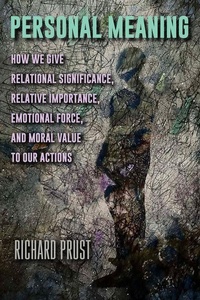
Personal Meaning
How We Give Relational Significance, Relative Importance, Emotional Force, and Moral Value to Our Actions
Will be published approx. on 2. September 2026
Book
Paperback/Softback
172 pages
979-8-8558-0603-8 (ISBN)
Description
The personal meaning of our action reveals who we are: understanding how that disclosure is possible enables us to describe our self-awareness more accurately and solve a raft of intellectual puzzles about our values and relationships.
Much of our action has personal meaning, meaning others are not entirely privy to. Our relationships can have a great deal of meaning or they can be of little meaning. Some of our actions register as important, others relatively unimportant. Sometimes we act in loving ways; sometimes we act out of fear. Sometimes we mean to do something with special moral value. Personal Meaning accounts for how we construct these features of our actions' meaning. It shows how we make sense of our relationships, our priorities, our emotions, and our morality in ways that can be reasonable or unreasonable. By laying out how we reason when we are being reasonable about personal matters, we discover what author Richard Prust calls the "character logic" of personal meaning. Appreciating its governance gives us two advantages: it lets us describe our lives more accurately than we can using the causal languages of science, and it enables us to find philosophical solutions to the issues discussed under these topics.
Much of our action has personal meaning, meaning others are not entirely privy to. Our relationships can have a great deal of meaning or they can be of little meaning. Some of our actions register as important, others relatively unimportant. Sometimes we act in loving ways; sometimes we act out of fear. Sometimes we mean to do something with special moral value. Personal Meaning accounts for how we construct these features of our actions' meaning. It shows how we make sense of our relationships, our priorities, our emotions, and our morality in ways that can be reasonable or unreasonable. By laying out how we reason when we are being reasonable about personal matters, we discover what author Richard Prust calls the "character logic" of personal meaning. Appreciating its governance gives us two advantages: it lets us describe our lives more accurately than we can using the causal languages of science, and it enables us to find philosophical solutions to the issues discussed under these topics.
Reviews / Votes
"Personal Meaning is an example of what an essay in American philosophy should be. It centers not on 'the problems of philosophers' but squarely on 'the problems of men,' in John Dewey's language, and it addresses some of the most common and heartfelt problems of the latter sort. Yet it also trenchantly and with clarity engages the problems of philosophers when they factor into basic human problems, and it is informed by a variety of work outside the field. Further, although Prust writes in the vein of classical American philosophers, he does not simply rehash what they have said or argue, in the typical fashion, that they have not received their due. Rather, in plain, readable, yet elegant, prose, he offers original thoughts that improve on theirs in a way that carries on the projects they began-most notably, the project of crafting a commonsensical philosophy of life. If he is correct, for example, about why the imperative to self-actualize is in harmony with moral imperatives, he has solved a big practical problem that no one else in American philosophy has adequately addressed." - Mason Marshall, Pepperdine UniversityMore details
Series
Language
English
Place of publication
Albany, NY
United States
Target group
Professional and scholarly
US School Grade: College Graduate Student and over
Product notice
Paperback (trade)
Dimensions
Height: 229 mm
Width: 152 mm
Thickness: 12 mm
ISBN-13
979-8-8558-0603-8 (9798855806038)
Copyright in bibliographic data and cover images is held by Nielsen Book Services Limited or by the publishers or by their respective licensors: all rights reserved.
Schweitzer Classification
Other editions
Additional editions
Richard Prust
Personal Meaning
How We Give Relational Significance, Relative Importance, Emotional Force, and Moral Value to Our Actions
E-Book
03/2026
State University of New York Press
€35.99
Available for download
Person
Richard Prust is Professor Emeritus of Philosophy at St. Andrews University. He is coauthor, with Jeffery Geller, of Personal Identity in Moral and Legal Reasoning.
Content
Acknowledgments
Introduction
1. Individual Meaning
2. Relational Significance
3. Relative Importance
4. Emotional Force
5. Moral Value
6. The Meaning of Life
Glossary
Notes
Bibliography
Index
Introduction
1. Individual Meaning
2. Relational Significance
3. Relative Importance
4. Emotional Force
5. Moral Value
6. The Meaning of Life
Glossary
Notes
Bibliography
Index