

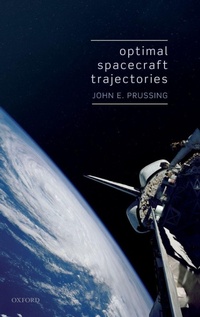
Optimal Spacecraft Trajectories
Published on 21. December 2017
Book
Hardback
152 pages
978-0-19-881108-4 (ISBN)
Description
This graduate textbook on optimal spacecraft trajectories demonstrates the theory and applications of using the minimum amount of propellant possible to reach a target destination. The author aims to produce the only comprehensive treatment of various aspects of this topic. It includes problems at the ends of the chapters and some of the appendices. But it is also suitable as a scholarly reference book as it includes recent research from the author and his colleagues.
More details
Language
English
Place of publication
Oxford
United Kingdom
Target group
College/higher education
Dimensions
Height: 240 mm
Width: 161 mm
Thickness: 13 mm
Weight
399 gr
ISBN-13
978-0-19-881108-4 (9780198811084)
Copyright in bibliographic data and cover images is held by Nielsen Book Services Limited or by the publishers or by their respective licensors: all rights reserved.
Schweitzer Classification
Other editions
Additional editions
John E. Prussing
Optimal Spacecraft Trajectories
Book
12/2017
Oxford University Press
€66.00
Shipment within 15-20 days
John E. Prussing
Optimal Spacecraft Trajectories
E-Book
12/2017
1st Edition
OUP eBook
€45.99
Available for download
Person
John Prussing is Professor Emeritus of Aerospace Engineering at the University of Illnois at Urbana-Champaign. He holds a SB, SM and a ScD in 1967 in aerospace engineering all from MIT, and served as professor of aerospace engineering between 1969 and 2007, and continues to teach part time, including short courses at NASA. He has published over 80 articles and has authored/co-authored three books.
Content
1: Parameter Optimization
2: Rocket Trajectories
3: Optimal Control Theory
4: Optimal Trajectories
5: Improving a Nonoptimal Impulsive Trajectories
6: Continuous-Thrust Trajectories
7: Cooperative Rendezvous
8: Second Order Conditions
A: Lagrange Multiplier Interpretation
B: Hohmann Transfer
C: Optimal Impulsive Linear Systems
D: Linear System Theory
E: Maximum Range Using Continuous Thrust in a Uniform Gravitational Field
F: Quadratic Forms
G: Simple Conjugate Point Example
2: Rocket Trajectories
3: Optimal Control Theory
4: Optimal Trajectories
5: Improving a Nonoptimal Impulsive Trajectories
6: Continuous-Thrust Trajectories
7: Cooperative Rendezvous
8: Second Order Conditions
A: Lagrange Multiplier Interpretation
B: Hohmann Transfer
C: Optimal Impulsive Linear Systems
D: Linear System Theory
E: Maximum Range Using Continuous Thrust in a Uniform Gravitational Field
F: Quadratic Forms
G: Simple Conjugate Point Example