

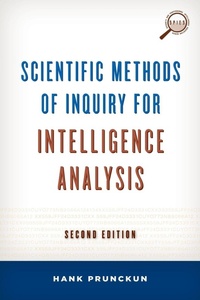
Scientific Methods of Inquiry for Intelligence Analysis
2nd Edition
Published on 8. September 2014
Book
Paperback/Softback
384 pages
978-1-4422-2432-2 (ISBN)
Description
Since 9/11, the needs of intelligence agencies as well as the missions they conduct have increased in number, size, and complexity. As such, government and private security agencies are recruiting staff to analyze the vast amount of data collected in these missions. This textbook offers a way of gaining the analytic skills essential to undertake intelligence work. It acquaints students and analysts with how intelligence fits into the larger research framework. It covers not only the essentials of applied research, but also the function, structure, and operational methods specifically involved in intelligence work. It looks at how analysts work with classified information in a security conscious environment as well as obtain data via covert methods. Students are left with little doubt about what intelligence is and how it is developed using scientific methods of inquiry.
This revised edition of the popular text has been expanded and updated significantly.
This revised edition of the popular text has been expanded and updated significantly.
Reviews / Votes
This excellent book is an update of a 2010 book by the same author, Hand-book of Scientific Methods of Inquiry for Intelligence Analysis. In structure, it is a very teacher- and student-friendly textbook. . . .It is one of the most complete, readable, and thought-provoking books on intelligence that I've had the pleasure of reading. . . .As some of you who read my reviews in the past know, I often judge a book by how many pages I dog-ear while I'm reading it. Trust me, this is very well dog eared. . . .Among the most interesting discussions for any analyst are the chapters on qualitative analysis, where the author walks the user through, very carefully, how to utilize various forms of analysis and to present those results to the end-user. Frankly the book is worth it simply for that chapter. To that I would add the chapter 'Threat, Vulnerability and Risk Assessments' is a real gem. It shows where intelligence must interface with other forms of analysis and planning. Having taught courses in competitive intelligence, I would not hesitate to utilize this as a primary text for my students. For my colleagues who teach governmental, military, and law enforcement intelligence, I think that a brief review of this book will bring you to the same conclusion. * International Association for Intelligence Education *More details
Series
Edition
2nd edition
Language
English
Place of publication
United States
Publishing group
Bloomsbury Publishing Plc
Target group
College/higher education
US School Grade: From College Freshman to College Graduate Student, Interest Age: From 18 to 22 years
Illustrations
43 b/w illustrations; 44 tables; 57 textboxes
Dimensions
Height: 229 mm
Width: 152 mm
Thickness: 23 mm
Weight
622 gr
ISBN-13
978-1-4422-2432-2 (9781442224322)
Copyright in bibliographic data and cover images is held by Nielsen Book Services Limited or by the publishers or by their respective licensors: all rights reserved.
Schweitzer Classification
Other editions
Additional editions
Hank Prunckun
Scientific Methods of Inquiry for Intelligence Analysis
E-Book
09/2014
2nd Edition
Rowman & Littlefield Publishers
€65.99
Available for download
Hank Prunckun
Scientific Methods of Inquiry for Intelligence Analysis
E-Book
09/2014
2nd Edition
Bloomsbury eBooks US
€65.99
Available for download
Person
Hank Prunckun is associate professor of intelligence analysis at the Australian Graduate School of Policing and Security, Charles Sturt University, Sydney.
Content
Editor's Foreword
Preface
1 Intelligence Theory
2 Intelligence Organizational Structures
3The Intelligence Research Process
4The Scientific Method of Inquiry
5 Intelligence Research Methodologies
6 Idea Generation and Conceptualization
7 Unobtrusive Data Collection
8 Open Sources of Information
9 Clandestine and Covert Sources of Information
10 Content Analysis of Qualitative Data
11 Qualitative Analytics
12 Target Profiles
13 Tactical Assessments
14 Vehicle Route Analysis
15 Geographic Analysis
16 Quantitative Analytics
17 Displaying Information in Figures and Tables
18 Threat, Vulnerability and Risk Assessments
19 Strategic Intelligence Assessments
20 Decision Support Analysis
21 Basics of Defensive Counterintelligence
22 Ethics in Intelligence Research
Appendix-Critical Values of Chi-Square Distribution
Index
About the Author
Preface
1 Intelligence Theory
2 Intelligence Organizational Structures
3The Intelligence Research Process
4The Scientific Method of Inquiry
5 Intelligence Research Methodologies
6 Idea Generation and Conceptualization
7 Unobtrusive Data Collection
8 Open Sources of Information
9 Clandestine and Covert Sources of Information
10 Content Analysis of Qualitative Data
11 Qualitative Analytics
12 Target Profiles
13 Tactical Assessments
14 Vehicle Route Analysis
15 Geographic Analysis
16 Quantitative Analytics
17 Displaying Information in Figures and Tables
18 Threat, Vulnerability and Risk Assessments
19 Strategic Intelligence Assessments
20 Decision Support Analysis
21 Basics of Defensive Counterintelligence
22 Ethics in Intelligence Research
Appendix-Critical Values of Chi-Square Distribution
Index
About the Author