

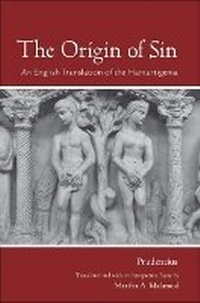
The Origin of Sin
An English Translation of the "Hamartigenia"
Published on 15. November 2011
Book
Paperback/Softback
248 pages
978-0-8014-8872-6 (ISBN)
Description
Aurelius Prudentius Clemens (348-ca. 406) is one of the great Christian Latin writers of late antiquity. Born in northeastern Spain during an era of momentous change for both the Empire and the Christian religion, he was well educated, well connected, and a successful member of the late Roman elite, a man fully engaged with the politics and culture of his times. Prudentius wrote poetry that was deeply influenced by classical writers and in the process he revived the ethical, historical, and political functions of poetry. This aspect of his work was especially valued in the Middle Ages by Christian writers who found themselves similarly drawn to the Classical tradition.
Prudentius's Hamartigenia, consisting of a 63-line preface followed by 966 lines of dactylic hexameter verse, considers the origin of sin in the universe and its consequences, culminating with a vision of judgment day: the damned are condemned to torture, worms, and flames, while the saved return to a heaven filled with delights, one of which is the pleasure of watching the torments of the damned. As Martha A. Malamud shows in the interpretive essay that accompanies her lapidary translation, the first new English translation in more than forty years, Hamartigenia is critical for understanding late antique ideas about sin, justice, gender, violence, and the afterlife. Its radical exploration of and experimentation with language have inspired generations of thinkers and poets since-most notably John Milton, whose Paradise Lost owes much of its conception of language and its strikingly visual imagery to Prudentius's poem.
Prudentius's Hamartigenia, consisting of a 63-line preface followed by 966 lines of dactylic hexameter verse, considers the origin of sin in the universe and its consequences, culminating with a vision of judgment day: the damned are condemned to torture, worms, and flames, while the saved return to a heaven filled with delights, one of which is the pleasure of watching the torments of the damned. As Martha A. Malamud shows in the interpretive essay that accompanies her lapidary translation, the first new English translation in more than forty years, Hamartigenia is critical for understanding late antique ideas about sin, justice, gender, violence, and the afterlife. Its radical exploration of and experimentation with language have inspired generations of thinkers and poets since-most notably John Milton, whose Paradise Lost owes much of its conception of language and its strikingly visual imagery to Prudentius's poem.
Reviews / Votes
"I am most impressed with the clarity and precision of this translation. Martha A. Malamud's verses render Prudentius' Latin into lucid and compelling measures that honor the literal meaning even as they imitate the cacophony, alliteration, and occasional clusters of half rhyme in the original. Throughout, Malamud demonstrates her keen ear for Prudentius' language." -- Emily Albu, UC Davis "Martha A. Malamud's translation is readable and dynamic. Her interpretive essay skillfully sets the literary context and is first-class in its close reading and interpretation. I learned a great deal. The Origin of Sin is a substantial and much-needed contribution to Prudentian studies, late antique studies, and even comparative literature." -- Marc Mastrangelo, Dickinson CollegeMore details
Series
Language
English
Place of publication
Ithaca
United States
Product notice
Paperback (trade)
Dimensions
Height: 235 mm
Width: 155 mm
Thickness: 16 mm
Weight
454 gr
ISBN-13
978-0-8014-8872-6 (9780801488726)
Copyright in bibliographic data and cover images is held by Nielsen Book Services Limited or by the publishers or by their respective licensors: all rights reserved.
Schweitzer Classification
Other editions
Additional editions
E-Book
03/2012
Cornell University Press
€27.49
Available for download
Persons
Martha A. Malamud is Professor of Classics at the University at Buffalo. She is the author of A Poetics of Transformation: Prudentius and Classical Mythology.
Content
Acknowledgments
Note on Translations and EditionsTHE ORIGIN OF SIN: AN ENGLISH TRANSLATION
Preface
The Origin of SinAN INTERPRETIVE ESSAY
Introduction
1. Writing in Chains
2. Figuring It Out
3. Seeking Hidden Truth
4. Falling into Language
5. Under Assault
6. Generation of Vipers
7. Signs of Woe
8. In AenigmateNotes
References
Index
Note on Translations and EditionsTHE ORIGIN OF SIN: AN ENGLISH TRANSLATION
Preface
The Origin of SinAN INTERPRETIVE ESSAY
Introduction
1. Writing in Chains
2. Figuring It Out
3. Seeking Hidden Truth
4. Falling into Language
5. Under Assault
6. Generation of Vipers
7. Signs of Woe
8. In AenigmateNotes
References
Index