

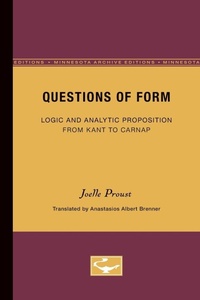
Questions of Form
Logic and Analytic Proposition from Kant to Carnap
Published on 14. November 1989
Book
Paperback/Softback
326 pages
978-0-8166-1761-6 (ISBN)
Description
Questions of Form was first published in 1989. Minnesota Archive Editions uses digital technology to make long-unavailable books once again accessible, and are published unaltered from the original University of Minnesota Press editions.
In Questions on Form, Joelle Proust traces the concept of the analytic proposition from Kant's development of the notion down to its place in the work of Rudolf Carnap, a founder of logical empiricism and a key figure in contemporary analytic philosophy. Using a method known in France as topique comparative,she provides a rigorous exposition of analyticity, situating it within four major philosophical systems-those of Kant, Bolzano, Frege, and Carnap-and clearly delineating its development from one system to the next.
Proust takes as her point of departure Kant's distinction between analytic and synthetic judgments. Though she makes clear that Kant drew on Locke, Hume, and Leibniz, she argues that his notion of analyticity was innovative, not simply an elaboration of something already found in their work. She shows that the analytic proposition unexpectedly (given its modest status in Kant) came to play an important part in efforts to convert problems considered "transcendental" into questions of belonging to formal logic.
Ultimately, her comparison of their systems reveals that the concept of the analytic, however specific its rile in each, remains linked to a foundationalist strategy-in effect, to the transcendentalist questions Kant used when he reinterpreted the findings of his empiricist predecessors. Hence, this book's provocative claim: today's so-called logical empiricism owes much more to Kant's notion of science than to Hume's.
In Questions on Form, Joelle Proust traces the concept of the analytic proposition from Kant's development of the notion down to its place in the work of Rudolf Carnap, a founder of logical empiricism and a key figure in contemporary analytic philosophy. Using a method known in France as topique comparative,she provides a rigorous exposition of analyticity, situating it within four major philosophical systems-those of Kant, Bolzano, Frege, and Carnap-and clearly delineating its development from one system to the next.
Proust takes as her point of departure Kant's distinction between analytic and synthetic judgments. Though she makes clear that Kant drew on Locke, Hume, and Leibniz, she argues that his notion of analyticity was innovative, not simply an elaboration of something already found in their work. She shows that the analytic proposition unexpectedly (given its modest status in Kant) came to play an important part in efforts to convert problems considered "transcendental" into questions of belonging to formal logic.
Ultimately, her comparison of their systems reveals that the concept of the analytic, however specific its rile in each, remains linked to a foundationalist strategy-in effect, to the transcendentalist questions Kant used when he reinterpreted the findings of his empiricist predecessors. Hence, this book's provocative claim: today's so-called logical empiricism owes much more to Kant's notion of science than to Hume's.
More details
Language
English
Place of publication
Minnesota
United States
Target group
College/higher education
Professional and scholarly
Dimensions
Height: 229 mm
Width: 152 mm
Thickness: 18 mm
Weight
477 gr
ISBN-13
978-0-8166-1761-6 (9780816617616)
Copyright in bibliographic data and cover images is held by Nielsen Book Services Limited or by the publishers or by their respective licensors: all rights reserved.
Schweitzer Classification