

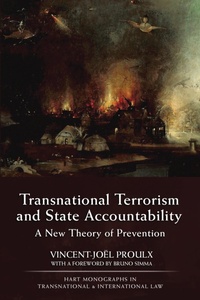
Transnational Terrorism and State Accountability
A New Theory of Prevention
1st Edition
Published on 5. November 2012
Book
Hardback
378 pages
978-1-84946-285-3 (ISBN)
Description
Every State has an obligation to prevent terrorist attacks emanating from its territory. This proposition stems from various multilateral agreements and UN Security Council resolutions. This study exhaustively addresses the scope of this obligation of prevention and the legal consequences flowing from its violation, so as to provide greater clarity on governments' counterterrorism duties and to enhance State accountability for preventable wrongs. It defines the contents and contours of the obligation while placing critical emphasis on the mechanics of State responsibility. Whether obscured by new technologies like the Internet, the sophisticated cellular structure of some terrorist organisations or convoluted political realities, the level of governmental involvement in terrorist activities is no longer readily discernible in every instance. Furthermore, the prospect of governments waging surrogate warfare through proxies also poses intractable challenges to the mechanism of attribution in the context of State responsibility.
This monograph sets out the shortcomings of the extant scheme of State responsibility while identifying a paradigm shift towards more indirect modes of accountability under international law, a trend corroborated by recent State and institutional practice. Drawing on varied legal and theoretical influences, the study devises and prescriptively argues for the implementation of a strict liability-inspired model grounded in the logic of indirect responsibility with a view to enhancing State compliance with counterterrorism obligations. This shifts the policy focus squarely to prevention, while promoting multilateralism and transnational cooperation. Ultimately, the legal and policy sensibilities underlying the book converge into a new theory of prevention in counterterrorism contexts.
From the Foreword by Judge Bruno Simma, International Court of Justice
"Even if one might disagree with the bases on which the author constructs his argument, the execution of the argument is solid and thorough. The coverage of the major policy arguments and the available legal source materials is equally impressive. Moreover, the author's positions are genuinely progressive and present a fairly innovative solution, in the form of a strict liability mechanism...It behoves all scholars and practitioners of international law with an interest in combating international terrorism to consider the proposals outlined in this book."
Transnational Terrorism and State Accountability by Vincent-Joel Proulx has been awarded the 2014 Myres McDougal Prize for best book in Law, Science, and Policy from the Society of Policy Scientists.
This monograph sets out the shortcomings of the extant scheme of State responsibility while identifying a paradigm shift towards more indirect modes of accountability under international law, a trend corroborated by recent State and institutional practice. Drawing on varied legal and theoretical influences, the study devises and prescriptively argues for the implementation of a strict liability-inspired model grounded in the logic of indirect responsibility with a view to enhancing State compliance with counterterrorism obligations. This shifts the policy focus squarely to prevention, while promoting multilateralism and transnational cooperation. Ultimately, the legal and policy sensibilities underlying the book converge into a new theory of prevention in counterterrorism contexts.
From the Foreword by Judge Bruno Simma, International Court of Justice
"Even if one might disagree with the bases on which the author constructs his argument, the execution of the argument is solid and thorough. The coverage of the major policy arguments and the available legal source materials is equally impressive. Moreover, the author's positions are genuinely progressive and present a fairly innovative solution, in the form of a strict liability mechanism...It behoves all scholars and practitioners of international law with an interest in combating international terrorism to consider the proposals outlined in this book."
Transnational Terrorism and State Accountability by Vincent-Joel Proulx has been awarded the 2014 Myres McDougal Prize for best book in Law, Science, and Policy from the Society of Policy Scientists.
Reviews / Votes
Thorough, well-researched and cogent, Vincent-Joel Proulx makes a compelling case for applying a strict-liability standard that would require states to respond to terrorist activities. -- Kienan D. Christianson * ASIL Cables Website * Cette these, particulierement convaincante et bien defendue, est construite de maniere lineaire et logique ... Tout au long de l'ouvrage, Proulx a su defendre de maniere solide et coherente son modele de responsabilite indirecte, qui constitue une nouvelle approche fort interessante au probleme de plus en plus complexe que pose la lutte contre le terrorisme moderne en droit international. La bibliographie de cet ouvrage est d'autant plus impressionnante ... C'est ainsi que Proulx nous offre un point de vue enrichissant et eclairant sur le probleme du terrorisme moderne a l'egard du droit international. -- Vincent Lanctot-Fortier * Revue quebecoise de droit international * ... the original conceptual perspective adopted by Vincent-Joel Proulx in his recent monograph Transnational Terrorism and State Accountability: A New Theory of Prevention, coupled with impressively rich research and sharp legal analysis, constitutes a significant contribution to the field. What Proulx offers in the nearly 350 pages of his fascinating monograph is no less than a radical but delicate re-conceptualization of the fundamentals of the law of state responsibility in order to better accommodate the complex, multi-faceted, and grave threat that terrorism currently poses to the international community ... Proulx's book is beyond any doubt an avant-garde reading of the law of state responsibility. Transnational Terrorism and State Accountability: A New Theory of Prevention is a remarkable intellectual exercise, rich in both extensive factual coverage and legal analysis. It is to be recommended to anyone with an interest in the role of international law in a constantly changing international universe, the interplay between new actors and phenomena, and the challenges they pose for traditional legal rules and conceptual paradigms. -- Michail Risvas * The Canadian Yearbook of International Law * This work is a noteworthy contribution to the existing literature mainly through its proposal for a "strict-liability infused model" in connection with states' indirect responsibility for failing to abide by their counter-terrorism obligations ... Transnational Terrorism and State Accountability: A New Theory of Prevention is a remarkably ambitious work that is both meticulous in its research in many aspects and engages to a large extent with both the legal and policy issues involved in its arguments. Any issue that one may take with the book should not detract from the overall progressive nature of its central propositions, which can only trigger further discussion and debate. Such contributions to tackling enormously complex issues such as preventing transnational terrorism should be welcomed and the current reviewer would encourage academics of various disciplines, practitioners and, perhaps most importantly of all, policy makers, to engage with these particular ones. -- Christian Henderson * Cambridge Law Journal *More details
Series
Language
English
Place of publication
Oxford
United Kingdom
Publishing group
Bloomsbury Publishing PLC
Target group
Professional and scholarly
Dimensions
Height: 240 mm
Width: 161 mm
Thickness: 25 mm
Weight
734 gr
ISBN-13
978-1-84946-285-3 (9781849462853)
Copyright in bibliographic data and cover images is held by Nielsen Book Services Limited or by the publishers or by their respective licensors: all rights reserved.
Schweitzer Classification
Other editions
Additional editions
E-Book
11/2012
1st Edition
Hart Publishing
€155.99
Available for download
E-Book
11/2012
1st Edition
Hart Publishing
€155.99
Available for download
Persons
Vincent-Joel Proulx is Assistant Professor at the National University of Singapore's Faculty of Law and a Barrister and Solicitor of the Ontario Bar. Previously, he served a three-year term as Special Assistant of the President of the International Court of Justice.
Content
Introduction
I. Introductory Remarks
II. Overview of Research
Part I - The International Response to 9/11 and Its Impact on the Law of State Responsibility
Chapter 1: State Responsibility, Terrorism and International Law
I. General Remarks: State Responsibility as a Complementary Solution
II. Emergence of the Obligation of Prevention
III. Counterterrorism Obligations after 9/11 and the Primary/Secondary Divide
IV. The Shortcomings of State Responsibility Vis-a-vis Terrorism
VI. Policy Relevance
Chapter 2: The Impact of 9/11 on International Law and Beyond
I. General Remarks
II. Direct Versus Indirect Responsibility
III. The Concept of Attribution
IV. A Paradigm Shift: Towards a Law of Indirect Responsibility
V. The Security Council's Posture Before and After 9/11
CONCLUSION TO PART I
Part II - Rethinking State Responsibility After 9/11: Defining the Scope of States' Counterterrorism Obligations and Implementing a Model to Ensure Compliance with Those Obligations
Introduction
Chapter 3: Unity Through Vagueness: The Challenges of Devising General Rules of Responsibility
I. Introduction
II. Alternative Response: Causation
III. Developing Guidelines and General Principles for Fact-Intensive, Fact-Specific Phenomena
IV. Doing Away with Attribution: Towards a Model of Strict Liability?
V. Conclusion
Chapter 4: Rethinking the Rationale Underlying State Responsibility for Terrorism: Trans-substantive Rules, Domestic Analogies and the Rationalist Agenda
I. Introduction
II. Revisiting Trans-substantive Rules
III. The Temporal Element of the Breach of an International Obligation
IV. Drawing on Legal Traditions and Domestic Law Analogies to Inform the Law of State Responsibility
V. Mitigating Tensions: Implementing a Model Inspired by Strict Liability
VI. Conclusion: Consolidating Rationalist Theories and State Responsibility
Chapter 5: Implementing a Two-tiered Strict Liability-infused Model
I. Introduction
II. A Two-tiered Strict Liability Mechanism
III. Other Advantages of a Strict Liability Model
IV. Content of the Obligation of Prevention
V. Conclusion: A Partial Politico-Legal Solution Lying at the Heart of International Law
CONCLUSION TO PART II
I. Introductory Remarks
II. Overview of Research
Part I - The International Response to 9/11 and Its Impact on the Law of State Responsibility
Chapter 1: State Responsibility, Terrorism and International Law
I. General Remarks: State Responsibility as a Complementary Solution
II. Emergence of the Obligation of Prevention
III. Counterterrorism Obligations after 9/11 and the Primary/Secondary Divide
IV. The Shortcomings of State Responsibility Vis-a-vis Terrorism
VI. Policy Relevance
Chapter 2: The Impact of 9/11 on International Law and Beyond
I. General Remarks
II. Direct Versus Indirect Responsibility
III. The Concept of Attribution
IV. A Paradigm Shift: Towards a Law of Indirect Responsibility
V. The Security Council's Posture Before and After 9/11
CONCLUSION TO PART I
Part II - Rethinking State Responsibility After 9/11: Defining the Scope of States' Counterterrorism Obligations and Implementing a Model to Ensure Compliance with Those Obligations
Introduction
Chapter 3: Unity Through Vagueness: The Challenges of Devising General Rules of Responsibility
I. Introduction
II. Alternative Response: Causation
III. Developing Guidelines and General Principles for Fact-Intensive, Fact-Specific Phenomena
IV. Doing Away with Attribution: Towards a Model of Strict Liability?
V. Conclusion
Chapter 4: Rethinking the Rationale Underlying State Responsibility for Terrorism: Trans-substantive Rules, Domestic Analogies and the Rationalist Agenda
I. Introduction
II. Revisiting Trans-substantive Rules
III. The Temporal Element of the Breach of an International Obligation
IV. Drawing on Legal Traditions and Domestic Law Analogies to Inform the Law of State Responsibility
V. Mitigating Tensions: Implementing a Model Inspired by Strict Liability
VI. Conclusion: Consolidating Rationalist Theories and State Responsibility
Chapter 5: Implementing a Two-tiered Strict Liability-infused Model
I. Introduction
II. A Two-tiered Strict Liability Mechanism
III. Other Advantages of a Strict Liability Model
IV. Content of the Obligation of Prevention
V. Conclusion: A Partial Politico-Legal Solution Lying at the Heart of International Law
CONCLUSION TO PART II