

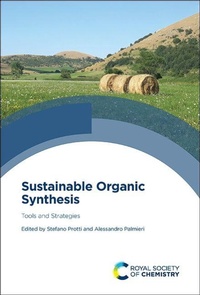
Sustainable Organic Synthesis
Tools and Strategies
Published on 29. October 2021
Book
Hardback
602 pages
978-1-83916-203-9 (ISBN)
Description
Recent years have seen huge growth in the area of sustainable chemistry. In order to meet the chemical needs of the global population whilst minimising impacts on health and the environment it is essential to keep reconsidering and improving synthetic processes.
Sustainable Organic Synthesis is a comprehensive collection of contributions, provided by specialists in Green Chemistry, covering topics ranging from catalytic approaches to benign and alternative reaction media, and innovative and more efficient technologies.
Sustainable Organic Synthesis is a comprehensive collection of contributions, provided by specialists in Green Chemistry, covering topics ranging from catalytic approaches to benign and alternative reaction media, and innovative and more efficient technologies.
More details
Language
English
Place of publication
Cambridge
United Kingdom
Target group
College/higher education
Product notice
Unsewn / adhesive bound
Dimensions
Height: 236 mm
Width: 158 mm
Thickness: 36 mm
Weight
1270 gr
ISBN-13
978-1-83916-203-9 (9781839162039)
DOI
10.1039/9781839164842
Copyright in bibliographic data and cover images is held by Nielsen Book Services Limited or by the publishers or by their respective licensors: all rights reserved.
Schweitzer Classification
Other editions
Additional editions
E-Book
10/2021
1st Edition
Royal Society of Chemistry
€172.99
Available for download
E-Book
10/2021
1st Edition
Royal Society of Chemistry
€172.99
Available for download
Persons
Stefano Protti obtained the Master's degree in 2003 (110/110 cum laude). In 2007, he completed his PhD in Pavia focusing on photochemical arylations via phenyl cations. Later he moved to LASIR Laboratory (Lille, France), where he investigated the photoreactivity and the photophysics of flavonoids. He came back to Pavia and started working in the field of (photo)green synthetic chemistry. After a postdoctoral stay at the iBitTec-S laboratory (CEA Saclay, France) carrying out studies on photocatalyzed oxidation reactions for energy storage, he moved again to Pavia. Since 2018 is Associate Professor at the University of Pavia, Italy. He is currently editor of the Specialist Periodical Reports in Photochemistry of the Royal Society of Chemistry, member of the Early Career Board of the ACS Sustainable Chemistry and Engineering and of the International Advisory Board of the European Journal of Organic Chemistry. The research activity of Stefano Protti has been mainly focused on the development of new synthetic methods for the light driven formation of C-C and C-heteroatom bonds under metal free conditions.
Alessandro Palmieri. Alessandro Palmieri obtained his Laurea degree cum laude in Chemistry in 2002 at the University of Camerino (Italy) where, five years later, he received the PhD degree in Chemical Sciences. Then, in the period 2007-2010 he held a postdoctoral fellowship and in 2008 he moved, as visiting postdoctoral fellow, to the ITC laboratory at the University of Cambridge (Prof. Steven V. Ley). After the experience as assistant professor (2010-2013), in 2014 he was appointed associate professor in Organic Chemistry at the University of Camerino. Currently, his research interests involve (i) the chemistry of aliphatic nitro compounds, (ii) the realization of new one-pot protocols for generating and derivatizing heterocyclic systems, (iii) the preparation and use of solid supported reagents, and (iv) the development of new sustainable processes and (v) flow chemical protocols.
Alessandro Palmieri. Alessandro Palmieri obtained his Laurea degree cum laude in Chemistry in 2002 at the University of Camerino (Italy) where, five years later, he received the PhD degree in Chemical Sciences. Then, in the period 2007-2010 he held a postdoctoral fellowship and in 2008 he moved, as visiting postdoctoral fellow, to the ITC laboratory at the University of Cambridge (Prof. Steven V. Ley). After the experience as assistant professor (2010-2013), in 2014 he was appointed associate professor in Organic Chemistry at the University of Camerino. Currently, his research interests involve (i) the chemistry of aliphatic nitro compounds, (ii) the realization of new one-pot protocols for generating and derivatizing heterocyclic systems, (iii) the preparation and use of solid supported reagents, and (iv) the development of new sustainable processes and (v) flow chemical protocols.
Content
Assessing the Sustainability of Syntheses of the Anti-tuberculosis Pharmaceutical Pretomanid by Green Metrics;
Homogeneous Catalysis;
Heterogeneous Catalysis;
Biocatalysis, an Introduction. Exploiting Enzymes as Green Catalysts in the Synthesis of Chemicals and Drugs;
Activation of Chemical Substrates Under Sustainable Conditions: Electrochemistry and Electrocatalysis;
Colored Compounds for Eco-sustainable Visibile-light Promoted Syntheses;
Activation of Chemical Substrates Under Sustainable Conditions: Mechanochemistry;
Sustainable Activation of Chemical Substrates Under Sonochemical Conditions;
Biomass-derived Solvents;
Supercritical Solvents;
Challenges of Using Fluorous Solvents for Greener Organic Synthesis;
Ionic Liquids and Deep Eutectic Solvents;
Environmentally Benign Media: Water, AOS, and Water/Organic Solvent Azeotropic Mixtures;
Solvent-free Conditions;
Biomass-derived Platform Chemicals;
Sustainable Tools for Flow Chemistry;
Step Economy;
Microwave Irradiation;
Process Intensification: From Green Chemistry to Continuous Processing;
The Contribution of Green Chemistry to Industrial Organic Synthesis
Homogeneous Catalysis;
Heterogeneous Catalysis;
Biocatalysis, an Introduction. Exploiting Enzymes as Green Catalysts in the Synthesis of Chemicals and Drugs;
Activation of Chemical Substrates Under Sustainable Conditions: Electrochemistry and Electrocatalysis;
Colored Compounds for Eco-sustainable Visibile-light Promoted Syntheses;
Activation of Chemical Substrates Under Sustainable Conditions: Mechanochemistry;
Sustainable Activation of Chemical Substrates Under Sonochemical Conditions;
Biomass-derived Solvents;
Supercritical Solvents;
Challenges of Using Fluorous Solvents for Greener Organic Synthesis;
Ionic Liquids and Deep Eutectic Solvents;
Environmentally Benign Media: Water, AOS, and Water/Organic Solvent Azeotropic Mixtures;
Solvent-free Conditions;
Biomass-derived Platform Chemicals;
Sustainable Tools for Flow Chemistry;
Step Economy;
Microwave Irradiation;
Process Intensification: From Green Chemistry to Continuous Processing;
The Contribution of Green Chemistry to Industrial Organic Synthesis