

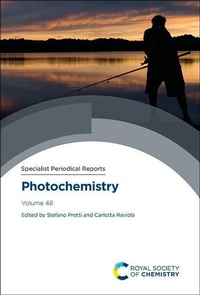
Photochemistry
Volume 48
Published on 18. November 2020
Book
Hardback
496 pages
978-1-83916-140-7 (ISBN)
Description
This volume combines reviews on the latest advances in photochemical research with specific topical highlights in the field. Starting with periodical reports of the recent literature on organic and computational aspects including reports on computational photochemistry and chemiluminescence of biological and nanotechnological molecules, photochemistry of alkenes, dienes and polyenes, aromatic compounds and oxygen-containing functions. The final chapter of this section is a review of industrial application of photochemistry from 2014 to 2019. Coverage continues with highlighted topics, in the second part, from ruthenium-caged bioactive compounds, advances in logically and light induced systems, developments of metal-free photocatalysts, photoresponsive organophosphorus materials and applications of photo-fragmentation in synthesis, photo-click chemistry and azo-based molecular photoswitches.
This volume will again include a section entitled 'SPR Lectures on Photochemistry', a collection of examples for academic readers to introduce a photochemistry topic and precious help for students in photochemistry.
Providing critical analysis of the topics, this book is essential reading for anyone wanting to keep up to date with the literature on photochemistry and its applications.
"A certain amount of energy destroys the same amount of CO2 according to the whether it is administered continuously or intermittently. In order to rationalize this result there are two possibilities, either the destruction of CO2 further occurred in the dark periods, which would lead to the same form of energy storing form, or in the illuminated period the reaction goes at twice the rate."
O. Warburg, Biochem. Z., 1919, 100, 230-270.
This volume will again include a section entitled 'SPR Lectures on Photochemistry', a collection of examples for academic readers to introduce a photochemistry topic and precious help for students in photochemistry.
Providing critical analysis of the topics, this book is essential reading for anyone wanting to keep up to date with the literature on photochemistry and its applications.
"A certain amount of energy destroys the same amount of CO2 according to the whether it is administered continuously or intermittently. In order to rationalize this result there are two possibilities, either the destruction of CO2 further occurred in the dark periods, which would lead to the same form of energy storing form, or in the illuminated period the reaction goes at twice the rate."
O. Warburg, Biochem. Z., 1919, 100, 230-270.
More details
Series
Language
English
Place of publication
Cambridge
United Kingdom
Target group
Professional and scholarly
Product notice
Unsewn / adhesive bound
Dimensions
Height: 234 mm
Width: 156 mm
Thickness: 28 mm
Weight
904 gr
ISBN-13
978-1-83916-140-7 (9781839161407)
DOI
10.1039/9781839162114
Copyright in bibliographic data and cover images is held by Nielsen Book Services Limited or by the publishers or by their respective licensors: all rights reserved.
Schweitzer Classification
Other editions
Additional editions
E-Book
11/2020
1st Edition
Royal Society of Chemistry
€432.99
Available for download
E-Book
11/2020
1st Edition
Royal Society of Chemistry
€432.99
Available for download
Persons
Stefano Protti obtained the Master's degree in 2003 (110/110 cum laude). In 2007, he completed his PhD in Pavia focusing on photochemical arylations via phenyl cations. Later he moved to LASIR Laboratory (Lille, France), where he investigated the photoreactivity and the photophysics of flavonoids. He came back to Pavia and started working in the field of (photo)green synthetic chemistry. After a postdoctoral stay at the iBitTec-S laboratory (CEA Saclay, France) carrying out studies on photocatalyzed oxidation reactions for energy storage, he moved again to Pavia. Since 2018 is Associate Professor at the University of Pavia, Italy. He is currently editor of the Specialist Periodical Reports in Photochemistry of the Royal Society of Chemistry, member of the Early Career Board of the ACS Sustainable Chemistry and Engineering and of the International Advisory Board of the European Journal of Organic Chemistry. The research activity of Stefano Protti has been mainly focused on the development of new synthetic methods for the light driven formation of C-C and C-heteroatom bonds under metal free conditions.
Content
Introduction of the Year 2019;
Photochemistry, Chemiluminescence and Dark Photochemistry: Computational Advances (2018-2019);
Organic aspects: Photochemistry of Alkenes, Dienes, Polyenes (2018-2019);
Photochemistry of Aromatic Compounds;
Oxygen-Containing Chromophores;
Organic Aspects: function containing a Heteroatom different from Oxygen (2018-2019);
Photo-rearrangement Reactions with application in Organic Synthesis (2015- 2019);
Recent Applications of Photochemistry on large-scale synthesis (2015-2019);
Recent Advances in Light-triggered Logic Devices;
(Hetero)aryl azoswitches and their Application;
Photoresponsive Organophosphorus Materials based on six- and seven-membered Phosphorus Heterocycles;
Photooxidative Vulnerability to Intralipid in Photodynamic Therapy;
Spectroscopy and photochemistry of organic compounds in ice;
Recent Advances in Fluorescence Sensing
Photochemistry, Chemiluminescence and Dark Photochemistry: Computational Advances (2018-2019);
Organic aspects: Photochemistry of Alkenes, Dienes, Polyenes (2018-2019);
Photochemistry of Aromatic Compounds;
Oxygen-Containing Chromophores;
Organic Aspects: function containing a Heteroatom different from Oxygen (2018-2019);
Photo-rearrangement Reactions with application in Organic Synthesis (2015- 2019);
Recent Applications of Photochemistry on large-scale synthesis (2015-2019);
Recent Advances in Light-triggered Logic Devices;
(Hetero)aryl azoswitches and their Application;
Photoresponsive Organophosphorus Materials based on six- and seven-membered Phosphorus Heterocycles;
Photooxidative Vulnerability to Intralipid in Photodynamic Therapy;
Spectroscopy and photochemistry of organic compounds in ice;
Recent Advances in Fluorescence Sensing