

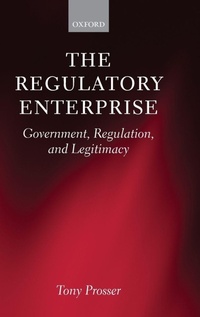
The Regulatory Enterprise
Government, Regulation, and Legitimacy
1st Edition
Published on 10. June 2010
Book
Hardback
272 pages
978-0-19-957983-9 (ISBN)
Description
Tony Prosser examines a range of different British regulatory bodies, including the Human Fertilisation and Embryology Authority, the Food Standards Agency, the Environment Agency, the Health and Safety Executive, the regulators for health and social care, and the utility regulators covering communications, energy, rail, and water. He emphasizes that no regulator works in isolation but is part of a complex network of different institutions, including central government departments and European institutions. Effective regulatory accountability requires that the relations between the different bodies are clear and transparent, and the book assesses the extent to which this is achieved in practice.
Prosser also highlights the range of tasks which regulators perform. Many regulators are responsible for economic regulation aimed at increasing efficiency and promoting consumer choice, but they also have other roles, notably protecting human rights, promoting social solidarity and social inclusion, and providing a forum for deliberation and learning through listening to different interests. The different legal duties of regulators, and their operation in practice, are examined in relation to each of these roles, with an emphasis on how regulators ought to decide and how they can be held accountable for their decisions.
Finally, the book looks at how regulators themselves are regulated as part of the 'better regulation' initiative, it examines attempts to reduce regulatory burdens and to improve regulatory procedures, for example through the use of regulatory impact analysis. It also features comparative analysis of experience from France and the USA.
Prosser also highlights the range of tasks which regulators perform. Many regulators are responsible for economic regulation aimed at increasing efficiency and promoting consumer choice, but they also have other roles, notably protecting human rights, promoting social solidarity and social inclusion, and providing a forum for deliberation and learning through listening to different interests. The different legal duties of regulators, and their operation in practice, are examined in relation to each of these roles, with an emphasis on how regulators ought to decide and how they can be held accountable for their decisions.
Finally, the book looks at how regulators themselves are regulated as part of the 'better regulation' initiative, it examines attempts to reduce regulatory burdens and to improve regulatory procedures, for example through the use of regulatory impact analysis. It also features comparative analysis of experience from France and the USA.
More details
Language
English
Place of publication
Oxford
United Kingdom
Target group
College/higher education
Professional and scholarly
Scholars and advanced students, lawyers, political scientists and economists interested in public law and regulatory bodies, European studies and economics.
Dimensions
Height: 240 mm
Width: 161 mm
Thickness: 19 mm
Weight
558 gr
ISBN-13
978-0-19-957983-9 (9780199579839)
Copyright in bibliographic data and cover images is held by Nielsen Book Services Limited or by the publishers or by their respective licensors: all rights reserved.
Schweitzer Classification
Person
Tony Prosser is the Professor of Public Law at the University of Bristol and Visiting Professor at the College of Europe in Bruges. He was previously John Millar Professor of Law at the University of Glasgow and has also taught at the University of Sheffield and the European University Institute, Florence. He has written over 100 academic articles and is the author or editor of eleven books, including The Limits of Competition Law (OUP, 2005) and Law and the Regulators (OUP, 1997).
Content
1. Introduction: Two Visions of Regulation and Four Regulatory Models ; 2. The Human Fertilisation and Embryology Authority ; 3. The Food Standards Agency ; 4. The Environment Agency ; 5. The Health and Safety Executive ; 6. The Care Quality Commission and its Predecessors ; 7. Monitor, the Independent Regulator of NHS Foundation Trusts ; 8. The Office of Communications ; 9. The Utility Regulators: The Office of Gas and Electricity Markets, the Water Services Regulation Authority, and the Office of Rail Regulation ; 10. Regulating the Regulators ; 11. Comparisons and Conclusions