

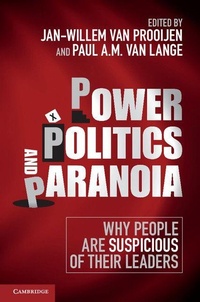
Power, Politics, and Paranoia
Why People are Suspicious of their Leaders
Published on 29. May 2014
Book
Hardback
340 pages
978-1-107-03580-5 (ISBN)
Description
Powerful societal leaders - such as politicians and Chief Executives - are frequently met with substantial distrust by the public. But why are people so suspicious of their leaders? One possibility is that 'power corrupts', and therefore people are right in their reservations. Indeed, there are numerous examples of unethical leadership, even at the highest level, as the Watergate and Enron scandals clearly illustrate. Another possibility is that people are unjustifiably paranoid, as underscored by some of the rather far-fetched conspiracy theories that are endorsed by a surprisingly large portion of citizens. Are societal power holders more likely than the average citizen to display unethical behaviour? How do people generally think and feel about politicians? How do paranoia and conspiracy beliefs about societal power holders originate? In this book, prominent scholars address these intriguing questions and illuminate the many facets of the relations between power, politics and paranoia.
Reviews / Votes
'Van Prooijen and van Lange have done an excellent job by bringing together a range of exciting chapters illustrating the dramatic influence that the behaviors and power of our leaders can have on our perceptions, beliefs and expectations.' David De Cremer, China Europe International Business School and London Business School 'Thoughtful insights and eye-opening data fill this terrific volume ... a must-read book for anyone interested in political leadership, the effects of power and how modern citizens should regard their politicians.' Roy F. Baumeister, Florida State University, author of Willpower: Rediscovering the Greatest Human Strength 'Power, Politics, and Paranoia does the discipline a valuable service by bringing ... these three research literatures together ... This volume is an important illustration of how power and paranoia are not simple reflections of individuals' psychological characteristics, but are informed by their position within groups and their group's position within the larger society.' Heather J. Smith and Stephanie McKee, Social Justice ResearchMore details
Language
English
Place of publication
Cambridge
United Kingdom
Target group
Professional and scholarly
Illustrations
8 Tables, black and white; 3 Halftones, black and white; 24 Line drawings, black and white
Dimensions
Height: 235 mm
Width: 157 mm
Thickness: 23 mm
Weight
644 gr
ISBN-13
978-1-107-03580-5 (9781107035805)
Copyright in bibliographic data and cover images is held by Nielsen Book Services Limited or by the publishers or by their respective licensors: all rights reserved.
Schweitzer Classification
Other editions
Additional editions
Jan-Willem Van Prooijen | Paul A. M. Van Lange
Power, Politics, and Paranoia
Why People are Suspicious of their Leaders
Book
09/2016
Cambridge University Press
€49.40
Shipment within 15-20 days
E-Book
05/2014
Cambridge University Press
€24.49
Available for download
Jan-Willem Van Prooijen | Paul A. M. Van Lange
Power, Politics, and Paranoia
Why People are Suspicious of their Leaders
E-Book
04/2014
1st Edition
Cambridge University Press
€29.49
Available for download
Persons
Jan-Willem van Prooijen is an Associate Professor in the Department of Social and Organizational Psychology at VU University Amsterdam, and Senior Researcher, Netherlands Institute for the Study of Crime and Law Enforcement (NSCR). Paul A. M. van Lange is a Professor and Department Chair in the Department of Social and Organizational Psychology at VU University Amsterdam.
Content
1. Power, politics, and paranoia: an introduction Jan-Willem van Prooijen and Paul A. M. van Lange; Part I. Power: 2. The effects of power on immorality Joris Lammers and Ilja van Beest; 3. Do we give power to the right people? When and how norm violators rise to the top Eftychia Stamkou and Gerben van Kleef; 4. The leaders' rosy halo: why do we give powerholders the benefit of the doubt? Pamela K. Smith and Jennifer R. Overbeck; 5. 'Power corrupts' revisited: the role of construal of power as opportunity or responsibility Kai Sassenberg, Naomi Ellemers, Daan Scheepers and Annika Scholl; Part II. Politics: 6. Never trust a politician? Collective distrust, relational accountability, and voter response Susan T. Fiske and Federica Durante; 7. Political distrust: the seed and fruit of popular empowerment Fouad Bou Zeineddine and Felicia Pratto; 8. All power to our great leader: political leadership under uncertainty John J. Haller and Michael A. Hogg; 9. Those who supported and voted for Berlusconi. A social-psychological profile of the willing followers of a controversial political leader Antonio Chirumbolo and Luigi Leone; 10. A growing confidence gap in politics? Data versus discourse Rudy B. Andeweg; Part III. Paranoia: 11. Misconnecting the dots: origins and dynamics of outgroup paranoia Roderick M. Kramer and Jennifer Schaffer; 12. Political paranoia and conspiracy theories Viren Swami and Adrian Furnham; 13. The social dimension of belief in conspiracy theories Jan-Willem van Prooijen and Paul A. M. van Lange; 14. Examining the monological nature of conspiracy theories Robbie M. Sutton and Karen M. Douglas; 15. The role of paranoia in a dual-process motivational model of conspiracy belief Marc Wilson and Chelsea Rose; 16. Searching for the root of all evil: an existential-sociological perspective on political enemyship and scapegoating Daniel Sullivan, Mark J. Landau, Zachary K. Rothschild and Lucas A. Keefer.