

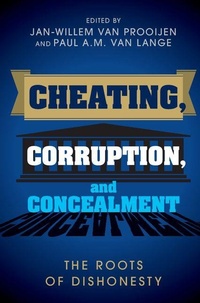
Cheating, Corruption, and Concealment
The Roots of Dishonesty
Published on 30. June 2016
Book
Hardback
330 pages
978-1-107-10539-3 (ISBN)
Description
Dishonesty is ubiquitous in our world. The news is frequently filled with high-profile cases of corporate fraud, large-scale corruption, lying politicians, and the hypocrisy of public figures. On a smaller scale, ordinary people often cheat, lie, misreport their taxes, and mislead others in their daily life. Despite such prevalence of cheating, corruption, and concealment, people typically consider themselves to be honest, and often believe themselves to be more moral than most others. This book aims to resolve this paradox by addressing the question of why people are dishonest all too often. What motivates dishonesty, and how are people able to perceive themselves as moral despite their dishonest behaviour? What personality and interpersonal factors make dishonesty more likely? And what can be done to recognise and reduce dishonesty? This is a fascinating overview of state-of-the-art research on dishonesty, with prominent scholars offering their views to clarify the roots of dishonesty.
More details
Language
English
Place of publication
Cambridge
United Kingdom
Target group
Professional and scholarly
Illustrations
6 Tables, black and white; 1 Halftones, black and white; 2 Line drawings, black and white
Dimensions
Height: 235 mm
Width: 157 mm
Thickness: 22 mm
Weight
630 gr
ISBN-13
978-1-107-10539-3 (9781107105393)
Copyright in bibliographic data and cover images is held by Nielsen Book Services Limited or by the publishers or by their respective licensors: all rights reserved.
Schweitzer Classification
Other editions
Additional editions
Jan-Willem Van Prooijen | Paul A. M. Van Lange
Cheating, Corruption, and Concealment
The Roots of Dishonesty
Book
04/2018
Cambridge University Press
€44.00
Shipment within 15-20 days
E-Book
06/2016
Cambridge University Press
€24.49
Available for download
Jan-Willem Van Prooijen | Paul A. M. Van Lange
Cheating, Corruption, and Concealment
The Roots of Dishonesty
E-Book
05/2016
Cambridge University Press
€29.49
Available for download
Persons
Jan-Willem van Prooijen is an Associate Professor in the Department of Social and Organizational Psychology at VU University Amsterdam, and a Senior Researcher at the Netherlands Institute for the Study of Crime and Law Enforcement (NSCR). Paul A. M. van Lange is Professor of Psychology at VU University Amsterdam and a Distinguished Research Fellow at the University of Oxford.
Content
1. Cheating, corruption, and concealment: an introduction to dishonesty Jan-Willem van Prooijen and Paul A. M. van Lange; Part I. Motivations for Dishonesty: 2. Moral motivation: a closer look C. Daniel Batson; 3. Beyond 'being good frees us to be bad': moral self-licensing and the fabrication of moral credentials Daniel A. Effron; 4. Deception as a means to an end: an instrumental approach Wolfgang Steinel, Lukas Koning, Eric van Dijk and Ilja van Beest; Part II. Justifying Dishonesty: 5. How moral flexibility constrains our moral compass Francesca Gino; 6. Always the hero to ourselves: the role of self-deception in unethical behaviour Celia Moore; 7. Not for my sake: preventing others from using potential beneficiaries' benefits as justifications for dishonesty Scott S. Wiltermuth and Medha Raj; 8. Corrupt collaboration: a behavioral ethics approach Shaul Shalvi, Ori Weisel, Sys Kochavi-Gamliel and Margarita Leib; Part III. Influences on Dishonesty: 9. Narcissism and dishonesty: the SAC model W. Keith Campbell and Lane Siedor; 10. When being creative frees us to be bad: linking creativity with moral licensing Lynne C. Vincent and Evan Polman; 11. Wealth and wrongdoing: social class differences in ethical reasoning and behavior Paul K. Piff, Daniel M. Stancato and E. J. Horberg; 12. Power, dishonesty, and justice Steven L. Blader and Andy J. Yap; Part IV. Reducing Dishonesty: 13. Religion, deception, and self-deception Stephanie R. Kramer and Azim F. Shariff; 14. The ergonomics of ethics Andy J. Yap; 15. When opposition is beneficial: the case of productive disobedience Piero Bocchiaro; 16. A cognitive approach to elicit verbal and nonverbal cues to deceit Aldert Vrij, Ronald P. Fisher, Hartmut Blank, Sharon Leal and Samantha Mann.