

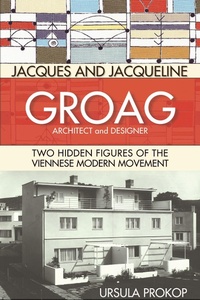
Jacques and Jacqueline Groag, Architect and Designer
Two Hidden Figures of the Viennese Modern Movement
Will be published approx. on 15. August 2019
Book
Hardback
272 pages
978-0-9997544-3-6 (ISBN)
Description
Prokop's meticulous history restores Jacques and Jacqueline Groag to their rightful places in the pantheon of Viennese Modernists.
Prokop explores their individual careers in Vienna and Czechoslovakia, their early collaborations in the 1930s, their lives as Jewish emigres, and the couple's unique contributions in Britain for postwar exhibitions, monuments, furniture and textile design, even a dress for future-queen Elizabeth II. Full color edition, supported by a grant from the Graham Foundation for Advanced Studies in the Fine Arts.
Prokop explores their individual careers in Vienna and Czechoslovakia, their early collaborations in the 1930s, their lives as Jewish emigres, and the couple's unique contributions in Britain for postwar exhibitions, monuments, furniture and textile design, even a dress for future-queen Elizabeth II. Full color edition, supported by a grant from the Graham Foundation for Advanced Studies in the Fine Arts.
Reviews / Votes
The houses of Groag with the beautiful terraces impress because of their clever balance. They radiate comfort.-Neue Freie Presse Among the buildings of the Werkbundsiedlung of 1932, the elegant house by architect Jacques Groag stood out in a positive way. Clever spatial economy succeeded in arranging the rooms so that they do not appear to be small and confined as is the case in one or the other home of the settlement, but spacious and airy. The sensation of the control of space and the strong impression of the room clearly marked the architect as a protege of Adolf Loos. Jacques Groag belongs to the younger Viennese architects whose style stands out because of its ingenious elegance and lightness.
- OEsterreichische Kunst (Austrian Art) The Festival of Britain, the third and much the largest of the post-war design bonanzas is now regarded mainly as the start of the mass-public acceptance of the 'modern' design and architecture. ... It opened up the possibilities inherent in designing and influenced the whole development of the modern multi-disciplinary design office. The Festival was British, extravagantly so, ... but it is ironic that many of the main designers of the Festival in the post-war periods had in fact arrived from abroad: Stefan Buzas, Jacques and Jacqueline Groag. ...Where would British design have been without this foreign input?
- Fiona McCarthy/Patrick Nugents, Eye for Industry, Royal Designers 1936-1986 Jacques Groag?s living spaces exhibit an attitude that abstains from exaggerated "sober" motifs. Next to the purist cheerfulness that is at play, imagination rules, as well as delicate proportions, which are a mental rather than utilitarian matter. This architect has created living spaces that veritably dissolve in light. There is an impulse to open up walls and to take away their material bodies. The fact that Groag came from painting to architecture is apparent via the pictorial effects; it is obvious that he masters the technicalities. ... Almost all of the rooms share a tendency towards delicate fabric covers that dissolve the boundaries of the rooms, a preference for natural-colored floor mats, and for light colors as such.
- Innendekoration Jacqueline Groag's long life of creativity received its strong foundations from the remarkable period of Viennese Arts and Crafts that - after three generations - we now recognize as the source of much of what European culture has given to the world. As one of the very few pupils of that great teacher, Josef Hoffmann, Jacqueline survived into our time of turbulence and uncertainty to make us understand that our lives are of real value only when we live with beauty.
- Stefan Buzas, Eulogy for Jacqueline Groag, January 21, 1986 The fact is, that [Jacques Groag] was, until the Nazis invaded Austria, one of the leading and most successful avant-garde architects in Vienna, where he was for many years engaged on work for important housing projects, public buildings and private houses. ... In Britain in the absence of any architectural work, he was glad to supply himself to utility furniture. When, after the war, building activities were resumed, no one in Britain seemed to be aware any longer of his caliber as an architect, and Groag himself was much too modest a man to claim what, by rights, ought to have been his due.
- Sir Gordon Russell, SIA Journal [Jacqueline Groag lives] in a world of imagination. [...] Starlight, with its interweaving of delicate chains, suggests to me marvellous and mysterious talks under the stars. I cannot remember designs for fabrics affecting me in this way before.
- Charles Reilly, Art and Industry Few designers can move easily from abstract design to the representational and produce equally good work in both disciplines. Jacqueline Groag not only possesses this special gift but also the ability to abstract from life so that reality still exists in many of her patterns, but transformed by the wit and charm of her own personality.
- The Ambassador Her work [...] in the clarity of its line and colour as much as subject-matter, eluded received notions and never lost an element of child-like wonder, of day dreaming.
- Isabelle Anscombe, author of A Woman's Touch [Jacqueline Groag] constantly and ingeniously exploited the decorative possibilities of simple motifs, frequently in highly complex designs.
- House and Garden The art historian Ursula Prokop empathically describes the life of the Groags [...] and characterizes their artistic achievements. The difficulty of finding sources - Groag's buildings have been extensively changed, many of his furniture have been lost or are widely scattered - made the research for the present double biography at first slow and tedious. Nevertheless, the author has managed to convey a multifaceted and vivid picture of [the Groags'] contemporary history, as well as highlighting the influence that the continental avant-garde had on British design of the post-war years and the acceptance of a modern language of form. Thus, the work that emerged in the context of a research project carried out at the University of Vienna is not only a late tribute to the two designers in their old homeland, but also a contribution to the subject of the individual design history that goes beyond individuality.
- Dagmar Steffen, Bauwelt Ursula Prokop offers an extensively researched book on the Viennese architect and designer couple Jacques and Jacqueline Groag that provides new infor-mation and new insight into the lives of two talented artists whose modernist work crossed over political. geographical, and cultural frontiers. [...] The book is a well-documented overview of the couple's lives and works. It introduces biographical material collected and preserved from many different collections, especially those of the two nephews, Mr. Jan Groag in New York and Dr. Willi Groag in Maanit, Israel. [...] This is a pioneering work that rightfully places the artists Jacques and Jacqueline Groag within the field of Viennese Modernism.
- Elana Shapira, Centropa Moving forward in time throughout the book, I couldn't help wonder if the couple would have been remembered - not "largely forgotten" [as the author states] - if they would have emigrated to the United States, where fellow Austrians R.M. Schindler and Richard Neutra went. I imagine the Austrian-Jewish-emigre version of Charles and Ray Eames. [ ... ] With skills in architecture, interior design, textiles, paintings, and other aspects of art and design, the Groags were capable of creating complete environments.
-A Daily Dose of Architecture This July Ursula Prokop's well-researched biography of Groag and his wife Jacqueline was published by DoppelHouse Press, bringing to our attention these two important designers who practiced in Austria, Czechoslovakia, and Britain after World War II. [...] The legacy of Jacques Groag lies in helping make Adolf Loos' and Ludwig Wittgenstein's architectural designs possible, producing his own modernist building designs, furnitures and interiors, and contributing an excellent [duplex] at the Werkbundsiedlung in Vienna. Jacqueline Groag is considered one of the most important British postwar designers. Both Jacques and Jacqueline were essential pieces in the multi-faceted Czech and Slovak tapestry of endeavor to enrich the world of art, design and architecture. - British Czech and Slovak Review A meticulous excavation of the lives of these two seminal figures in the Viennese modern movement, who, if not entirely lost to history, previously were mere peripheral actors. This book, originally published in German in 2005, has altered the terrain: the Groags are now very much present in the consciousness of scholars in the field. They are hidden no more, and their rediscovery has prompted some reassessment of them and their work, but also of the history of Viennese design.-Central European History Journal Ursula Prokop [...] extends her commitment to presenting the interwar environment in Vienna as a leading center of a modern movement wherein Jewish creatives and clients played an important role. ... Prokop has gathered an impressive amount of information and presents a thrilling story of the partially forgotten Groags. (A complete list of the Groags' projects and an accessible bibliography is also useful for resuscitating the pair's design careers.)
- Ladislav Jackson, Design and Culture Journal Between the two world wars, Vienna was a major hub of creative activity, especially in the fields of painting, architecture, and design. [...] In 1938, the Groags, like many of Vienna's Jewish artists and intellectuals who were not sent to concentration camps, were forced into exile by the Nazi regime. This expulsion not only deprived many people of their homes and livelihoods; it also left Austria bereft of a creative energy that had defined a rich, innovative era there. Ursula Prokop's abundantly illustrated double biography brings these little-known figures and their fascinating work to life.
-The Paper Brigade / Jewish Book Council
More details
Language
English
Place of publication
Los Angeles
United States
Product notice
Paper over boards
Illustrations
Color illustrations, Black and white illustrations and photographs
Dimensions
Height: 232 mm
Width: 156 mm
Thickness: 21 mm
Weight
712 gr
ISBN-13
978-0-9997544-3-6 (9780999754436)
Copyright in bibliographic data and cover images is held by Nielsen Book Services Limited or by the publishers or by their respective licensors: all rights reserved.
Schweitzer Classification
Persons
Laura McGuire is Assistant Professor of Architecture at the University of Hawaii's School of Architecture in Manoa. She specializes in early- and mid-century architecture and design history with a combined Ph.D. in those fields from University of Texas, Austin. A Fulbright Scholar in Austria in 2009, she has spent the last decade working on exhibitions, articles, book chapters, and other editorial projects that reflect on Vienna's unique cultural contributions through immigrant and exiled cultural figures, including designer Paul T. Frankl, architect/artist Frederick Kiesler, and philosopher Otto Neurath.
Content
Introduction
The Early Years
The background and education of Jacques Groag
World War I and professional beginnings
The First Projects
Collaboration on the Wittgenstein House, 1926-29
The Moller Villa, 1927-1928
The first independent project: The Groag Villa in Olmuetz, 1927-1928
Vienna?s artistic environment
The Artistic Breakthrough
Projects in Vienna and Moravia - first success as an interior architect
Getting to know Hilde Blumberger
The duplex at the Vienna Werkbundsiedlung, 1931-1932
Furniture and interiors
The Gustav Stern House in Perchtoldsdorf, 1932/33
The Paula and Hans Briess Villa in Olmuetz, 1933
Projects in the Late 1930s
Ing. Rudolf Seidler Villa in Olmuetz, 1935
Conversion and furnishings of the Paula Wessely Villa in Vienna-Grinzing, 1935
Otto Eisler country house in Ostravice, 1935-1939
The late 1930s - various projects in Moravia-Ostrau and Brno
Displacement and intermezzo in Prague, 1938-1939
Emigration and a New Beginning in England
Escape and a difficult start
The end of the war - an urban planning project for Soho, 1945
Jacqueline Groag establishes herself as a textile designer
The emigrants in England - a problematic situation
The Groags After the War - Utility Furniture and Exhibition Design
The utility furniture program - a new arena
The first postwar exhibitions - Modern Homes and Britain Can Make It, 1946
Further exhibitions - Ideal Home, 1949 and British Industries Fair, 1950
The end of the postwar era - The Festival of Britain, 1951
The 1950s - Jacques Groag's interiors and painting as therapy
The late work of Jacqueline Groag
Conclusion
Jacques Groag - Catalog of Works
Architecture, interior design and furniture design
Painting and graphic art
Professional articles and publications
Bibliography
Monographs, catalogs, and articles
Unpublished typescripts and manuscripts
Periodicals - Jacques Groag
Periodicals - Jacqueline Groag
Archives and private sources
The Early Years
The background and education of Jacques Groag
World War I and professional beginnings
The First Projects
Collaboration on the Wittgenstein House, 1926-29
The Moller Villa, 1927-1928
The first independent project: The Groag Villa in Olmuetz, 1927-1928
Vienna?s artistic environment
The Artistic Breakthrough
Projects in Vienna and Moravia - first success as an interior architect
Getting to know Hilde Blumberger
The duplex at the Vienna Werkbundsiedlung, 1931-1932
Furniture and interiors
The Gustav Stern House in Perchtoldsdorf, 1932/33
The Paula and Hans Briess Villa in Olmuetz, 1933
Projects in the Late 1930s
Ing. Rudolf Seidler Villa in Olmuetz, 1935
Conversion and furnishings of the Paula Wessely Villa in Vienna-Grinzing, 1935
Otto Eisler country house in Ostravice, 1935-1939
The late 1930s - various projects in Moravia-Ostrau and Brno
Displacement and intermezzo in Prague, 1938-1939
Emigration and a New Beginning in England
Escape and a difficult start
The end of the war - an urban planning project for Soho, 1945
Jacqueline Groag establishes herself as a textile designer
The emigrants in England - a problematic situation
The Groags After the War - Utility Furniture and Exhibition Design
The utility furniture program - a new arena
The first postwar exhibitions - Modern Homes and Britain Can Make It, 1946
Further exhibitions - Ideal Home, 1949 and British Industries Fair, 1950
The end of the postwar era - The Festival of Britain, 1951
The 1950s - Jacques Groag's interiors and painting as therapy
The late work of Jacqueline Groag
Conclusion
Jacques Groag - Catalog of Works
Architecture, interior design and furniture design
Painting and graphic art
Professional articles and publications
Bibliography
Monographs, catalogs, and articles
Unpublished typescripts and manuscripts
Periodicals - Jacques Groag
Periodicals - Jacqueline Groag
Archives and private sources