

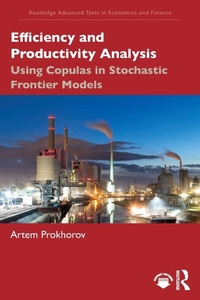
Efficiency and Productivity Analysis
Using Copulas in Stochastic Frontier Models
1st Edition
Published on 28. February 2024
Book
Paperback/Softback
224 pages
978-0-367-34610-2 (ISBN)
Description
This book is an easy-to-understand guide to modeling productivity and efficiency using modern statistical tools. It introduces readers to the fundamentals of stochastic frontier analysis (SFA) and gradually takes them to the forefront of academic research in this area, examining the latest concepts and methods related to the use of copulas in SFA.
Following a comprehensive review of classic methodology, Professor Artem Prokhorov covers topics in panel data modeling, in endogeneity in SFA, in joint modeling of technical and allocative inefficiency, and in optimal and robust prediction of inefficiency scores. This is done using copulas to capture various kinds of statistical dependence that have been previously ignored when modeling production. The classic and advanced topics are illustrated using practical examples and codes written in modern programming languages. As an important example, the book spells out the case where both the values of output and the ratio of inputs used in production are optimized simultaneously. Such simultaneity, if ignored, leads to biased estimates of productivity and returns-to-scale and may understate inefficiency.
The book offers a useful reference for those interested in the newest robust methods of business analytics in the area of productivity and efficiency, with implications for strategy, budgeting, resourcing and benchmarking of firms, industries and production units more generally.
Following a comprehensive review of classic methodology, Professor Artem Prokhorov covers topics in panel data modeling, in endogeneity in SFA, in joint modeling of technical and allocative inefficiency, and in optimal and robust prediction of inefficiency scores. This is done using copulas to capture various kinds of statistical dependence that have been previously ignored when modeling production. The classic and advanced topics are illustrated using practical examples and codes written in modern programming languages. As an important example, the book spells out the case where both the values of output and the ratio of inputs used in production are optimized simultaneously. Such simultaneity, if ignored, leads to biased estimates of productivity and returns-to-scale and may understate inefficiency.
The book offers a useful reference for those interested in the newest robust methods of business analytics in the area of productivity and efficiency, with implications for strategy, budgeting, resourcing and benchmarking of firms, industries and production units more generally.
Reviews / Votes
"Artem Prokhorov has pulled together a comprehensive survey of results for copula methods for Stochastic Frontier models. Many of these are from his own published work. Analysts and practitioners will want to complete their examination with this guide to leading edge extensions and tools for the Stochastic Frontier methodology."William H. Greene, New York University and University of South Florida; Past Editor in Chief, Journal of Productivity Analysis
"Modeling dependence in stochastic frontier models has long been underutilized and misunderstood. This text provides a cutting edge and comprehensive treatment of the subject from the leading expert in this area. Full of examples, intuition and code, this work will move both applied and theoretical researchers closer to the 'frontier'."
Christopher F. Parmeter, Associate Professor, University of Miami, United States
"This is the first, and so far only, book that brings together the approach of statistical copulas and the Stochastic Frontier models, and does so in rigorous way, while also being user-friendly for practitioners, due to the well-designed examples, exercises and programming codes it provides to the readers."
Valentin Zelenyuk, Professor, The University of Queensland, Australia
"This revolutionary book utilizes state-of-the-art copula approaches to precisely model dependency in stochastic frontier models. Through well-crafted chapters, practical examples, and program codes, it provides graduate students, analysts, and practitioners with comprehensive tools to master these advanced techniques. Highly recommend it!"
Kien C. Tran, Professor, University of Lethbridge and Research Affiliate, Center for Econometrics and Business Analytics (CEBA), St. Petersburg State University, Russia
More details
Series
Language
English
Place of publication
London
United Kingdom
Publishing group
Taylor & Francis Ltd
Target group
College/higher education
Postgraduate
Illustrations
22 s/w Abbildungen, 22 s/w Photographien bzw. Rasterbilder, 23 s/w Tabellen
23 Tables, black and white; 22 Halftones, black and white; 22 Illustrations, black and white
Dimensions
Height: 234 mm
Width: 156 mm
Thickness: 13 mm
Weight
380 gr
ISBN-13
978-0-367-34610-2 (9780367346102)
Copyright in bibliographic data and cover images is held by Nielsen Book Services Limited or by the publishers or by their respective licensors: all rights reserved.
Schweitzer Classification
Other editions
Additional editions
E-Book
02/2024
1st Edition
Taylor & Francis
€51.49
Available for download
Book
02/2024
1st Edition
Routledge
€206.40
Shipment within 15-20 days
E-Book
02/2024
1st Edition
Taylor & Francis
€51.49
Available for download
Person
Artem Prokhorov is a Professor at the Business School of the University of Sydney, Australia. He is also a Research Fellow at the Centre Interuniversitaire de Recherche en Economie Quantitative (CIREQ) at the University of Montreal, Canada, and a Co-Founder and Academic Advisor of the Center for Econometrics and Business Analytics (CEBA) at St. Petersburg State University, Russia. Professor Prokhorov is a founding member of the International Society for Efficiency and Productivity Analysis (ISEAPA). He holds a Cand Sci degree from St. Petersburg State University and a PhD degree in Economics from Michigan State University.
Content
1. Introduction 2. Basics of Stochastic Frontier Analysis for Cross-Sectional Data 3. Basics of Stochastic Frontier Analysis for Panel Data 4. Copulas for Panel Stochastic Frontier Models 5. Modeling Endogeneity in Stochastic Frontier Models 6. Modeling Dependence in Production Systems 7. Predicting Inefficiency 8. Concluding Remarks