

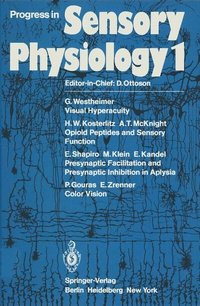
Progress in Sensory Physiology
Springer (Publisher)
Published on 10. December 2011
Book
Paperback/Softback
VII, 182 pages
978-3-642-66746-6 (ISBN)
Description
I fancy that many of you, like myself, have woken up in the night with a "sleeping" arm or leg. It is a very peculiar feeling to have that arm or leg, cold and lifeless, hanging there at your side as if it were something which does not belong to you. In such situations you recover some of the motor functions before the sensory functions, which en ables you to move the limb like a pendulum. For a few sec onds the arm functions as an artificial limb - a prosthesis without sensors. In general we are not aware of the importance of our sensory organs until we lose them. You do not feel the pressure of your clothes on the skin or the ring on your finger. In the nineteenth century such phenomena generally named adaptation, were studied to a great extent, partic ularly in vision, as well as in the so-called lower senses. The question whether sensory adaptation was due to changes in the peripheral sensory receptors or in the central nervous structure remained in general open until the 1920s. Then the development of the electronic arsenal gave us the means to attack the problem by direct observations of the electrical events in the peripheral as well as the central nervous system. But even today there are still some blank areas in our knowledge of adaptation.
More details
Series
Edition
Softcover reprint of the original 1st ed. 1981
Language
English
Place of publication
Berlin
Germany
Publishing group
Springer Berlin
Target group
Professional and scholarly
Research
Illustrations
VII, 182 p.
Dimensions
Height: 24.4 cm
Width: 17 cm
Weight
349 gr
ISBN-13
978-3-642-66746-6 (9783642667466)
DOI
10.1007/978-3-642-66744-2
Schweitzer Classification
Other editions
Additional editions

Book
06/1981
1st Edition
Springer
€128.39
Article exhausted; check different version
Persons
Content
Visual Hyperacuity.- Opioid Peptides and Sensory Function.- Ionic Mechanisms and Behavioral Functions of Presynaptic Facilitation and Presynaptic Inhibition in Aplysia: A Model System for Studying the Modulation of Signal Transmission in Sensory Neurons.- Color Vision: A Review from a Neurophysiological Perspective.