

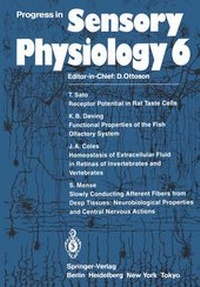
Progress in Sensory Physiology
Springer (Publisher)
1st Edition
Published on 1. December 1985
Book
Hardback
VI, 228 pages
978-3-540-15340-5 (ISBN)
Description
1. Themeanrestingmembranepotentialofrattaste cells is - 36 mVunderadap- tation of the tongue to 41.4 mMNaCI and - 50mV under water adaptation. 2. The shapes ofreceptor potentials ofrattastecells inresponsetothe four basic tastestimuli(0.5MNaCI, 0.02 M Q-HCI, 0.01 MHCl, and0.5 M sucrose)are classified into three types, namely (1) a depolarization alone, (2) a depolariza- tion preceded by a transient hyperpolarization, and (3) a hyperpolarization alone. No regenerative spike potentials are evoked in rat taste cells by chemical stimuli. The amplitude of rat taste cell responses increases with increasing concentrationofthe taste stimulus. Mostofthe rat taste cells show a multiple sensitivity in that single cells respond to various combinations of the four basic taste stimuli with depolarizations or hyperpolarizations. 3. The rise and fall times of depolarizing responses to 0.5 M NaCI are much shorter than those of depolarizing responses to the other three stimuli. The fall time of depolarization evoked by 0.01 M HCI is the longest. The rise and fall times of all hyperpolarizing responses are shorter than those of all de- polarizing responses.
More details
Other editions
Additional editions
Persons
Content
Receptor Potential in Rat Taste Cells.- Functional Properties of the Fish Olfactory System.- Homeostasis of Extracellular Fluid in Retinas of Invertebrates and Vertebrates.- Slowly Conducting Afferent Fibers from Deep Tissues: Neurobiological Properties and Central Nervous Actions.