

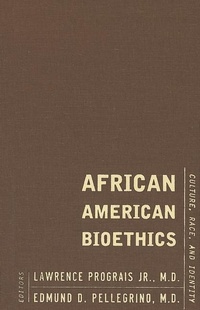
African American Bioethics
Culture, Race, and Identity
Published on 3. May 2007
Book
Hardback
192 pages
978-1-58901-163-2 (ISBN)
Description
Do people of differing ethnicities, cultures, and races view medicine and bioethics differently? And, if they do, should they? Are doctors and researchers taking environmental perspectives into account when dealing with patients? If so, is it done effectively and properly?
In African American Bioethics, Lawrence J. Prograis Jr. and Edmund D. Pellegrino bring together medical practitioners, researchers, and theorists to assess one fundamental question: Is there a distinctive African American bioethics?
The book's contributors resoundingly answer yes-yet their responses vary. They discuss the continuing African American experience with bioethics in the context of religion and tradition, work, health, and U.S. society at large-finding enough commonality to craft a deep and compelling case for locating a black bioethical framework within the broader practice, yet recognizing profound nuances within that framework.
As a more recent addition to the study of bioethics, cultural considerations have been playing catch-up for nearly two decades. African American Bioethics does much to advance the field by exploring how medicine and ethics accommodate differing cultural and racial norms, suggesting profound implications for growing minority groups in the United States.
In African American Bioethics, Lawrence J. Prograis Jr. and Edmund D. Pellegrino bring together medical practitioners, researchers, and theorists to assess one fundamental question: Is there a distinctive African American bioethics?
The book's contributors resoundingly answer yes-yet their responses vary. They discuss the continuing African American experience with bioethics in the context of religion and tradition, work, health, and U.S. society at large-finding enough commonality to craft a deep and compelling case for locating a black bioethical framework within the broader practice, yet recognizing profound nuances within that framework.
As a more recent addition to the study of bioethics, cultural considerations have been playing catch-up for nearly two decades. African American Bioethics does much to advance the field by exploring how medicine and ethics accommodate differing cultural and racial norms, suggesting profound implications for growing minority groups in the United States.
Reviews / Votes
The contributors provide a compelling case for locating an African-American framework for bioethics. Practitioners, researchers, and theorists will find this book worth reading. There is no compendium on the subject like it. * New England Journal of Medicine * African American Bioethics: Culture, Race, and Identity represents an excellent contribution to the field of bioethics. It has implications for those who want to study further the social effects of health care and bioethics on other racial and ethnic non-dominant groups living in the United States and seek to access its health care delivery system. * Health Progress *More details
Language
English
Place of publication
Washington, DC
United States
Target group
Professional and scholarly
US School Grade: College Graduate Student and over
Product notice
sewn/stitched
Cloth over boards
Illustrations
Not illustrated
Dimensions
Height: 218 mm
Width: 140 mm
Thickness: 18 mm
Weight
376 gr
ISBN-13
978-1-58901-163-2 (9781589011632)
Copyright in bibliographic data and cover images is held by Nielsen Book Services Limited or by the publishers or by their respective licensors: all rights reserved.
Schweitzer Classification
Persons
Lawrence J. Prograis Jr., MD, is senior scientist, Special Programs and Bioethics, Division of Allergy, Immunology and Transplantation at the National Institute of Allergy and Infectious Diseases, the National Institutes of Health.
Edmund D. Pellegrino, MD, is the John Carroll Professor of Medicine and Medical Ethics Emeritus at Georgetown University. He is the coeditor of Jewish and Catholic Bioethics.
Edmund D. Pellegrino, MD, is the John Carroll Professor of Medicine and Medical Ethics Emeritus at Georgetown University. He is the coeditor of Jewish and Catholic Bioethics.
Content
AcknowledgmentsIntroduction
Culture and Bioethics: Where Ethics and Mores MeetEdmund D. Pellegrino
Chapter 1. Revisiting African American Perspectives on Biomedical Ethics: Distinctiveness and Other QuestionsJorge L. A. Garcia
Chapter 2. The Moral Weight of Culture in EthicsSegun GbadegesinChapter 3. Whitewashing Black Health: Lies, Deceptions, Assumptions and Assertions-And the Disparities ContinueAnnette Dula
Chapter 4. Race, Equity, Health Policy, and the African American CommunityPatricia A. King
Chapter 5. Religion and Ethical Decision Making in the African American Community: Bioterrorism and the Black Postal WorkersCheryl J. Sanders
Chapter 6. Personal Narrative and an African American Perspective on Medical EthicsEzra E. H. Griffith
Chapter 7. Does an African American Perspective Alter Clinical Ethical Decision Making at the Bedside?Reginald L. Peniston
Chapter 8. Race, Genetics, and EthicsKevin FitzGerald and Charmaine Royal
Afterword: An African American's Internal Perspective on Biomedical EthicsLawrence J. Prograis, Jr.
Contributors Index
Culture and Bioethics: Where Ethics and Mores MeetEdmund D. Pellegrino
Chapter 1. Revisiting African American Perspectives on Biomedical Ethics: Distinctiveness and Other QuestionsJorge L. A. Garcia
Chapter 2. The Moral Weight of Culture in EthicsSegun GbadegesinChapter 3. Whitewashing Black Health: Lies, Deceptions, Assumptions and Assertions-And the Disparities ContinueAnnette Dula
Chapter 4. Race, Equity, Health Policy, and the African American CommunityPatricia A. King
Chapter 5. Religion and Ethical Decision Making in the African American Community: Bioterrorism and the Black Postal WorkersCheryl J. Sanders
Chapter 6. Personal Narrative and an African American Perspective on Medical EthicsEzra E. H. Griffith
Chapter 7. Does an African American Perspective Alter Clinical Ethical Decision Making at the Bedside?Reginald L. Peniston
Chapter 8. Race, Genetics, and EthicsKevin FitzGerald and Charmaine Royal
Afterword: An African American's Internal Perspective on Biomedical EthicsLawrence J. Prograis, Jr.
Contributors Index