

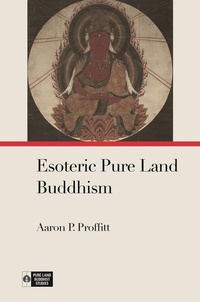
Esoteric Pure Land Buddhism
Published on 31. January 2024
Book
Paperback/Softback
468 pages
978-0-8248-9371-2 (ISBN)
Description
What, if anything, is Esoteric Pure Land Buddhism? In 1224, the medieval Japanese scholar-monk Dohan (1179-1252) composed The Compendium on Esoteric Mindfulness of Buddha (Himitsu nenbutsu sho), which begins with another seemingly simple question: Why is it that practitioners of mantra and meditation rely on the recitation of the name of the Buddha Amitabha? To answer this question, Dohan explored diverse areas of study spanning the whole of the East Asian Mahayana Buddhist tradition. Although contemporary scholars often study Esoteric Buddhism and Pure Land Buddhism as if they were mutually exclusive and diametrically opposed schools of Buddhism, in the present volume Aaron Proffitt examines Dohan's Compendium in the context of the eastward flow of Mahayana Buddhism from India to Japan and uncovers Mahayana Buddhists employing multiple, overlapping, so-called "esoteric" approaches along the path to awakening.
Proffitt divides his study into two parts. In Part I he considers how early Buddhologists, working under colonialism, first constructed Mahayana Buddhism, Pure Land Buddhism, and Esoteric Buddhism as discrete fields of inquiry. He then surveys the flow of Indian Buddhist spells, dhara?i, and mantra texts into China and Japan and the diverse range of Buddhist masters who employed these esoteric techniques to achieve rebirth in Sukhavati, the Pure Land of Bliss. In Part II, he considers the life of Dohan and analyzes the monk's comprehensive view of buddhanusm?ti as a form of ritual technology that unified body and mind, Sukhavati as a this-worldly or other-worldly soteriological goal synonymous with nirvana itself, and the Buddha Amitabha as an object of devotion beyond this world of suffering. The work concludes with the first full translation of Dohan's Himitsu nenbutsu sho into a modern language.
Proffitt divides his study into two parts. In Part I he considers how early Buddhologists, working under colonialism, first constructed Mahayana Buddhism, Pure Land Buddhism, and Esoteric Buddhism as discrete fields of inquiry. He then surveys the flow of Indian Buddhist spells, dhara?i, and mantra texts into China and Japan and the diverse range of Buddhist masters who employed these esoteric techniques to achieve rebirth in Sukhavati, the Pure Land of Bliss. In Part II, he considers the life of Dohan and analyzes the monk's comprehensive view of buddhanusm?ti as a form of ritual technology that unified body and mind, Sukhavati as a this-worldly or other-worldly soteriological goal synonymous with nirvana itself, and the Buddha Amitabha as an object of devotion beyond this world of suffering. The work concludes with the first full translation of Dohan's Himitsu nenbutsu sho into a modern language.
Reviews / Votes
Aaron Proffitt combines two terms that are usually considered distinct-"Esoteric" and "Pure Land"-to show that both traditions as we know them today in Japan were incubated in the same historical and intellectual context. Their disambiguation did not happen until much later, and much of the reification happened in modernity. . . . With scholarly acumen, Proffitt shows that Esoteric Buddhism and Pure Land Buddhism were not mutually exclusive categories, but rather elements existing in the same cultural sphere, each influencing and shaping the other." - Joie Szu-Chiao Chen, Buddhadharma (Summer 2023)More details
Series
Language
English
Place of publication
Honolulu, HI
United States
Target group
Professional and scholarly
Product notice
Paperback (trade)
Unsewn / adhesive bound
Illustrations
1 b&w illustration
Dimensions
Height: 228 mm
Width: 152 mm
Thickness: 34 mm
Weight
676 gr
ISBN-13
978-0-8248-9371-2 (9780824893712)
Copyright in bibliographic data and cover images is held by Nielsen Book Services Limited or by the publishers or by their respective licensors: all rights reserved.
Schweitzer Classification