

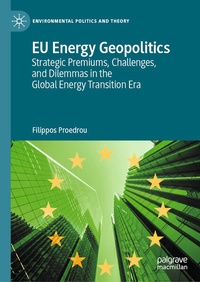
EU Energy Geopolitics
Description
The global energy transition will be a game-changer for global politics. The field of energy geopolitics hence is changing fast, providing challenges, opportunities and variable outcomes for states across the world. The academic scholarship on the geopolitics of renewables has expanded exponentially over the last decade focusing on winners vs losers, conflict vs cooperation and establishing initial expectations and general propositions regarding the outcomes of the global energy transition. Cases studies, however, have been far and few, and appear in book chapters or, more rarely, journal articles. Overall, there is a dearth of academic monographs examining in depth how specific actors in the global system approach new energy geopolitics, how they are impacted by the global energy transition, and how this links with their grand strategy. This short monograph aims to fill this gap by offering an up-to-date case study of EU energy geopolitics. Grounded upon the sub-field of energy geopolitics, it produces a conceptual framework linking the global energy transition with EU grand strategy to assess how it impacts EU's position in the global system, as well as the strategic gains, trade-offs and risks implicated. The book takes as its starting point and reviews systematically the main assumptions of the geopolitics of the global energy transition literature and the EU energy and climate policy that drives and shapes the EU energy transition. It subsequently focuses its attention on the impact of the EU energy transition on EU energy security, economic competitiveness and foreign policy/ power position and the potential it generates for more conflict or cooperation. The discussion is anchored in the different forms of power the EU operationalizes and showcases the strengths, limits and antinomies of the EU power toolbox in EU energy geopolitics. The originality, significance and contribution of this monograph lies in the cross-fertilization of fossil divestment and clean energy geopolitics, energy and climate policy, energy transition and EU as a power scholarship, with an eye to provide a comprehensive, up-to-date account of new EU energy geopolitics. In all, this monograph dissects the prospects and geopolitical implications of the new energy geopolitics, and the foreign policy ramifications engendered by the global energy transition. This book is aimed at academics and students in the areas of International Relations, International Political Economy, European Studies, Geopolitics, and Energy Politics. It aspires, moreover, to become a reference point for the scholarship in the field of energy (geo)politics. Moreover, it will be of value to think-tanks and policy-makers working in the fields of foreign, energy and climate policy.
Reviews / Votes
"This book lucidly analyses the opportunities, risks and challenges for the EU in the dynamically evolving geopolitics of the energy and climate transition in the context of broader geopolitics. Filippos Proedrou succeeds in painting a clear but nuanced picture of the strategic choices for the EU against the backdrop of the major ongoing developments and future trajectories, while paying due attention to existing uncertainties - highly recommended reading!" (Sebastian Oberthür - VUB Brussels School of Governance & University of East Finland)
"Proedrou's monograph presents an easy-to-follow, in-depth look at how the European Union shapes and is shaped by the geopolitics of the energy transition. It enriches the field with a much-needed case-study that highlights the complex interactions that determine new opportunities and challenges in terms of energy security, market dominance, and political power. Its lessons on the propensity for cooperation and conflict of a cleaner energy world are just as important for scholars interested in energy and climate geopolitics as (EU) decision makers in charge of energy, industrial, foreign, and security policy." (Daniel Scholten, University of Minnesota)
"This eloquent monograph provides a comprehensive account of the EU's position and role in new energy geopolitics. It unpacks the main pillars of the new energy geopolitics, zooms in on the central questions in the global energy transition literature, and provides well-substantiated answers from the EU perspective. The book advances scholarly knowledge by analyzing in what ways, to what extent and under what premises the EU emerges as a global energy transition winner and what the global energy transition means for EU foreign policy in terms of peace dividends and conflict potential." (Indra Øverland, Norwegian Institute of International Affairs)
"The EU has held a unique position as a trendsetter, market-maker, and technological innovator in the global energy landscape. A new global energy regime cannot be imagined without a comprehensive opt-in by the EU and its constituents. Understanding the EU's strategic priorities in such a future regime, then, becomes essential in comprehending how the EU's actions can shape geopolitics of global energy markets. This book contributes to the scholarship of the geopolitics of the global energy transition by offering a multi-level analysis of major geopolitical drivers of and challenges to the EU's energy transition. The monograph also skilfully synthesizes insights from the foreign policy analysis, energy policy, and strategic analysis literatures to identify interests, institutions and information structures that shape the EU's position in the constantly evolving energy landscape." (Emre Hatipologu, King Abdullah Petroleum Studies and Research Center)
More details
Other editions
Additional editions
Person
Filippos Proedrou is Associate Professor of Global Political Economy in the University of South Wales. He is the author of Energy Policy and Security under Climate Change (Palgrave 2018) and EU Energy Security in the Gas Sector: Evolving Dynamics, Policy Dilemmas and Prospects (Ashgate 2012) .
Content
Chapter 1 - Introduction.- Chapter 2 - The geopolitics of the global energy transition.- Chapter 3 - The EU energy transition.- Chapter 4 - Geopolitical implications of the global energy transition for the EU.- Chapter 5 - Conclusion.