

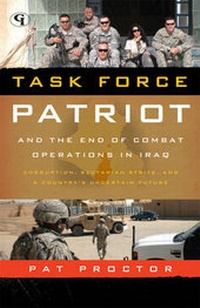
Task Force Patriot and the End of Combat Operations in Iraq
Published on 17. November 2011
Book
Hardback
232 pages
978-1-60590-777-2 (ISBN)
Description
Iraq in 2009 was a strange netherworld, not quite war but not yet peace. The country teetered on the threshold of great change with the impending national elections and the promised withdrawal of all US combat forces. These changes would usher in either an era of irreversible stability or a return to the sectarian carnage that nearly destroyed Iraq in 2006. It was during this period of uncertainty that Task Force Patriot arrived to take over as the last US combat force to occupy Saddam Hussein's hometown of Tikrit. In this gripping first-hand account of the final months of combat operations, author Pat Proctor brings his unique, insider perspective to reveal the circumstances that put this battalion in a position to turn the tide of the Iraq war. Despite resistance from insurgents, intransigent Iraqi politicians, and, occasionally, the US interagency team, this artillery-turned-infantry battalion found itself in a position to not only improve conditions in its area, but solve the last unsettled problem of the Iraq war, the sectarian divide.
Task Force Patriot, through the confluence of lucky circumstances and innovative thinking, had stumbled upon a unique approach-a combination of hardball politics, economic investment, and a nuanced application of force-that could potentially end Sunni separatism in Iraq. This book tells the untold story of this critical period during the second national elections, which, eight months later, was only beginning to yield a government. More importantly, however, this book tells the story of the last crucial days of the Iraq War.
Task Force Patriot, through the confluence of lucky circumstances and innovative thinking, had stumbled upon a unique approach-a combination of hardball politics, economic investment, and a nuanced application of force-that could potentially end Sunni separatism in Iraq. This book tells the untold story of this critical period during the second national elections, which, eight months later, was only beginning to yield a government. More importantly, however, this book tells the story of the last crucial days of the Iraq War.
Reviews / Votes
In his detailed narrative about Task Force Patriot's efforts as the last U.S. combat force in Saddam Hussein's old stomping ground of Salah ad Din, Army Lt. Col. Pat Proctor is not afraid to admit a "fatal assumption" or a "serious flaw" that leads to his unit's realization that "it was time to start from scratch," again and again. Frustrations with local politicians, some State department representatives and local business practices get in the Army's way but the officer is persuasive. "There is the money you have to spend to build the project," he tells an Iraqi contractor, "and there is the money you have to spend to make everyone happy." Is the U.S. investment worthwhile? "We will never know the answer until we leave Iraq and let the Iraqis settle these disputes for themselves." Military Times The U.S. military venture in Iraq is ending; now come the retrospectives. Even the staunchest opponents of our involvement in Iraq must concede that the level of violence has declined (for now) over the past three years. Proctor, an Iraq War veteran, directed combat operations for an infantry battalion in the province of Salah ad Din in 2009. He was charged with the duty of tamping down sectarian violence while helping to build up national institutions-in short, engaging in nation building. On the one hand, this is an inspiring account as Proctor and his men labor in a complex, confusing, and dangerous milieu that is not quite war and not quite peace. But Proctor is unsparing in his revelations about unresolved issues that figure to make a truly stable and democratic Iraq unlikely. These include still-rampant sectarian hatred, massive corruption, and a government that is both unresponsive and incompetent at both national and local levels. This isn't a pretty picture, but it is a sobering one that Americans must consider as future events unfold. Booklist Task Force Patriot is not a tedious recitation of counterinsurgency operations in Iraq. Proctor weaves intrigue into his matter-of-fact reportage and composes descriptive prose, both of which add a dash of artistry...Accessible to a general readership and technical enough to satisfy a military-minded audience, Proctor's book is instructive, candid, and thought-provoking. Foreword Reviews Lieutenant Colonel Pat Proctor provides valuable insight into the adaptability of the American Soldier and the versatility of tactical leaders in war. His compelling narrative provides an in-depth account of how his battalion implemented counterinsurgency theory in one corner of Iraq. -- General William B. Caldwell IV, US Army Every officer and NCO in the US Army charged with countering an insurgency should study this richly researched account of the realities of nation building. American money does not create decent host-nation leaders; it does place American military leaders in impossible situations. -- Bing West, author of The Village, The Strongest Tribe, and The Wrong War As we approach the twilight of the war in Iraq, it is widely acknowledged that the public understands too little about the experience of soldiers who have been engaged in that conflict over the past eight years. In Task Force Patriot and the End of Combat Operations in Iraq, Pat Proctor sheds light on the political, human, and psychological dimension of that experience, recounting how he and his soldiers fought across an area the size of New Jersey to achieve an outcome consistent with our interests and worthy of the sacrifices so many have made. This is a compelling account not only because it helps explain the American military experience in Iraq, but also because it reveals the difficulties that our soldiers are likely to confront in future conflicts. -- General H. R. McMaster, author of Dereliction of Duty Traditionally regarded as a squad leader's fight, counterinsurgency in Iraq was often more of a Battalion commander's war. Colonel Proctor's excellent account of his experiences as a Battalion S3 should be required reading for military or civilian students, for leaders seeking to master this complex art, and for anyone interested in how Americans handled the critical transition from combat operations in Iraq. -- David Kilcullen, author of The Accidental Guerilla and CounterinsurgencyMore details
Language
English
Place of publication
Rockville
United States
Dimensions
Height: 240 mm
Width: 162 mm
Thickness: 21 mm
Weight
472 gr
ISBN-13
978-1-60590-777-2 (9781605907772)
Copyright in bibliographic data and cover images is held by Nielsen Book Services Limited or by the publishers or by their respective licensors: all rights reserved.
Schweitzer Classification
Other editions
Additional editions
E-Book
12/2011
1st Edition
Bloomsbury eBooks US
€28.49
Available for download
E-Book
12/2011
1st Edition
Government Institutes
€28.49
Available for download
Person
Lieutenant Colonel Pat Proctor (US Army) is an Iraq War veteran with over seventeen years of active service. As a joint operational planner in Iraq in 2007, he participated in General Patraeus' Joint Strategic Assessment Team and the campaign redesign of Operation Iraqi Freedom. He returned to Iraq in 2009 as a battalion operations officer, where he directed continuous combat operations across two-thirds of Saddam Hussein's home province of Salah ad Din. He holds master's degrees from the US Army Command and General Staff College and School of Advance Military Studies. He is currently the chief of plans for the 1st Infantry Division at Fort Riley, Kansas and a doctoral student in history at Kansas State University.
Content
Acknowledgments Introduction Chapter 1: Ad Dawr Chapter 2: Corporal Carrasco Chapter 3: Lt.Col. Ahmed al Fahal Chapter 4: The Jadir Brothers Chapter 5: Sheikh Sabah al Shimiri Chapter 6: Task Force Wolfhounds Epilogue About the Author