

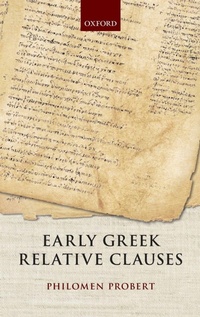
Early Greek Relative Clauses
Published on 29. January 2015
Book
Hardback
544 pages
978-0-19-871382-1 (ISBN)
Description
Early Greek Relative Clauses contributes to an old debate currently enjoying a revival: should we expect languages spoken a few thousand years ago, such as Proto-Indo-European, to be less well-equipped than modern languages when it comes to subordinate clauses? Early Greek relative clauses provide a test case for this problem. Early Greek uses several kinds of relative clause, but all these are usually thought to come from one, or at most two, prehistoric types. In a new look at the evidence, this book finds that a rich variety of relative clause types has been in place for a considerable time.
The reconstruction of prehistoric linguistic stages requires detailed work on the individual languages descending from them. A substantial part of the book is therefore devoted to a new look at the relative clause systems found in a wide variety of early Greek texts. It emerges that the same basic system is in use across all these texts. Different kinds of relative clause predominate in different kinds of text, however, because relative clause syntax and semantics interact with the needs of different kinds of text.
Considering material as diverse as the Homeric poems, laws inscribed in stone on the island of Crete, and the philosophical prose of Heraclitus, the discussion remains clear and straightforward as Probert considers the uses and histories of different relative clause types.
The reconstruction of prehistoric linguistic stages requires detailed work on the individual languages descending from them. A substantial part of the book is therefore devoted to a new look at the relative clause systems found in a wide variety of early Greek texts. It emerges that the same basic system is in use across all these texts. Different kinds of relative clause predominate in different kinds of text, however, because relative clause syntax and semantics interact with the needs of different kinds of text.
Considering material as diverse as the Homeric poems, laws inscribed in stone on the island of Crete, and the philosophical prose of Heraclitus, the discussion remains clear and straightforward as Probert considers the uses and histories of different relative clause types.
Reviews / Votes
Probert's book constitutes a very important step forward towards a more comprehensive understanding of relative clauses in all stages of Greek. * Klaas Bentein, Journal of Hellenic Studies * a valuable survey of this important type of clause and, in its meticulous presentation of the primary evidence and thorough investigation of the secondary literature, could well serve as a model for research in historical syntax generally. * Coulter H. George, Classical Review * this book comes highly recommended for all scholars with an interest in early Greek syntax. It succeeds admirably in bridging Greek philology, typology and theoretical linguistics. It is rich in fine observations on the passages under discussion ... research will surely profit enormously from Probert's work. * Dag Haug, Mnemosyne *More details
Language
English
Place of publication
Oxford
United Kingdom
Target group
College/higher education
Professional and scholarly
Illustrations
14 black and white illustrations
Dimensions
Height: 240 mm
Width: 161 mm
Thickness: 33 mm
Weight
954 gr
ISBN-13
978-0-19-871382-1 (9780198713821)
Copyright in bibliographic data and cover images is held by Nielsen Book Services Limited or by the publishers or by their respective licensors: all rights reserved.
Schweitzer Classification
Other editions
Additional editions
Philomen Probert
Early Greek Relative Clauses
E-Book
01/2015
1st Edition
OUP eBook
€67.49
Available for download
Person
Philomen Probert is University Lecturer in Classical Philology and Linguistics at the University of Oxford and a Fellow of Wolfson College.
Content
Acknowledgements ; General Abbreviations ; Abbreviations for Grammatical Categories ; Ancient Authors and Works, with Editions Used ; Epigraphic and Papyrological Publications ; Symbols ; 1. Introduction ; 2. Proto-Indo-European, Greek, and Primitive Languages: The Last 150 Years ; 3. Approaches to Proto-Indo-European Relative Clauses ; 4. What is a Relative Clause? ; 5. Definiteness and Related Concepts ; 6. Varieties of Greek Relative Clause ; 7. Matters of Case ; 8. Forays into Early Greek Relative Clauses in Non-epic Genres ; 9. Postnominal and Inherently Maximalizing Relative Clauses in Homer ; 10. How Does Homer Choose between Inherently Maximalizing Constructions? ; 11. How Does Homer Choose between omicron, eta, tauomicron, and omicronsigmaf, eta, omicron? ; 12. Homeric Relative Clauses in Direct Speech and Narrative ; 13. Cretan Inscriptions to 400 BC ; 14. Against Four Syntactic Relics and For One ; 15. Conclusions ; References ; Glossary of Technical Terms