

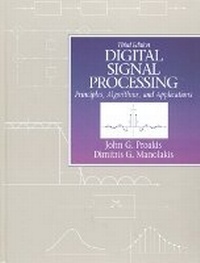
Digital Signal Processing
Principles, Algorithms and Applications: International Edition
3rd Edition
Published on 26. October 1995
Book
Paperback/Softback
1016 pages
978-0-13-394289-7 (ISBN)
Description
Suitable for a one- or two-semester undergraduate-level electrical engineering, computer engineering, and computer science course in Discrete Systems and Digital Signal Processing. Assumes some prior knowledge of advanced calculus, linear systems for continuous-time signals, and Fourier series and transforms.
Giving students a sound balance of theory and practical application, this no-nonsense text presents the fundamental concepts and techniques of modern digital signal processing with related algorithms and applications. Covering both time-domain and frequency- domain methods for the analysis of linear, discrete-time systems, the book offers cutting-edge coverage on such topics as sampling, digital filter design, filter realizations, deconvolution, interpolation, decimation, state-space methods, spectrum analysis, and more. Rigorous and challenging, it further prepares students with numerous examples, exercises, and experiments emphasizing software implementation of digital signal processing algorithms integrated throughout.
Giving students a sound balance of theory and practical application, this no-nonsense text presents the fundamental concepts and techniques of modern digital signal processing with related algorithms and applications. Covering both time-domain and frequency- domain methods for the analysis of linear, discrete-time systems, the book offers cutting-edge coverage on such topics as sampling, digital filter design, filter realizations, deconvolution, interpolation, decimation, state-space methods, spectrum analysis, and more. Rigorous and challenging, it further prepares students with numerous examples, exercises, and experiments emphasizing software implementation of digital signal processing algorithms integrated throughout.
More details
Edition
3rd edition
Language
English
Place of publication
United States
Publishing group
Pearson Education (US)
Target group
Professional and scholarly
Dimensions
Height: 235 mm
Width: 177 mm
Thickness: 35 mm
Weight
1417 gr
ISBN-13
978-0-13-394289-7 (9780133942897)
Copyright in bibliographic data and cover images is held by Nielsen Book Services Limited or by the publishers or by their respective licensors: all rights reserved.
Schweitzer Classification
Other editions
New editions
Book
04/2009
4th Edition
Pearson
€224.06
Article exhausted; check for reprint
Previous edition

John G. Proakis | Dimitris Manolakis
Digital Signal Processing
Principles, Algorithms and Applications
Book
01/1992
2nd Edition
Macmillan USA
€53.37
Article exhausted; check for reprint
Content
1. Introduction.
2. Discrete-Time Signals and Systems.
3. The Z-Transform and Its Application to the Analysis of LTI Systems.
4. Frequency Analysis of Signals and Systems.
5. The Discrete Fourier Transform: Its Properties and Applications.
6. Efficient Computation of the DFT: Fast Fourier Transform Algorithms.
7. Implementation of Discrete-Time Systems.
8. Design of Digital Filters.
9. Sampling and Reconstruction of Signals.
10. Multirate Digital Signal Processing.
11. Linear Prediction and Optimum Linear Filters.
12. Power Spectrum Estimation.
Appendix A. Random Signals, Correlation Functions, and Power Spectra.
Appendix B. Random Numbers Generators.
Appendix C. Tables of Transition Coefficients for the Design of Linear-Phase FIR Filters.
Appendix D. List of MATLAB Functions.
References and Bibliography.
Index.
2. Discrete-Time Signals and Systems.
3. The Z-Transform and Its Application to the Analysis of LTI Systems.
4. Frequency Analysis of Signals and Systems.
5. The Discrete Fourier Transform: Its Properties and Applications.
6. Efficient Computation of the DFT: Fast Fourier Transform Algorithms.
7. Implementation of Discrete-Time Systems.
8. Design of Digital Filters.
9. Sampling and Reconstruction of Signals.
10. Multirate Digital Signal Processing.
11. Linear Prediction and Optimum Linear Filters.
12. Power Spectrum Estimation.
Appendix A. Random Signals, Correlation Functions, and Power Spectra.
Appendix B. Random Numbers Generators.
Appendix C. Tables of Transition Coefficients for the Design of Linear-Phase FIR Filters.
Appendix D. List of MATLAB Functions.
References and Bibliography.
Index.