

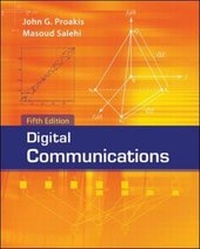
Digital Communications
5th Edition
Published on 16. December 2007
Book
Hardback
1168 pages
978-0-07-295716-7 (ISBN)
Description
Digital Communications is a classic book in the area that is designed to be used as a senior or graduate level text. The text is flexible and can easily be used in a one semester course or there is enough depth to cover two semesters. Its comprehensive nature makes it a great book for students to keep for reference in their professional careers.This all-inclusive guide delivers an outstanding introduction to the analysis and design of digital communication systems. Includes expert coverage of new topics: Turbocodes, Turboequalization, Antenna Arrays, Digital Cellular Systems, and Iterative Detection. Convenient, sequential organization begins with a look at the history and classification of channel models and builds from there.
More details
Edition
5th edition
Language
English
Place of publication
United States
Publishing group
McGraw-Hill Education - Europe
Target group
College/higher education
Illustrations
260 Illustrations
Dimensions
Height: 229 mm
Width: 206 mm
Thickness: 48 mm
Weight
1871 gr
ISBN-13
978-0-07-295716-7 (9780072957167)
Schweitzer Classification
Content
Digital Communications 5eChapter 1: IntroductionChapter 2: Deterministic and Random Signal AnalysisChapter 3: Digital Modulation SchemesChapter 4: Optimum Receivers for AWGN ChannelsChapter 5: Carrier and Symbol SynchronizationChapter 6: An Introduction to Information TheoryChapter 7: Linear Block CodesChapter 8: Trellis and Graph Based CodesChapter 9: Digital Communication Through Band-Limited ChannelsChapter 10: Adaptive EqualizationChapter 11: Multi-channel and Multi-carrier SystemsChapter 12: Spread Spectrum Signals for Digital CommunicationsChapter 13: Fading Channels I: Characterization and SignalingChapter 14: Fading Channels II: Capacity and CodingChapter 15: Multiple-Antenna SystemsChapter 16: Multi-user CommunicationsAppendix A MatricesAppendix B Error Probability for Multichannel Binary SignalsAppendix C Error Probabilities for Adaptive Reception of M-Phase SignalsAppendix D Square Root FactorizationReferences and BibliographyIndex