

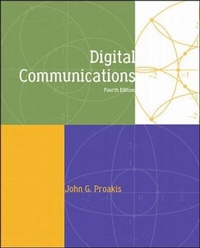
Digital Communications
4th Edition
Published on 16. September 2000
Book
Hardback
1024 pages
978-0-07-232111-1 (ISBN)
Description
Digital Communications is a classic book in the area that is designed to be used as a senior or graduate level text. The text is flexible and can easily be used in a one semester course or there is enough depth to cover two semesters. Its comprehensive nature makes it a great book for students to keep refer to in their professional careers.This best-selling book in Digital Communications by John G. Proakis has been revised to reflect the current trends in the field. Some of the topics that have been added include Turbocodes, Antenna Arrays, Iterative Detection, and Digital Cellular Systems. Also new to this edition are electronic figures for presentation materials found on the website.
More details
Edition
4th edition
Language
English
Place of publication
United States
Publishing group
McGraw-Hill Education - Europe
Target group
College/higher education
Dimensions
Height: 239 mm
Width: 193 mm
Thickness: 43 mm
Weight
1660 gr
ISBN-13
978-0-07-232111-1 (9780072321111)
Copyright in bibliographic data and cover images is held by Nielsen Book Services Limited or by the publishers or by their respective licensors: all rights reserved.
Schweitzer Classification
Content
1 Introduction2 Probability and Stochastic Processes3 Source Coding4 Characterization of Communication Signals and Systems5 Optimum Receivers for the Additive White Gaussian Noise Channel6 Carrier and Symbol Synchronization7 Channel Capacity and Coding 8 Block and Convolutional Channel Codes9 Signal Design for Band-Limited Channels10 Communication through Band-Limited Linear Filter Channels11 Adaptive Equalization12 Multichannel and Multicarrier Systems13 Spread Spectrum Signals for Data Communications14 Digital Communication through Fading Multipath Channels15 Multiuser CommunicationsAppendix A The Levinson-Durbin AlgorithmAppendix B Error Probability for Multichannel Binary SignalsAppendix C Error Probabilities for Adaptive Reception of M-phase SignalsAppendix D Square-Root FactorizationReferences and BibliographyIndex