

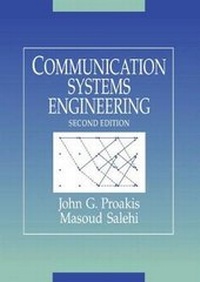
Communication Systems Engineering
2nd Edition
Published on 22. October 2018
Book
Paperback/Softback
816 pages
978-0-13-061793-4 (ISBN)
Description
Thorough coverage of basic digital communication system principles ensures that readers are exposed to all basic relevant topics in digital communication system design. The use of CD player and JPEG image coding standard as examples of systems that employ modern communication principles allows readers to relate the theory to practical systems. Over 180 worked-out examples throughout the book aids readers in understanding basic concepts. Over 480 problems involving applications to practical systems such as satellite communications systems, ionospheric channels, and mobile radio channels gives readers ample opportunity to practice the concepts they have just learned. KEY TOPICS: With an emphasis on digital communications, Communication Systems Engineering, Second Edition introduces the basic principles underlying the analysis and design of communication systems. In addition, this book gives a solid introduction to analog communications and a review of important mathematical foundation topics. New material has been added on wireless communication systems-GSM and CDMA/IS-94; turbo codes and iterative decoding; multicarrier (OFDM) systems; multiple antenna systems. Includes thorough coverage of basic digital communication system principles-including source coding, channel coding, baseband and carrier modulation, channel distortion, channel equalization, synchronization, and wireless communications. Includes basic coverage of analog modulation such as amplitude modulation, phase modulation, and frequency modulation as well as demodulation methods. MARKET: For use as a reference for electrical engineers for all basic relevant topics in digital communication system design.
More details
Edition
2nd edition
Language
English
Place of publication
United States
Publishing group
Pearson Education (US)
Target group
College/higher education
Dimensions
Height: 231 mm
Width: 241 mm
Thickness: 35 mm
Weight
1328 gr
ISBN-13
978-0-13-061793-4 (9780130617934)
Copyright in bibliographic data and cover images is held by Nielsen Book Services Limited or by the publishers or by their respective licensors: all rights reserved.
Schweitzer Classification
Other editions
New editions
Book
04/2003
2nd Edition
Pearson
€227.15
Article is exhausted; no reprint
Previous edition

John G. Proakis | Masoud Salehi
Communication Systems Engineering
Book
12/1993
Pearson Education (US)
€44.56
Article exhausted; check different version
Content
(NOTE: Each chapter concludes with Further Reading and Problems.)
1. Introduction.
Historical Review. Elements of an Electrical Communication System. Communication Channels and Their Characteristics. Mathematical Models for Communication Channels. Organization of the Book.
2. Frequency Domain Analysis of Signals and Systems.
Fourier Series. Fourier Transforms. Power and Energy. Sampling of Bandlimited Signals. Bandpass Signals.
3. Analog Signal Transmission and Reception.
Introduction to Modulation. Amplitude Modulation (AM). Angle Modulation. Radio and Television Broadcasting. Mobile Radio Stations.
4. Random Processes.
Probability and Random Variables. Random Processes: Basic Concepts. Random Processes in the Frequency Domain. Gaussian and White Processes. Bandlimited Processes and Sampling. Bandpass Processes.
5. Effect of Noise on Analog Communication Systems.
Effect of Noise on Linear-Modulation Systems. Carrier-Phase Estimation with a Phase-Locked Loop (PLL). Effect of Noise on Angle Modulation. Comparison of Analog-Modulation Systems. Effects of Transmission Losses and Noise in Analog Communication Systems.
6. Information Sources and Source Coding.
Modeling of Information Sources. Source-Coding Theorem. Source-Coding Algorithms. Rate-Distortion Theory. Quantization. Waveform Coding. Analysis-Synthesis Techniques. Digital Audio Transmission and Digital Audio Recording. The JPEG Image-Coding Standard.
7. Digital Transmission through the Additive White Gaussian Noise Channel.
Geometric Representation of Signal Waveforms. Pulse Amplitude Modulation. Two-Dimensional Signal Waveforms. Multidimensional Signal Waveforms. Optimum Receiver for Digitally Modulated Signals in Additive White Gaussian Noise. Probability of Error for Signal Detection in Additive White Gaussian Noise. Performance Analysis for Wireline and Radio Communication Channels. Symbol Synchronization.
8. Digital Transmission through Bandlimited AWGN Channels.
Digital Transmission through Bandlimited Channels. The Power Spectrum of Digitally Modulated Signals. Signal Design for Bandlimited Channels. Probability of Error in Detection of Digital PAM. Digitally Modulated Signals with Memory. System Design in the Presence of Channel Distortion. Multicarrier Modulation and OFDM.
9. Channel Capacity and Coding.
Modeling of Communication Channels. Channel Capacity. Bounds on Communication. Coding for Reliable Communication. Linear Block Codes. Cyclic Codes. Convolutional Codes. Complex Codes Based on Combination of Simple Codes. Coding for Bandwidth-Constrained Channels. Practical Applications of Coding.
10. Wireless Communications.
Digital Transmission on Fading Multipath Channels. Continuous Carrier-Phase Modulation. Spread-Spectrum Communication Systems. Digital Cellular Communication Systems.
Appendix A: The Probability of Error for Multichannel Reception of Binary Signals.
References.
Index.
1. Introduction.
Historical Review. Elements of an Electrical Communication System. Communication Channels and Their Characteristics. Mathematical Models for Communication Channels. Organization of the Book.
2. Frequency Domain Analysis of Signals and Systems.
Fourier Series. Fourier Transforms. Power and Energy. Sampling of Bandlimited Signals. Bandpass Signals.
3. Analog Signal Transmission and Reception.
Introduction to Modulation. Amplitude Modulation (AM). Angle Modulation. Radio and Television Broadcasting. Mobile Radio Stations.
4. Random Processes.
Probability and Random Variables. Random Processes: Basic Concepts. Random Processes in the Frequency Domain. Gaussian and White Processes. Bandlimited Processes and Sampling. Bandpass Processes.
5. Effect of Noise on Analog Communication Systems.
Effect of Noise on Linear-Modulation Systems. Carrier-Phase Estimation with a Phase-Locked Loop (PLL). Effect of Noise on Angle Modulation. Comparison of Analog-Modulation Systems. Effects of Transmission Losses and Noise in Analog Communication Systems.
6. Information Sources and Source Coding.
Modeling of Information Sources. Source-Coding Theorem. Source-Coding Algorithms. Rate-Distortion Theory. Quantization. Waveform Coding. Analysis-Synthesis Techniques. Digital Audio Transmission and Digital Audio Recording. The JPEG Image-Coding Standard.
7. Digital Transmission through the Additive White Gaussian Noise Channel.
Geometric Representation of Signal Waveforms. Pulse Amplitude Modulation. Two-Dimensional Signal Waveforms. Multidimensional Signal Waveforms. Optimum Receiver for Digitally Modulated Signals in Additive White Gaussian Noise. Probability of Error for Signal Detection in Additive White Gaussian Noise. Performance Analysis for Wireline and Radio Communication Channels. Symbol Synchronization.
8. Digital Transmission through Bandlimited AWGN Channels.
Digital Transmission through Bandlimited Channels. The Power Spectrum of Digitally Modulated Signals. Signal Design for Bandlimited Channels. Probability of Error in Detection of Digital PAM. Digitally Modulated Signals with Memory. System Design in the Presence of Channel Distortion. Multicarrier Modulation and OFDM.
9. Channel Capacity and Coding.
Modeling of Communication Channels. Channel Capacity. Bounds on Communication. Coding for Reliable Communication. Linear Block Codes. Cyclic Codes. Convolutional Codes. Complex Codes Based on Combination of Simple Codes. Coding for Bandwidth-Constrained Channels. Practical Applications of Coding.
10. Wireless Communications.
Digital Transmission on Fading Multipath Channels. Continuous Carrier-Phase Modulation. Spread-Spectrum Communication Systems. Digital Cellular Communication Systems.
Appendix A: The Probability of Error for Multichannel Reception of Binary Signals.
References.
Index.