

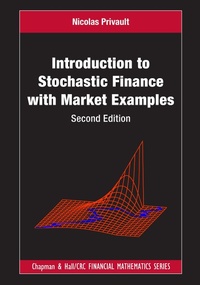
Introduction to Stochastic Finance with Market Examples
2nd Edition
Published on 13. December 2022
Book
Hardback
652 pages
978-1-032-28826-0 (ISBN)
Description
Introduction to Stochastic Finance with Market Examples, Second Edition presents an introduction to pricing and hedging in discrete and continuous-time financial models, emphasizing both analytical and probabilistic methods. It demonstrates both the power and limitations of mathematical models in finance, covering the basics of stochastic calculus for finance, and details the techniques required to model the time evolution of risky assets. The book discusses a wide range of classical topics including Black-Scholes pricing, American options, derivatives, term structure modeling, and change of numeraire. It also builds up to special topics, such as exotic options, stochastic volatility, and jump processes.
New to this Edition
New chapters on Barrier Options, Lookback Options, Asian Options, Optimal Stopping Theorem, and Stochastic Volatility
Contains over 235 exercises and 16 problems with complete solutions available online from the instructor resources
Added over 150 graphs and figures, for more than 250 in total, to optimize presentation
57 R coding examples now integrated into the book for implementation of the methods
Substantially class-tested, so ideal for course use or self-study
With abundant exercises, problems with complete solutions, graphs and figures, and R coding examples, the book is primarily aimed at advanced undergraduate and graduate students in applied mathematics, financial engineering, and economics. It could be used as a course text or for self-study and would also be a comprehensive and accessible reference for researchers and practitioners in the field.
New to this Edition
New chapters on Barrier Options, Lookback Options, Asian Options, Optimal Stopping Theorem, and Stochastic Volatility
Contains over 235 exercises and 16 problems with complete solutions available online from the instructor resources
Added over 150 graphs and figures, for more than 250 in total, to optimize presentation
57 R coding examples now integrated into the book for implementation of the methods
Substantially class-tested, so ideal for course use or self-study
With abundant exercises, problems with complete solutions, graphs and figures, and R coding examples, the book is primarily aimed at advanced undergraduate and graduate students in applied mathematics, financial engineering, and economics. It could be used as a course text or for self-study and would also be a comprehensive and accessible reference for researchers and practitioners in the field.
More details
Series
Edition
2nd edition
Language
English
Place of publication
Oxford
United Kingdom
Publishing group
Taylor & Francis Ltd
Target group
College/higher education
Academic
Illustrations
219 s/w Zeichnungen, 16 s/w Tabellen, 219 s/w Abbildungen
16 Tables, black and white; 219 Line drawings, black and white; 219 Illustrations, black and white
Dimensions
Height: 256 mm
Width: 190 mm
Thickness: 42 mm
Weight
1355 gr
ISBN-13
978-1-032-28826-0 (9781032288260)
Copyright in bibliographic data and cover images is held by Nielsen Book Services Limited or by the publishers or by their respective licensors: all rights reserved.
Schweitzer Classification
Other editions
Additional editions
Nicolas Privault
Introduction to Stochastic Finance with Market Examples
E-Book
12/2022
2nd Edition
Chapman & Hall/CRC
€138.99
Available for download
Nicolas Privault
Introduction to Stochastic Finance with Market Examples
E-Book
12/2022
2nd Edition
Chapman & Hall/CRC
€138.99
Available for download
Previous edition
Book
12/2013
1st Edition
CRC Press
€112.84
Article exhausted; check for reprint
Person
Nicolas Privault received a PhD degree from the University of Paris VI, France. He was with the University of Evry, France, the University of La Rochelle, France, and the University of Poitiers, France. He is currently a Professor with the School of Physical and Mathematical Sciences, Nanyang Technological University, Singapore. His research interests are in the areas of stochastic analysis and its applications.
Content
Introduction. 1. Assets, Portfolios, and Arbitrage. 1.1. Portfolio Allocation and Short Selling. 1.2. Arbitrage. 1.3. Risk-Neutral Probability Measures. 1.4. Hedging of Contingent Claims. 1.5. Market Completeness. 1.6. Example: Binary Market. Exercises. 2. Discrete-Time Market Model. 2.1. Discrete-Time Compounding. 2.2. Arbitrage and Self-Financing Portfolios. 2.3. Contingent Claims. 2.4. Martingales and Conditional Expectations. 2.5. Market Completeness and Risk-Neutral Measures. 2.6. The Cox-Ross-Rubinstein (CRR) Market Model. Exercises. 3. Pricing and Hedging in Discrete Time. 3.1. Pricing Contingent Claims. 3.2. Pricing Vanilla Options in the CRR Model. 3.3. Hedging Contingent Claims. 3.4. Hedging Vanilla Options. 3.5. Hedging Exotic Options. 3.6. Convergence of the CRR Model. Exercises. 4. Brownian Motion and Stochastic Calculus. 4.1. Brownian Motion. 4.2. Three Constructions of Brownian Motion. 4.3. Wiener Stochastic Integral. 4.4. Ito Stochastic Integral. 4.5. Stochastic Calculus. Exercises. 5. Continuous-Time Market Model. 5.1. Asset Price Modeling. 5.2. Arbitrage and Risk-Neutral Measures. 5.3. Self-Financing Portfolio Strategies. 5.4. Two-Asset Portfolio Model. 5.5. Geometric Brownian Motion. Exercises. 6. Black-Scholes Pricing and Hedging. 6.1. The Black-Scholes PDE. 6.2. European Call Options. 6.3. European Put Options. 6.4. Market Terms and Data. 6.5. The Heat Equation. 6.6. Solution of the Black-Scholes PDE. Exercises. 7. Martingale Approach to Pricing and Hedging. 7.1. Martingale Property of the Ito Integral. 7.2. Risk-neutral Probability Measures. 7.3. Change of Measure and the Girsanov Theorem. 7.4. Pricing by the Martingale Method. 7.5. Hedging by the Martingale Method. Exercises. 8. Stochastic Volatility. 8.1. Stochastic Volatility Models. 8.2. Realized Variance Swaps. 8.3. Realized Variance Options. 8.4. European Options - PDE Method. 8.5. Perturbation Analysis. Exercises. 9. Volatility Estimation. 9.1. Historical Volatility. 9.2. Implied Volatility. 9.3. Local Volatility. 9.4. The VIX (R) Index. Exercises. 10. Maximum of Brownian motion. 10.1. Running Maximum of Brownian Motion. 10.2. The Reflection Principle. 10.3. Density of the Maximum of Brownian Motion. 10.4. Average of Geometric Brownian Extrema. Exercises. 11. Barrier Options. 11.1. Options on Extrema. 11.2. Knock-Out Barrier. 11.3. Knock-In Barrier. 11.4. PDE Method. 11.5. Hedging Barrier Options. Exercises. 12. Lookback Options. 12.1. The Lookback Put Option. 12.2. PDE Method. 12.3. The Lookback Call Option. 12.4. Delta Hedging for Lookback Options. Exercises. 13. Asian Options. 13.1. Bounds on Asian Option Prices. 13.2. Hartman-Watson Distribution. 13.3. Laplace Transform Method. 13.4. Moment Matching Approximations. 13.5. PDE Method. Exercises. 14. Optimal Stopping Theorem. 14.1. Filtrations and Information Flow. 14.2. Submartingales and Supermartingales. 14.3. Optimal Stopping Theorem. 14.4. Drifted Brownian Motion. Exercises. 15. American Options. 15.1. Perpetual American Put Options. 15.2. PDE Method for Perpetual Put Options. 15.3. Perpetual American Call Options. 15.4. Finite Expiration American Options. 15.5. PDE Method with Finite Expiration. Exercises. 16. Change of Numeraire and Forward Measures. 16.1. Notion of Numeraire. 16.2. Change of Numeraire. 16.3. Foreign Exchange. 16.4. Pricing Exchange Options. 16.5. Hedging by Change of Numeraire. Exercises. 17. Short Rates and Bond Pricing. 17.1. Vasicek model. 17.2. Affine Short Rate Models. 17.3. Zero-Coupon and Coupon Bonds. 17.4. Bond Pricing PDE. Exercises. 18. Forward Rates. 18.1. Construction of Forward Rates. 18.2. LIBOR/SOFR Swap Rates. 18.3. The HJM Model. 18.4. Yield Curve Modeling. 18.5. Two-Factor Model. 18.6. The BGM Model. Exercises. 19. Pricing of Interest Rate Derivatives. 19.1. Forward Measures and Tenor Structure. 19.2. Bond Options. 19.3. Caplet Pricing. 19.4. Forward Swap Measures. 19.5. Swaption Pricing. Exercises. 20. Stochastic Calculus for Jump Processes. 20.1. The Poisson Process. 20.2. Compound Poisson Process. 20.3. Stochastic Integrals and Ito Formula with Jumps. 20.4. Stochastic Differential Equations with Jumps. 20.5. Girsanov Theorem for Jump Processes. Exercises. 21. Pricing and Hedging in Jump Models. 21.1. Fitting the Distribution of Market Returns. 21.2. Risk-Neutral Probability Measures. 21.3. Pricing in Jump Models. 21.4. Exponential Levy Models. 21.5. Black-Scholes PDE with Jumps. 21.6. Mean-Variance Hedging with Jumps. Exercises. 22. Basic Numerical Methods. 22.1. Discretized Heat Equation. 22.2. Discretized Black-Scholes PDE. 22.3. Euler Discretization. 22.4. Milshtein Discretization. Exercises. Bibliography. Index