

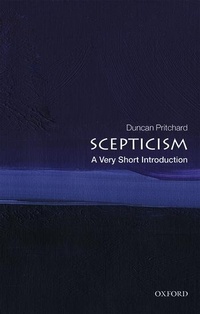
Scepticism
A Very Short Introduction
Published on 26. September 2019
Book
Paperback/Softback
144 pages
978-0-19-882916-4 (ISBN)
Description
Throughout history scepticism and the urge to question accepted truths has been a powerful force for change and growth. Today, as we are bombarded by adverts, scientific studies praising the latest superfoods, and political rhetoric, a healthy amount of scepticism is widely encouraged. But when is such scepticism legitimate - for example, as a driver of new ideas - and when is it problematic? And what role might adopting a sceptical outlook play in leading an intellectually virtuous life?
In this Very Short Introduction Duncan Pritchard explores both the advantages of scepticism, in challenging outdated notions, and also how it can have unhelpful social consequences, in generating distrust. He considers the role of scepticism at the source of contemporary social and political movements such as climate change denial, post-truth politics, and fake news. Pritchard also examines the philosophical arguments for a radical form of scepticism which maintains that knowledge is impossible, and explores some of the main responses to these arguments. Finally, he considers the part scepticism might play in applying better thinking and learning to achieve a more meaningful life.
ABOUT THE SERIES: The Very Short Introductions series from Oxford University Press contains hundreds of titles in almost every subject area. These pocket-sized books are the perfect way to get ahead in a new subject quickly. Our expert authors combine facts, analysis, perspective, new ideas, and enthusiasm to make interesting and challenging topics highly readable.
In this Very Short Introduction Duncan Pritchard explores both the advantages of scepticism, in challenging outdated notions, and also how it can have unhelpful social consequences, in generating distrust. He considers the role of scepticism at the source of contemporary social and political movements such as climate change denial, post-truth politics, and fake news. Pritchard also examines the philosophical arguments for a radical form of scepticism which maintains that knowledge is impossible, and explores some of the main responses to these arguments. Finally, he considers the part scepticism might play in applying better thinking and learning to achieve a more meaningful life.
ABOUT THE SERIES: The Very Short Introductions series from Oxford University Press contains hundreds of titles in almost every subject area. These pocket-sized books are the perfect way to get ahead in a new subject quickly. Our expert authors combine facts, analysis, perspective, new ideas, and enthusiasm to make interesting and challenging topics highly readable.
More details
Series
Language
English
Place of publication
Oxford
United Kingdom
Illustrations
8 black and white images
Dimensions
Height: 172 mm
Width: 108 mm
Thickness: 15 mm
Weight
110 gr
ISBN-13
978-0-19-882916-4 (9780198829164)
Copyright in bibliographic data and cover images is held by Nielsen Book Services Limited or by the publishers or by their respective licensors: all rights reserved.
Schweitzer Classification
Other editions
Additional editions
E-Book
09/2019
1st Edition
OUP eBook
€5.49
Available for download
E-Book
09/2019
1st Edition
OUP eBook
€5.49
Available for download
Person
Duncan Pritchard is Distinguished Professor of Philosophy at the University of California, Irvine, and Professor of Philosophy at the University of Edinburgh. His books include Epistemic Luck (OUP, 2005), Epistemological Disjunctivism (OUP, 2012), The Nature and Value of Knowledge (OUP 2010), co-authored with Alan Millar, Adrian Haddock, and Epistemic Angst (Princeton UP, 2015). In 2007 he was awarded the Philip Leverhulme Prize, and, in 2011, he was elected to a Fellowship of the Royal Society of Edinburgh.
Content
1: What is scepticism?
2: Is knowledge impossible?
3: Defending knowledge
4: Scepticism as a way of life
Further reading
Index
2: Is knowledge impossible?
3: Defending knowledge
4: Scepticism as a way of life
Further reading
Index