

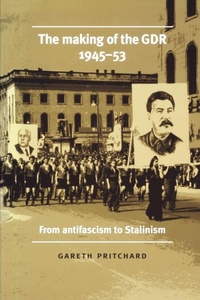
Making of the GDR, 1945-53
Published on 13. May 2004
Book
Paperback/Softback
256 pages
978-0-7190-6981-9 (ISBN)
Description
'Pritchard masterfully interweaves materials from professional journals, memoirs, interview protocols, diaries, Eastern and Western historical interpretations, as well as a wide range of state and party archives. The result is an impressive and important achievement that belongs on the shelf of anyone interested in the foundation period of East European Communist regimes.'
American Historical Review
The making of the GDR 1945-53 is a groundbreaking analysis of the Stalinisation of East Germany. Whereas most traditional accounts have explained the creation of the GDR in terms of high politics and of Soviet foreign policy, this book focuses on the social roots of the emerging dictatorship. These were located above all in the traditions of the German labour movement and the history of the anti-Nazi resistance. The GDR was not imposed on the East German people at the point of Russian bayonets; it emerged out of the interaction between Soviet occupation policy and the politics of the East German working class. The making of the GDR 1945-53 also tells a powerful human story, in which the aspirations of antifascists and Socialists were manipulated and ultimately betrayed by Stalinism.
Based on extensive research, this book will be of interest to those concerned with the division of Germany, the nature of the GDR, and the whole trajectory of post-war German politics. -- .
American Historical Review
The making of the GDR 1945-53 is a groundbreaking analysis of the Stalinisation of East Germany. Whereas most traditional accounts have explained the creation of the GDR in terms of high politics and of Soviet foreign policy, this book focuses on the social roots of the emerging dictatorship. These were located above all in the traditions of the German labour movement and the history of the anti-Nazi resistance. The GDR was not imposed on the East German people at the point of Russian bayonets; it emerged out of the interaction between Soviet occupation policy and the politics of the East German working class. The making of the GDR 1945-53 also tells a powerful human story, in which the aspirations of antifascists and Socialists were manipulated and ultimately betrayed by Stalinism.
Based on extensive research, this book will be of interest to those concerned with the division of Germany, the nature of the GDR, and the whole trajectory of post-war German politics. -- .
Reviews / Votes
"'Pritchard masterfully interweaves materials from professional journals, memoirs, interview protocols, diaries, Eastern and Western historical interpretations, as well as a wide range of state and party archives. The result is an impressive and important achievement that belongs on the shelf of anyone interested in the foundation period of East European Communist regimes.' American Historical Review"More details
Language
English
Place of publication
Manchester
United Kingdom
Target group
College/higher education
Professional and scholarly
Dimensions
Height: 234 mm
Width: 156 mm
Thickness: 14 mm
Weight
395 gr
ISBN-13
978-0-7190-6981-9 (9780719069819)
Copyright in bibliographic data and cover images is held by Nielsen Book Services Limited or by the publishers or by their respective licensors: all rights reserved.
Schweitzer Classification
Other editions
Previous edition

Book
06/2000
Manchester University Press
€75.80
Article exhausted; check for reprint
Person
Gareth Pritchard is Lecturer in Modern History at the University of Wales, Swansea -- .
Content
Introduction: The two traditions
Chapter 1: Eastern Germany at 'Zero Hour'
Chapter 2: Antifascist committees and factory councils
Chapter 3: The rebirth of the KPD and SPD
Chapter 4: Denazification and Reconstruction
Chapter 5: The Socialist Unity Party
Chapter 6: Between popular politics and communist dictatorship
Chapter 7: The stalinisation of the SED
Chapter 8: Workers party versus Working Class
Conclusion -- .
Chapter 1: Eastern Germany at 'Zero Hour'
Chapter 2: Antifascist committees and factory councils
Chapter 3: The rebirth of the KPD and SPD
Chapter 4: Denazification and Reconstruction
Chapter 5: The Socialist Unity Party
Chapter 6: Between popular politics and communist dictatorship
Chapter 7: The stalinisation of the SED
Chapter 8: Workers party versus Working Class
Conclusion -- .