

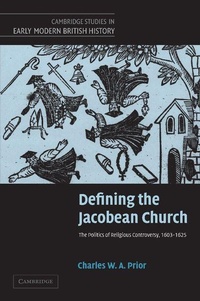
Defining the Jacobean Church
The Politics of Religious Controversy, 1603-1625
Published on 30. August 2012
Book
Paperback/Softback
314 pages
978-1-107-40688-9 (ISBN)
Description
This 2005 book proposes a model for understanding religious debates in the Churches of England and Scotland between 1603 and 1625. Setting aside 'narrow' analyses of conflict over predestination, its theme is ecclesiology - the nature of the Church, its rites and governance, and its relationship to the early Stuart political world. Drawing on a substantial number of polemical works, from sermons to books of several hundred pages, it argues that rival interpretations of scripture, pagan, and civil history and the sources central to the Christian historical tradition lay at the heart of disputes between proponents of contrasting ecclesiological visions. Some saw the Church as a blend of spiritual and political elements - a state Church - while others insisted that the life of the spirit should be free from civil authority.
Reviews / Votes
Review of the hardback: 'The not unreasonable claim made by this book is that we should try to interpret and decipher the ecclesiological dynamics of the Jacobean Church by distancing ourselves, as far as we can, from narrow theological concerns.' The Journal of Ecclesiastical HistoryMore details
Series
Language
English
Place of publication
Cambridge
United Kingdom
Target group
Professional and scholarly
Product notice
Paperback (trade)
Dimensions
Height: 229 mm
Width: 152 mm
Thickness: 17 mm
Weight
457 gr
ISBN-13
978-1-107-40688-9 (9781107406889)
Copyright in bibliographic data and cover images is held by Nielsen Book Services Limited or by the publishers or by their respective licensors: all rights reserved.
Schweitzer Classification
Other editions
Additional editions
E-Book
09/2005
1st Edition
Cambridge University Press
€32.49
Available for download
Book
07/2005
Cambridge University Press
€142.00
Shipment within 15-20 days
Person
Content
1. Introduction: defining the Church; 2. The language of ecclesiastical polity and Jacobean conformist thought; 3. Doctrine, law, and conflict over the Canons of 1604; 4. Apostoli, Episcopi, Divini?: models of ecclesiastical governance; 5. Bellum Ceremoniale: scripture, custom, and ceremonial practice; 6. Ceremonies, episcopacy, and the Scottish kirk; 7. Conclusion: narratives of civil and ecclesiastical authority.