

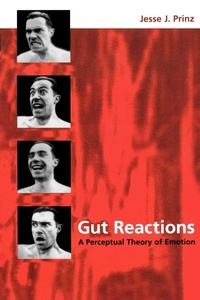
Gut Reactions
A Perceptual Theory of Emotion
Published on 20. July 2006
Book
Paperback/Softback
288 pages
978-0-19-530936-2 (ISBN)
Description
Gut Reactions is an interdisciplinary defense of the claim that emotions are perceptions of changes in the body. This thesis, pioneered by William James and resuscitated by Antonio Damasio, has been widely criticized for failing to acknowledge that emotions are meaningful insofar as they represent concerns, not respiratory function and blood pressure. Fear represents danger, sadness represents loss. To explain this fact, many researchers conclude that emotions must involve judgments regarding one's relationship to the environment. Prinz offers a new unified account of the emotions that reconciles these two theories. He argues that emotions are embodied appraisals--they are perceptions of the body, but, through the body, they also allow us to literally perceive danger, loss, and other matters of concern.
The basic idea behind embodied appraisal theory is captured in the familiar notion of a "gut reaction," which has been overlooked by much emotion research. Using recent work in semantics, Prinz show how emotions can be meaningful without incorporating judgments or other cognitive states. Criticizing those who think that some emotions are social constructions, while others can be explained by evolutionary psychology, Prinz argues that all emotions are the same kind of phenomena, involving both nature and nurture.
Prinz also distinguishes emotions from other affective states, such as motivations and moods, and offers a theory of emotional valence (what makes some emotions good and others bad). Ultimately, his theory of emotion consciousness is inspired by recent research on the neural correlates of conscious vision. Drawing a parallel between emotion consciousness and visual consciousness, Prinz shows that emotion is a form of perception in the fullest sense. Where vision reveals the identity of objects in a given situation, emotion reveals how that situation bears on our well-being.
The basic idea behind embodied appraisal theory is captured in the familiar notion of a "gut reaction," which has been overlooked by much emotion research. Using recent work in semantics, Prinz show how emotions can be meaningful without incorporating judgments or other cognitive states. Criticizing those who think that some emotions are social constructions, while others can be explained by evolutionary psychology, Prinz argues that all emotions are the same kind of phenomena, involving both nature and nurture.
Prinz also distinguishes emotions from other affective states, such as motivations and moods, and offers a theory of emotional valence (what makes some emotions good and others bad). Ultimately, his theory of emotion consciousness is inspired by recent research on the neural correlates of conscious vision. Drawing a parallel between emotion consciousness and visual consciousness, Prinz shows that emotion is a form of perception in the fullest sense. Where vision reveals the identity of objects in a given situation, emotion reveals how that situation bears on our well-being.
Reviews / Votes
[an] important and intriguing book ... it is at all times carefully argued and written with the verve which is characteristic of its author and which is so enjoyable ... No on interested in the emotions should ignore it. * Peter Goldie, Mind *More details
Series
Language
English
Place of publication
New York
United States
Target group
Professional and scholarly
Illustrations
2 halftones, 16 line drawings
Dimensions
Height: 234 mm
Width: 156 mm
Thickness: 16 mm
Weight
442 gr
ISBN-13
978-0-19-530936-2 (9780195309362)
Copyright in bibliographic data and cover images is held by Nielsen Book Services Limited or by the publishers or by their respective licensors: all rights reserved.
Schweitzer Classification
Other editions
Additional editions
E-Book
08/2004
1st Edition
OUP eBook
€16.49
Available for download
E-Book
08/2004
1st Edition
OUP eBook
€16.49
Available for download
Person
Jesse Prinz is Associate Professor of Philosophy at the University of North Carolina at Chapel Hill. He is the author of Furnishing the Mind, in which he defends the view that all concepts have their basis in perception, and two forthcoming titles. In The Emotional Basis of Morals, he argues that moral concepts essentially involve emotions, and, in eyond Human Nature, he argues that culture and experience shape human thought.
Content
1: Introduction: Piecing Passions Apart
2: Feeling Without Thinking
3: Embodied Appraisals
4: Basic Emotions and Nature
5: Emotions and Nature
6: Emotions and Nurture
7: Valence
8: A Typology of Affective States
9: Emotional Consciousness
10: Is Getting Mad Like Seeing Red?
Coda: Parting Ways
References
Index
2: Feeling Without Thinking
3: Embodied Appraisals
4: Basic Emotions and Nature
5: Emotions and Nature
6: Emotions and Nurture
7: Valence
8: A Typology of Affective States
9: Emotional Consciousness
10: Is Getting Mad Like Seeing Red?
Coda: Parting Ways
References
Index