

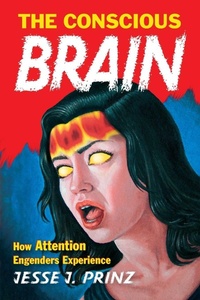
The Conscious Brain
How Attention Engenders Experience
Published on 26. March 2015
Book
Paperback/Softback
416 pages
978-0-19-021895-9 (ISBN)
Description
The problem of consciousness continues to be a subject of great debate in cognitive science. Synthesizing decades of research, The Conscious Brain advances a new theory of the psychological and neurophysiological correlates of conscious experience.
Prinz's account of consciousness makes two main claims: first consciousness always arises at a particular stage of perceptual processing, the intermediate level, and, second, consciousness depends on attention. Attention changes the flow of information allowing perceptual information to access memory systems. Neurobiologically, this change in flow depends on synchronized neural firing. Neural synchrony is also implicated in the unity of consciousness and in the temporal duration of experience.
Prinz also explores the limits of consciousness. We have no direct experience of our thoughts, no experience of motor commands, and no experience of a conscious self. All consciousness is perceptual, and it functions to make perceptual information available to systems that allows for flexible behavior.
Prinz concludes by discussing prevailing philosophical puzzles. He provides a neuroscientifically grounded response to the leading argument for dualism, and argues that materialists need not choose between functional and neurobiological approaches, but can instead combine these into neurofunctional response to the mind-body problem.
The Conscious Brain brings neuroscientific evidence to bear on enduring philosophical questions, while also surveying, challenging, and extending philosophical and scientific theories of consciousness. All readers interested in the nature of consciousness will find Prinz's work of great interest.
Prinz's account of consciousness makes two main claims: first consciousness always arises at a particular stage of perceptual processing, the intermediate level, and, second, consciousness depends on attention. Attention changes the flow of information allowing perceptual information to access memory systems. Neurobiologically, this change in flow depends on synchronized neural firing. Neural synchrony is also implicated in the unity of consciousness and in the temporal duration of experience.
Prinz also explores the limits of consciousness. We have no direct experience of our thoughts, no experience of motor commands, and no experience of a conscious self. All consciousness is perceptual, and it functions to make perceptual information available to systems that allows for flexible behavior.
Prinz concludes by discussing prevailing philosophical puzzles. He provides a neuroscientifically grounded response to the leading argument for dualism, and argues that materialists need not choose between functional and neurobiological approaches, but can instead combine these into neurofunctional response to the mind-body problem.
The Conscious Brain brings neuroscientific evidence to bear on enduring philosophical questions, while also surveying, challenging, and extending philosophical and scientific theories of consciousness. All readers interested in the nature of consciousness will find Prinz's work of great interest.
Reviews / Votes
The Conscious Brain is highly readable throughout and offers a detailed and balanced overview of the relevant scientific literature. The arguments it presents are sophisticated, subtle, and engaging, and interrelated in such a way that it gives us a glimmer of hope that one day we will discover a complete theory of consciousness ... Now go buy a copy and give your braina treat! * Sam Clarke, Philosophy Now *More details
Series
Language
English
Place of publication
New York
United States
Target group
College/higher education
Professional and scholarly
Dimensions
Height: 234 mm
Width: 156 mm
Thickness: 25 mm
Weight
698 gr
ISBN-13
978-0-19-021895-9 (9780190218959)
Copyright in bibliographic data and cover images is held by Nielsen Book Services Limited or by the publishers or by their respective licensors: all rights reserved.
Schweitzer Classification
Other editions
Additional editions

E-Book
09/2012
1st Edition
OUP eBook
€27.49
Available for download

E-Book
08/2012
1st Edition
OUP eBook
€27.49
Available for download
Person
Distinguished Professor of Philosophy at the City University of New York, Graduate Center
Content
Preface ; Part I. A Theory of Consciousness ; Chapter 1. Do We Really Need Another Theory of Consciousness? ; Chapter 2. Which States Are Conscious? The Intermediate Level ; Chapter 3. When Are We Conscious? Attention and Availability ; Part II. The Limits of Consciousness ; Chapter 4. Does Consciousness Outstrip Perception? A Restrictive View ; Chapter 5. Why Are We Conscious? Action without Enaction ; Chapter 6. Whose Conscious States Are These? The Illusory Self ; Part III. The Metaphysics of Consciousness ; Chapter 7. How Is Consciousness Unified? Attentional Resonance ; Chapter 8. What Is Consciousness? Neural Correlates and Nuerofunctionalism ; Chapter 9. Could Consciousness Be Physical? The Brain Maintained ; Conclusion: AIR Compared