

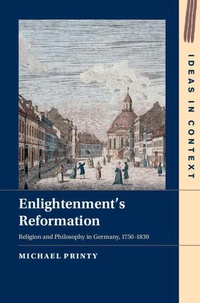
Enlightenment's Reformation
Religion and Philosophy in Germany, 1750-1830
Published on 5. December 2024
Book
Hardback
284 pages
978-1-009-49406-9 (ISBN)
Description
How did we get from the religious core of the sixteenth-century Reformation to the notions of freedom popularised by Hegel and Ranke? Enlightenment's Reformation explores how two key cultural and intellectual achievements - the sixteenth-century Reformation and the late eighteenth-century birth of 'German' philosophy - became fused in public discussion over the course of the 'long' eighteenth century. Michael Printy argues that Protestant theologians and intellectuals recast the meaning of Protestantism as part of a wide-ranging cultural apology aimed at the twin threats of unbelief and deism on the one hand, and against Pietism and a nascent evangelical awakening on the other. The reimagining of the Reformation into a narrative of progress was powerful, becoming part of mainstream German intellectual culture in the early decades of the nineteenth century. Utilising Reformation history, Enlightenment history, and German philosophy, this book explores how the rich if unstable idea linking Protestantism and modern freedom came to dominate German intellectual culture until the First World War.
More details
Series
Language
English
Place of publication
Cambridge
United Kingdom
Target group
College/higher education
Illustrations
Worked examples or Exercises
Dimensions
Height: 235 mm
Width: 157 mm
Thickness: 20 mm
Weight
568 gr
ISBN-13
978-1-009-49406-9 (9781009494069)
Copyright in bibliographic data and cover images is held by Nielsen Book Services Limited or by the publishers or by their respective licensors: all rights reserved.
Schweitzer Classification
Person
Michael Printy is the Librarian for Western European Humanities at Yale University Library, covering French, German, Italian, and European and British history. He teaches courses on the Enlightenment and on the History of Information. Previous publications include Enlightenment and the Creation of German Catholicism (Cambridge, 2009).
Content
Introduction; Part I. Recasting German Protestantism, 1750-1790: 1. The determination of man: philosophy, apologetics and the new language of religion; 2. Transitions: the conservative enlightenment of Johann Lorenz Mosheim and Johann Georg Walch; 3. Enlightenment theology and the protestant public: 'neology,' Dogma and the perfection of Christianity, 1750-1790; Part II. Revolutions of the Spirit, 1780-1830: 4. Karl Leonhard Reinhold and the philosophy of Protestantism; 5. The reformation and modern freedom: the German past after revolution and Napoleon; 6. 'True sons of the reformation': philosophy, theology, and the protestant public 1817-1830; Epiloge: enlightenment's reformation, 1830-1929; Bibliography; Index.