

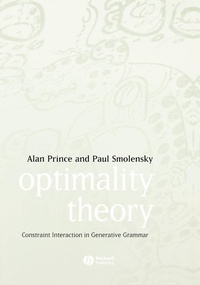
Optimality Theory
Constraint Interaction in Generative Grammar
1st Edition
Published on 2. August 2004
Book
Paperback/Softback
304 pages
978-1-4051-1933-7 (ISBN)
Description
This book is the final version of the widely-circulated 1993 Technical Report that introduces a conception of grammar in which well-formedness is defined as optimality with respect to a ranked set of universal constraints.
Final version of the widely circulated 1993 Technical Report that was the seminal work in Optimality Theory, never before available in book format.
Serves as an excellent introduction to the principles and practice of Optimality Theory.
Offers proposals and analytic commentary that suggest many directions for further development for the professional.
Final version of the widely circulated 1993 Technical Report that was the seminal work in Optimality Theory, never before available in book format.
Serves as an excellent introduction to the principles and practice of Optimality Theory.
Offers proposals and analytic commentary that suggest many directions for further development for the professional.
Reviews / Votes
"This is a very important book. Optimality Theory has transformed the field of linguistics more than almost any other development of the past half-century, and Prince and Smolensky started it all." John J. McCarthy, University of Massachusetts, Amherst"OT does not need to permanently influence linguistic theory: it has already done so. Between 1993 and 2004, Prince and Smolensky's Optimality Theory was by far the most widely circulated manuscript among phonologists. Fortunately, it is now available for a larger audience in this text edition." Rene Kager, Utrecht University
More details
Language
English
Place of publication
Hoboken
United Kingdom
Publishing group
John Wiley and Sons Ltd
Target group
Professional and scholarly
Product notice
Paperback (trade)
Unsewn / adhesive bound
Dimensions
Height: 254 mm
Width: 178 mm
Thickness: 16 mm
Weight
576 gr
ISBN-13
978-1-4051-1933-7 (9781405119337)
Copyright in bibliographic data and cover images is held by Nielsen Book Services Limited or by the publishers or by their respective licensors: all rights reserved.
Schweitzer Classification
Persons
Alan Prince is Professor of Linguistics and a member of the Cognitive Science Center at Rutgers University and is, along with Paul Smolensky, one of the founders of Optimality Theory. He has published in journals such as Linguistic Inquiry, Science, Cognition, and Critical Inquiry.
Paul Smolensky is Professor of Cognitive Science at Johns Hopkins University. His publications include Learnability in Optimality Theory (with Bruce Tesar, 2000) and Mathematical Perspectives on Neural Networks (edited with Michael Mozer and David Rumelhart, 1996).
Paul Smolensky is Professor of Cognitive Science at Johns Hopkins University. His publications include Learnability in Optimality Theory (with Bruce Tesar, 2000) and Mathematical Perspectives on Neural Networks (edited with Michael Mozer and David Rumelhart, 1996).
Content
Prefatory Note ix
Acknowledgments x
Part I Optimality and Constraint Interaction 11
Part II Syllable Theory 101
Part III Issues and Answers in Optimality Theory 203
Appendix 258
References 266
Index of Constraints 281
Index of Languages 283
General Index 284
Acknowledgments x
Part I Optimality and Constraint Interaction 11
Part II Syllable Theory 101
Part III Issues and Answers in Optimality Theory 203
Appendix 258
References 266
Index of Constraints 281
Index of Languages 283
General Index 284